This article draws on the National Hurricane Center's intermediate advisory 13A and the morning report from Mexico's National Meteorological Service (SMN), both from September 30, 2026. Check the current SMN or NHC advisory before making operational decisions. Rachel wasn't expected to hit Michoacán, but the port of Lázaro Cárdenas stayed closed. For coastal businesses, large openings come first: if one fails, the building pressurizes and the roof is at risk.
Where Rachel Was and Why the Port Closed
Rachel passed Michoacán as a tropical storm on September 28 and 29, more than 400 km (250 miles) south of the port. On September 30, now a Category 1 hurricane, it sat about 570 km (355 miles) west of Lázaro Cárdenas with 140 km/h (85 mph) winds, moving away to the northwest. The city was outside the warning area, which began at Punta San Telmo.
The remaining risk was the sea. Mexico's Navy closed Lázaro Cárdenas and Zihuatanejo to all vessels because high surf can capsize or sink them. That morning, the SMN forecast 75 to 150 mm (3 to 6 inches) of rain on the Michoacán coast, gusts of 50 to 70 km/h (30 to 45 mph) in the west of the state, and 4- to 6-meter (13- to 20-foot) waves, with possible seawater intrusion in vulnerable areas.
A Commercial Problem, Not Just a Residential One
Lázaro Cárdenas is one of Mexico's most important ports, and its industry, logistics, warehouses, retail, and business hotels depend on the port and highways staying open. The week before Rachel, surf from Hurricane Polo pounded Playa Azul and, according to event reports, damaged at least nine homes—the same pattern of high seas from a distant storm.
For a port business, the costliest storm is often the one that never arrives. One passing 500 km (310 miles) away breaks few windows, but it shuts the port, stalls the supply chain, and soaks goods in poorly sealed warehouses. That's why commercial hurricane protection belongs in the continuity plan. The question isn't "Will the building hold?" but "Can we operate when the port reopens?"
Why a Single Door Can Cost You the Roof
A sealed building resists wind like a box: wind pushes on the exposed face and pulls on the roof, while the interior stays stable. If a large opening on that side fails, wind rushes in and pressurizes the building. Internal pressure then pushes the roof up while outside suction pulls on it, and the forces add up. One failed roll-up steel door can cost an entire warehouse roof (see how internal pressure can tear off a roof). The riskiest openings—roll-up and dock doors, gates, and storefronts—are rarely treated as part of the full building envelope, and they're the hardest to reinforce at the last minute.
What to Protect First
When time is short, this is the order:
- Roll-up steel doors, loading dock doors, and gates on the exposed side: the biggest pressurization risk.
- Glass façades and storefronts: the highest replacement cost.
- Offices and staff entrances, with their servers, files, and equipment.
- Electrical rooms, substations, backup generators, and pumps: without them, reopening is delayed.
- Smaller windows, if time allows.
Each business has its own focus. Warehouses: roll-up and dock doors first. Hotels: rooms you can sell the next day, so ocean-facing windows and sliders, then the lobby and restaurant (see hotel protection). Playa Azul restaurants: surf and loose objects, so close up the front and protect the kitchen and refrigerators. Offices in town: wind-driven rain and street flooding, so raise equipment and files and seal entrances. Everywhere, secure anything in yards and on rooftops and clear the drains.
Who Deploys the Protection, and When
Deployments usually fail because no one is in charge, staff leave before finishing, or the one person who knew the system is gone. A solid plan names a lead and a backup and sets clear triggers: get ready when a storm is active, deploy under a watch or warning, and finish before tropical-storm-force winds arrive. It assigns crews by area with timed tasks and includes a written manual and annual training, which we provide with our installations because staff turn over. It also sets a cutoff time to release people. The National Weather Service notes that a watch means conditions are possible, generally within 48 hours, and a warning, within 36. Timing an annual drill makes deployment measurable.
Emergency Plywood vs. a Pre-Engineered System
Plywood is the most common response on the Michoacán coast, and it beats nothing. But it deserves an honest comparison:
| Criterion | Emergency plywood | Certified pre-engineered system |
|---|---|---|
| Strength | Not certified; depends on installation | Tested to a standard, with a file number |
| Availability | Sells out with every advisory | Stored on site, made to measure |
| Installation time | Days for a large building | Hours with trained staff |
| Large openings (roll-up and dock doors) | Very hard to secure | Designed for wide spans |
| Façade damage | New holes every time | Discreet permanent anchors |
| Reuse | Warps and rots in the humidity | Folds and stores for years |
| Crew safety | Heavy panels at height | Light fabric, about 1 kg per 3 m² (2.2 lb per 32 sq ft) |
| Cost per event | Repeats every time | One-time investment plus maintenance |
On a small house, well-installed plywood can be a reasonable stopgap (for homes, see residential protection). For a business with large openings and several threats per season, a pre-engineered system solves what decides the outcome: time.
What Backs the HS-1500 System
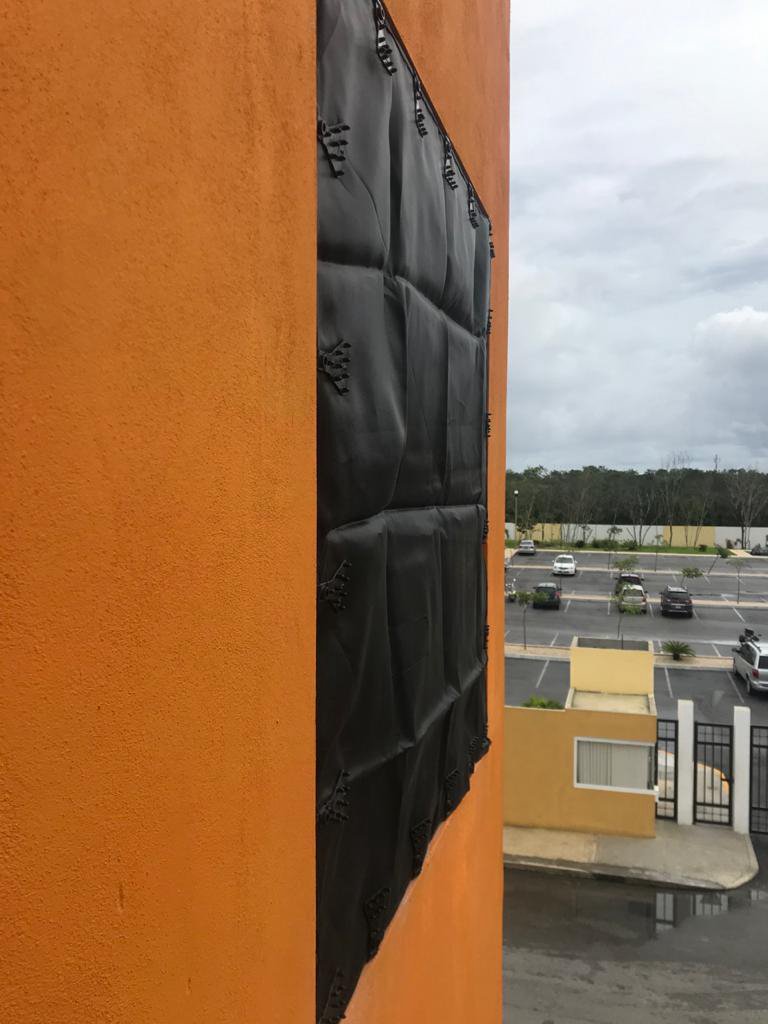
Hurricane Solution's HS-1500 is certified to ASTM E1996-09 at Level E, the standard's highest, designed for essential facilities such as hospitals, police and fire stations, and power plants—a relevant category in a port zone. The test fires a 4.1 kg (9 lb) wood missile at 80 feet per second, versus about 50 for the Miami-Dade large-missile standard, and every certification has a verifiable file number (more in HS-1500 and Level E). The fabric is mounted with slight slack to absorb impact, overlapped about 10 cm (4 inches), and anchored roughly every 30 cm (12 inches). Hurricane Solution has operated in Mexico since 2008, on both the Caribbean and Pacific coasts.
What to Check Once the Storm Passes
Minor damage that goes unnoticed becomes a failure in the next storm. Check, in order: electrical safety and unstable structures; loose or corroded anchors; cuts and rub marks on fabric and panels; roll-up and dock door tracks and guides; and seals, roofs, and drains. Take dated photos for your insurer. Before storage, rinse off the salt with fresh water, dry everything, and label each piece with its opening. Inspect again at the start (May 15) and close (November 30) of each season.
What It Costs to Protect a Business
Hurricane fabric protection systems are custom-engineered based on high-velocity wind-load calculations, opening spans, mounting substrates, and motorization requirements. Contact our engineering team directly for a precise project calculation.
The useful comparison is the cost of not operating. An illustrative example (an estimate, not a real case): a distributor billing 400,000 pesos a day that loses three days to improvised prep, cleanup, and repairs gives up 1.2 million pesos in sales before counting damage. Twice a season, going without a system costs more than having one.
Another illustrative case, common in port areas: two identical neighboring warehouses get the same forecast. The one with a plan reinforces its doors and opens the next day. At the one that waits, a gust bends an unsecured roll-up door, several pallets get soaked, and a customer gets its order two days late. The difference was the plan.
If You Can Do Only One Thing
Find the largest opening on the exposed side—usually a roll-up steel door or a loading dock door—and make sure you can protect or reinforce it in under an hour. A custom system can't be built with a storm bearing down, so use Rachel as the starting point for a free technical assessment. In the same series, we've published guides for Puerto Vallarta, Manzanillo, Cabo Corrientes and Costalegre, and Los Cabos after Hurricane Polo.
Frequently Asked Questions
Was Hurricane Rachel going to hit Lázaro Cárdenas?
No, per the NHC advisory of September 30, 2026: it was 570 km west and moving away, outside the tropical storm warning area that began at Punta San Telmo. Rain and high surf were expected. Always check the current advisory.
Why did the port close if the hurricane was far away?
High surf, which can capsize vessels. Mexico's Navy decides when it reopens.
Is plywood enough for a business?
It beats nothing, but it isn't certified and is hard to secure over large openings. A pre-engineered system goes up in hours and lasts for years.
How much does it cost to protect a business?
It depends on the size and number of openings. We quote after a free technical assessment.