HS-1250: hurricane protection engineered for strength and architecture
HS-1250 was engineered from the ground up for hurricane protection. It is not a general-purpose shade or architectural screen later adapted to storms. Its purpose is to combine high material strength with the visibility, lightness and appearance that hotels, resorts and high-value residences often need.
Key specifications
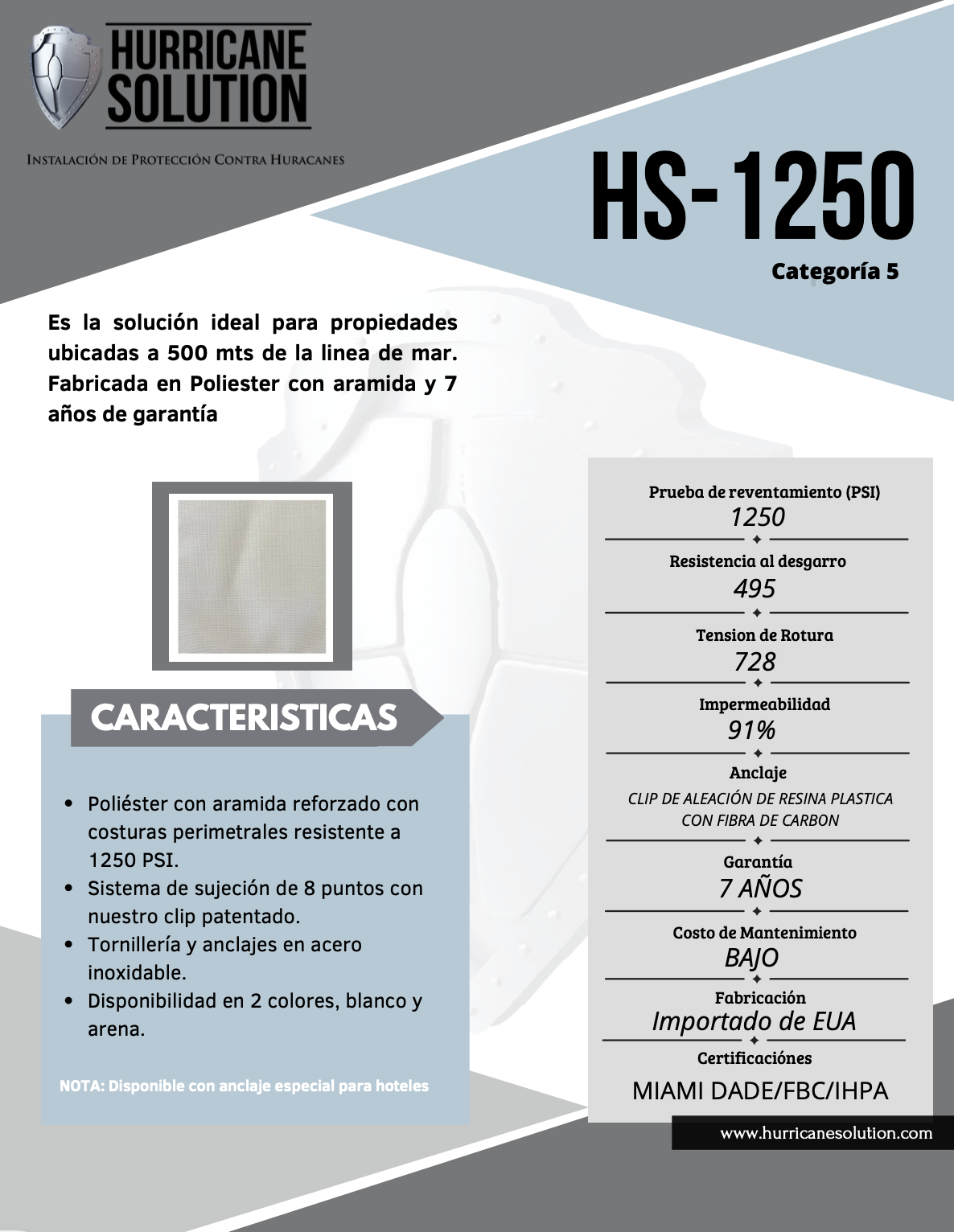
| Property | HS-1250 |
|---|---|
| Public material descriptor | Aramid-reinforced hurricane screen; exact construction is proprietary |
| Documented Mullen Burst (ASTM D3786) | 1,250+ PSI |
| Openness / visibility | 5% open; transparent white: occupants can make out what is on the other side |
| Color | White |
| Typical exposure | All zones, including beachfront, subject to project engineering |
| Warranty | 7-year system warranty |
| Anchoring | Hurricane Solution flexible clip / engineered anchoring platform |
| Maintenance | Very low maintenance |
Why HS-1250 exists
Hotels and luxury residences face a problem ordinary hurricane products do not solve well: protection can be technically strong and still be unacceptable to the architect, condominium rules or guest experience. HS-1250 solves both: a white, high-strength system that stays visually compatible with modern architecture while providing the material margin severe coastal exposure demands.
The best proof point is Puerto Cancún: Hurricane Solution protected 1,231.67 m² of openings across 45 rooms, two lobbies and corridor glazing with white HS-1250. The project required multiple mounting geometries, hidden structural reinforcement and detailed handover documentation, and the system was deployed successfully when Hurricane Milton threatened the region in October 2024 (read the case).
Visibility during deployment
HS-1250 is approximately 5% open. It is transparent white: even when deployed, occupants can make out what is on the other side. That is the practical difference from HS-1500, which lets light through but does not let you make out what is outside. In hotels, restaurants and high-end residences, that visibility matters for guest comfort, staff operations and the feel of the space.
Beachfront use
HS-1250 is not confined to a narrow distance band from the coast. We specify it in all zones, including beachfront, when the building conditions, opening sizes and risk profile support it. Choosing between HS-1250 and HS-1500 is not only about meters to the water: protection margin, visibility, aesthetics, operations and the consequences of failure matter too. For hotels, see hotels; for homes, residential.
What the technical file supports
The HS-1250 material documentation includes a Mullen Burst result above 1,250 PSI, ball-burst and puncture data, grab-tensile values and weatherability testing. It is published as material evidence in the technical library.
The HS-1500 system approvals (Level E, Miami-Dade, Florida) belong to the tested HS-1500 assembly and are not transferred to HS-1250. We will only show system approvals for HS-1250 when a report for the exact assembly exists.
Very low maintenance
- After a storm, rinse the screen with fresh water so salt residue is not stored with the product.
- Never place a wet screen into storage; let it dry completely first.
- Keep the screws in the anchors whenever practical, so screws are not lost and anchor holes do not fill with dirt or debris.
- Once a year, before hurricane season, confirm that every screw threads correctly into its anchor.
The goal is not annual service work; it is making sure the system is ready to deploy when the warning arrives.
HS-1250 compared with HS-875 and HS-1500
HS-875, HS-1250 and HS-1500 compared
| System | Documented strength (Mullen, ASTM D3786) | Visibility | Typical use | Warranty |
|---|---|---|---|---|
| HS-875 | 825 PSI | 5% open; see-through | Inland/off-beach residential and commercial (about 3 km+ from the coast) | 5 years |
| HS-1250 | 1,250+ PSI | 5% open; transparent white, you can make out what is on the other side | All zones, including beachfront; where aesthetics and visibility matter | 7 years |
| HS-1500 | 1,500+ PSI | Translucent; light passes but you cannot make out the other side | All zones, including beachfront; maximum protection / closed-envelope strategy | 10 years |
Indicative price: $125–185 USD per m² of protected opening (see pricing). How the anchoring works: patented anchoring. Full comparison: best hurricane protection in Mexico.
No properly engineered, installed, anchored and deployed Hurricane Solution system has ever failed during a hurricane.
Frequent questions
Can HS-1250 be used beachfront?
Yes. Hurricane Solution can specify HS-1250 in all zones, including beachfront, when the project engineering and desired protection level make it the right system.
What is HS-1250 made from?
Publicly, HS-1250 is described as an aramid-reinforced hurricane screen. Its exact construction is proprietary.
Can you see through HS-1250?
Yes. It is transparent white and about 5% open, so with the screen deployed you can make out what is on the other side.
Why is HS-1250 white?
It was developed for projects where architecture matters. The white system integrates better with many contemporary hotels and residences while keeping high material strength.
Is HS-1250 Level E?
We do not claim that. The published ASTM E1996 Level E approval belongs to the HS-1500 assembly. For HS-1250 we publish its material evidence (1,250+ PSI Mullen Burst, puncture, tensile and weatherability).
What maintenance does it need?
Very little: rinse with fresh water after a storm, dry fully before storage, keep the screws in the anchors and confirm once a year that every screw threads into its anchor.
Get a quote for HS-1250
We prepare a proposal from your opening sizes. Office: 984 803 5014 · WhatsApp: 984 404 5980.