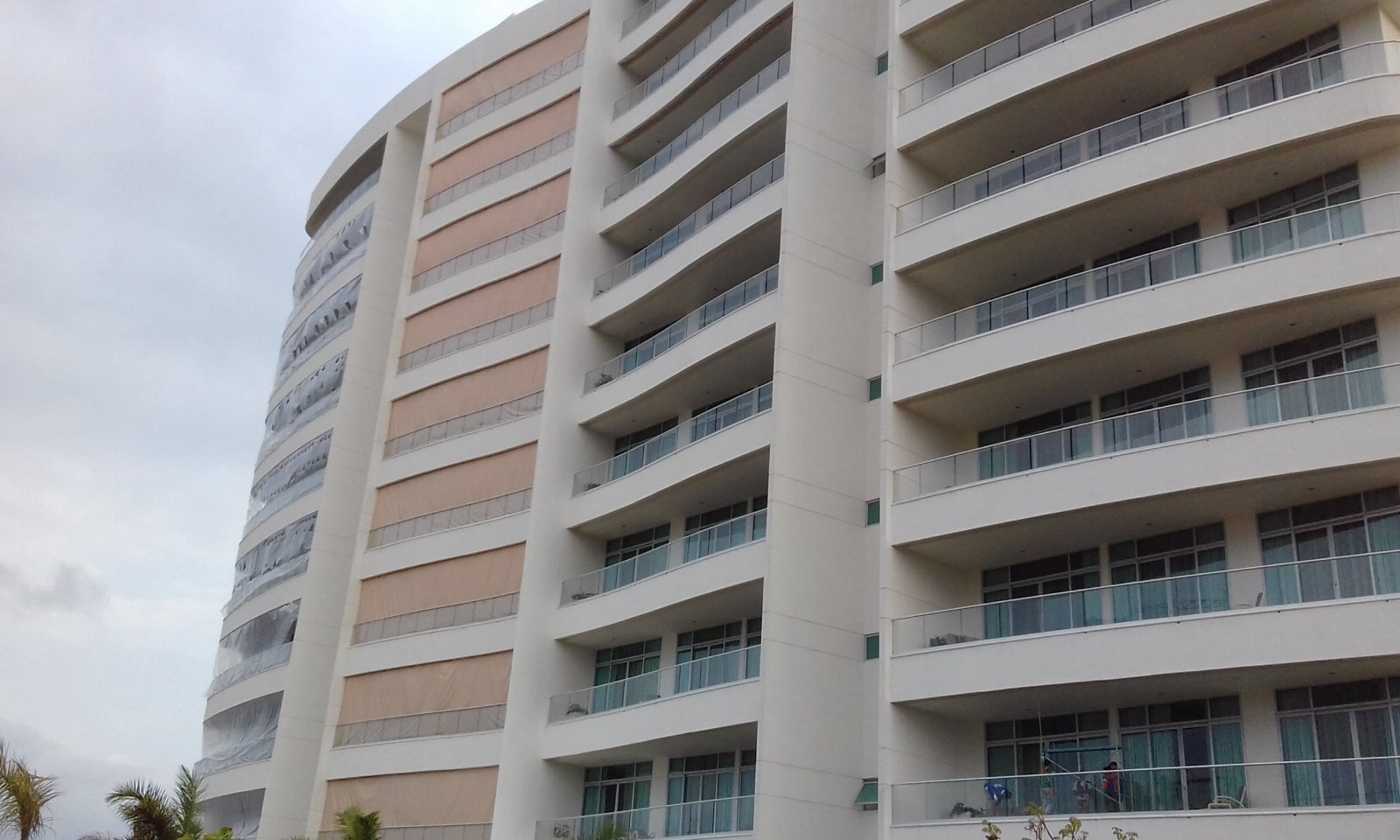
The best hurricane protection for a Cancún hotel meets three conditions at once: verifiable certification, coverage of the entire building envelope, and a design that doesn't compromise operations or aesthetics. At a design hotel in Puerto Cancún, Hurricane Solution protected 1,231.67 m² (about 13,260 sq ft) of openings with white HS-1250 hurricane fabric, certified Cat 5 and backed by a Miami-Dade NOA. The project was handed over in December 2022, and in October 2024 the hotel deployed the system successfully ahead of Hurricane Milton.
Why a Cancún hotel needs a different approach
In Quintana Roo, hurricanes are not a theoretical risk. Wilma (2005) battered Cancún and the Riviera Maya for hours. Beryl made landfall near Tulum in July 2024, and three months later Milton tracked off Yucatán's north coast.
The architecture that sells rooms—floor-to-ceiling glass, balconies facing the sea, glass lobbies—is exactly what leaves the building most exposed. Every view a guest pays for is also a way in for wind, water, and wind-borne debris. That's why a hotel can't be protected like a house: it has hundreds of openings and an operation that never stops.
The project: a design hotel in Puerto Cancún
The client is a luxury hotel from an international design brand, with an adjoining residential building, curved canopies, and condominium rules that limit what can be visible on the façade. The scope covered 1,231.67 m²: 45 rooms on levels II, III, and IV, the street-side lobby, the pool-side lobby, and the corridors on all three levels. Lagoon-view rooms have no balcony, and on the upper floors they can only be protected from inside.
The original proposal, in June 2022, specified our HS-1500 system. During the project, the hotel and Hurricane Solution agreed to switch to white HS-1250 fabric, both for aesthetics and to comply with the condominium rules. The white fabric blends with the building's light-colored façade. According to its spec sheet, its resins are 40% stronger than standard polypropylene, so it holds its color without giving up UV resistance. All work was scheduled around the hotel's operations so guests weren't disturbed.
What a hurricane actually does to a glass hotel
It's rarely a wall that fails. The damage is usually a chain that starts at a single opening:
- A piece of debris—a branch, a sign, a beach lounger—breaks a window.
- Wind rushes in and pressurizes the interior, pushing on roofs, ceilings, and the remaining glass from inside. A single broken sliding door can compromise an entire floor.
- Wind-driven rain travels almost sideways, gets in through door tracks and joints, and runs down to the floors below. That's why impact protection should be paired with rain protection.
- Certified fabric on weak anchors is not a certified system.
That's why this hotel protected the full building envelope, not just the entrance.
The solution: two installation types
Trapezoidal installation
On the ocean-facing balconies, the fabric forms a sloped plane running from the ceiling down to the floor. That keeps it away from the glass, allows even tensioning, and stops it from flapping in the wind. It also leaves enough room for staff to get back into the room after installing it.
Flush-mount installation
On the windows, the fabric runs parallel to the glass with low-profile anchors. In the second-floor lagoon-view rooms, it's mounted from the garden terrace. On the third and fourth floors, it goes up from inside the room, with no scaffolding and no exterior ladders.
What the drawings don't show: three problems solved on site
- The curve of the pool-side lobby: behind the ceiling, there was no solid base at all. The crew welded steel tube sections (PTR, the Mexican equivalent of HSS tubing) inside the soffit, then closed it, patched it, and painted it.
- The street-side lobby: the concrete joists had no spec sheet. Rather than guess at their capacity, the crew welded 50 linear meters (164 feet) of steel tube between the joists, in runs of 2 to 5.8 meters.
- The pool bar: the wood decking was cut to set flush anchors that disappear when the system is stored. Under the canopies, the anchors were painted to match the ceiling.
The takeaway: in a finished hotel, cost and schedule are driven by what's behind the ceiling, not by the fabric. A technical walkthrough up front prevents surprises. More on that in certified anchors.
What certification the system carries—and what Level E means
The HS-1250 installed at this hotel is Cat 5–certified fabric with a Notice of Acceptance (NOA) from Miami-Dade County, with file numbers that any architect or insurer can verify.
Level E is the most demanding tier of the ASTM E1996 standard. A 9-pound (4.1 kg) 2x4 is fired at the system at 80 feet per second, and the system must then survive thousands of pressure cycles. It's the level required for hospitals and military installations. For comparison, the Miami-Dade large-missile test fires the same lumber at about 50 feet per second. Because impact energy grows with the square of velocity, Level E delivers roughly 2.56 times the energy. Hurricane Solution is the only company in Mexico certified to Level E (ASTM E1996-09), with its HS-1500 system—the one in this project's original proposal (see Level E).
The handover report: every opening numbered and mapped
The 43-page report brings together the engineering assessment, structural modifications with drawings, room-by-room photos, and a schedule of fabric panels and anchors. The guest rooms alone account for 75 panels and 2,751 anchors, from one panel and 22 anchors in the simplest room to two panels and 130 anchors in the most complex. A color code shows the status of every opening at a glance.
That way, any new supervisor can deploy the protection. For the insurer, the report is hard evidence of what was installed and where. How that affects a policy depends on each insurer; see insurance documentation.
The real test: Hurricane Milton, October 2024
Almost two years after handover, the real test arrived. According to the NOAA National Hurricane Center report, Milton reached Category 5 in the Gulf of Mexico, and its track off Yucatán's north coast brought tropical-storm conditions, storm surge, and heavy surf to the area. The hotel deployed its HS-1250 protection successfully.
Without a system, a warning sets off a last-minute scramble for plywood, with no guarantee it will hold. With a documented system, the team pulls the labeled panels, hangs them on anchors that are already in place, and checks each opening against the report. After the storm, they take the panels down, inspect, and reopen. Here's how we structure a hotel hurricane deployment.
What it costs to close a hotel: an illustrative estimate
The figures below are illustrative estimates based on reference values, not data from this hotel:
- A 200-room hotel with a US$400 average daily rate (ADR) and 75% occupancy has a RevPAR (revenue per available room) of US$300. That's about US$60,000 for every day it's closed.
- A three-week closure after envelope damage adds up to roughly US$1.26 million, before repairs.
- Moisture and mold remediation can run US$15,000 to US$40,000 per affected room.
- Two warnings per season, each with two days of precautionary closures, come to about US$240,000 a year.
The useful question is what each season without protection costs. We break that down in hotel hurricane protection ROI.
Hotel protection systems compared
| Criteria | Certified fabric | Hurricane mesh | Metal panels | Roll-down shutters |
|---|---|---|---|---|
| Impact certification | Verifiable (HS-1250: Cat 5, Miami-Dade NOA) | Varies by manufacturer | Varies; often untested | Varies by manufacturer |
| Visual impact | Low; invisible when stored | Low; you can still see out | High during the storm | High; housing visible year-round |
| Curved or large openings | Adapts | Adapts | Difficult | Limited |
| Storage | Compact, labeled | Compact | Bulky, heavy | None needed |
| Salt air | Low maintenance | Low maintenance | Corrosion | Exposed motors and tracks |
How much does certified protection cost?
Hurricane fabric protection systems are custom-engineered based on high-velocity wind-load calculations, opening spans, mounting substrates, and motorization requirements. Contact our engineering team directly for a precise project calculation.
From the Caribbean to the Pacific: the same method
Hurricane Solution has applied this method since 2008 in Cancún, Playa del Carmen, Tulum, Los Cabos, Puerto Vallarta, Mazatlán, and Acapulco. On the Caribbean side, the main threats are wind-borne debris and sideways rain. On the Pacific side, it's repeated warnings and salt air. The principles stay the same: verifiable certification, full-envelope coverage, anchoring into known structure, and documentation for every opening.
Before next season, the first step is a technical walkthrough that ends in a documented plan. This hotel didn't just buy fabric panels. It bought a system, and that system worked when Milton arrived. You can request a free technical assessment or see how we work with hotels.
Frequently Asked Questions
What is the best hurricane protection for a hotel in Cancún?
Certified hurricane fabric that covers the full envelope without disrupting operations or changing the façade.
What certification does HS-1250 fabric carry?
It is Cat 5–certified and holds a Miami-Dade NOA, with file numbers that can be independently verified. It's available in white.
Did it work during a real hurricane?
Yes. This hotel deployed it successfully ahead of Hurricane Milton in October 2024.
How much does it cost to protect a hotel or a home?
Hurricane fabric protection systems are custom-engineered based on high-velocity wind-load calculations, opening spans, mounting substrates, and motorization requirements. Contact our engineering team directly for a precise project calculation.