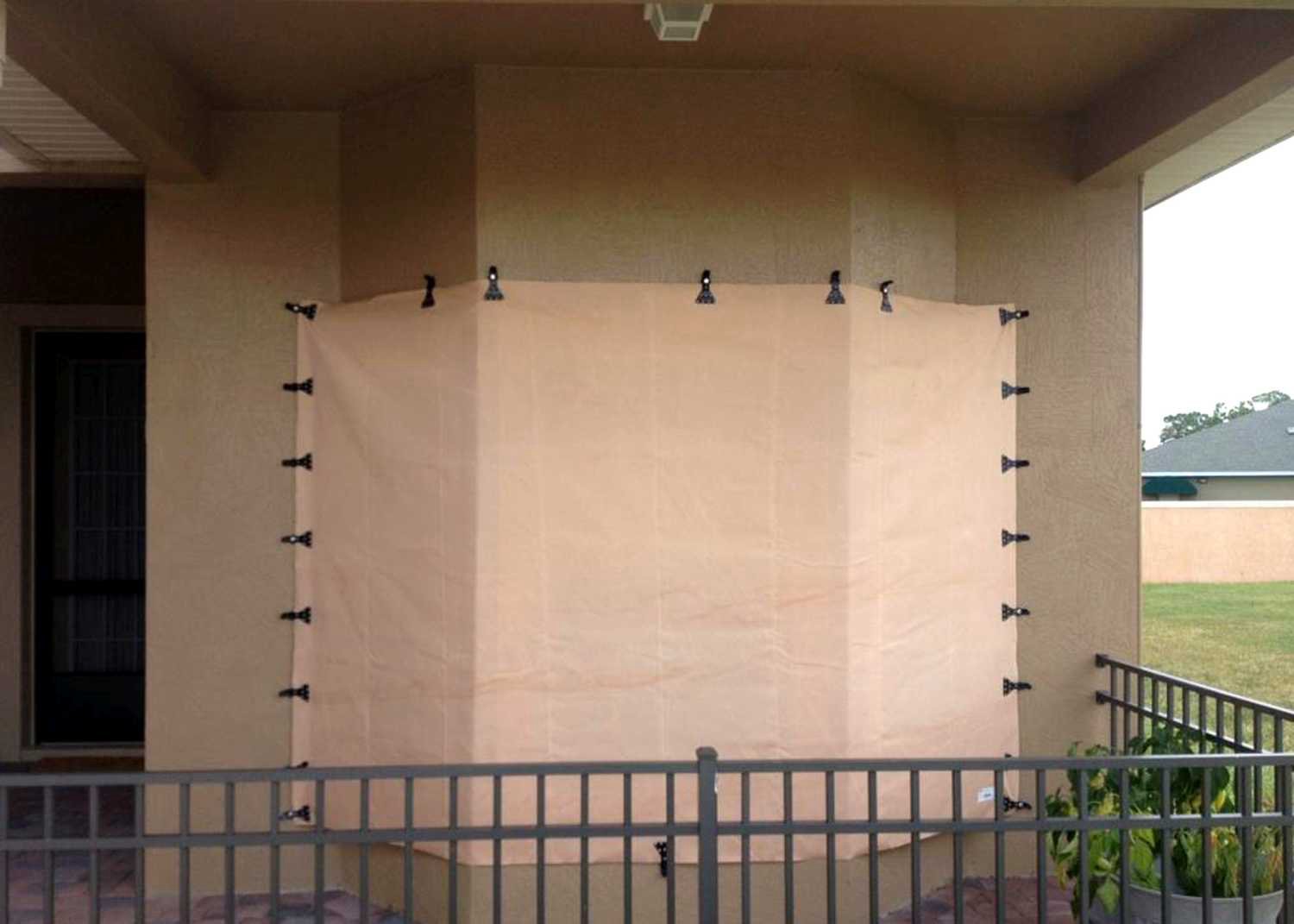
The HS-1500 is Hurricane Solution's flagship system and the only one in Mexico with military Level E certification (ASTM E1996-09), the same standard that protects U.S. naval hospitals and Air Force bases. But the ballistic fabric is only half the story: in practice, a hurricane protection system is only as strong as its weakest point, and in the HS-1500 that same standard applies to every component, not just the fabric.
The fabric: what the numbers really mean
The HS-1500 fabric is a 25x25 ballistic nylon weave, 1,000 microns thick (±5%) with a resin finish. In the Mullen Burst bursting-strength test (ASTM D-3786), performed by the University of Clemson's Materials Science and Engineering laboratory, the documented result was not a number but the absence of one: the April 1, 2010 letter states that the fabric exceeded the maximum capacity of the Mullen Burst gauge (1,500 psi), so no values could be reported. The lab equipment reached its limit before the fabric did.
For context, a Category 5 hurricane exerts roughly 1,200 psi on an exposed surface. The HS-1500 fabric was certified above that threshold without reaching a measurable breaking point.
Other documented lab results include trapezoidal tear strength (ASTM D-5733) of up to 669 lbf in fill and 655 lbf in warp; grab strength (ASTM D-5034, Grab Test) with peak loads of up to 1,009 lbf; and abrasion resistance (ASTM D-4886) retaining 95% of the original strength after testing, meaning the material does not degrade significantly with repeated use and exposure between seasons.
The component fabric comparisons ignore: clip and anchor
Most sales materials stop at fabric strength. But the strongest fabric in the world is useless if the clip holding it to the wall gives way before the fabric does, or if the anchor was installed without accounting for the actual design pressure of the specific facade.
The HS-1500 uses a terminal retention clip made of Polyamide 66 (Rhodia Engineering Plastics), designed to transfer the fabric's load to the anchor without itself becoming the failure point. According to structural engineering drawings by MEA Engineers, Inc. (signed and sealed by a professional engineer licensed in Florida), the complete system —fabric, clip and anchor— was designed and tested as an integral unit, not as independent components assembled afterward.
The right question when buying a system is not just «how strong is the fabric?», but whether the clip and anchor are designed, tested and certified as part of the same system. A system certified as an integral unit eliminates the possibility of pairing a certified fabric with an anchor never evaluated for that specific load.
Wall mount vs. interior mount
The drawings include design-pressure tables for two distinct conditions: wall mount and interior mount. For a panel with a 12-foot span, the load on the structure in wall-mount condition can reach 351.9 pounds per linear foot (PLF) under a 60 PSF design pressure, while interior mount shows different values because of how the force is transferred to the anchor. This distinction determines whether a system installed incorrectly for a facade's conditions can fail at pressures far below what the fabric alone would resist.
Storm bar for large-format openings
For openings that exceed the panel's standard span, the HS-1500 includes an aluminum storm bar (2"x3"x1/8", 6063-T6 alloy), with its own maximum-length table based on the number of anchors per end and the required design pressure. With one anchor per end and 60 PSF, the maximum allowable length is 75 inches for a 3-foot-span panel, adjusting according to panel size and required pressure.
Missile impact: what happened
In July 2012, Fenestration Testing Laboratory, Inc. of Medley, Florida, performed a large missile impact test. According to the letter signed by its chief executive, a projectile struck the center of the panel at 113.4 feet per second (about 77 mph / 124 kph) and «there was no apparent damage and the projectile did not penetrate». This test was run at a speed above the 74 mph general specification on the system's data sheet: a documented additional safety margin, not just the required minimum.
Level E certification: why it is different from everything else in Mexico
Military Level E certification, under ASTM E1996-09, was designed for buildings that cannot fail under any circumstance: naval hospitals, air bases and command facilities. Unlike Miami-Dade County or the Florida Building Code —which test wind, water, projectiles and barometric pressure separately—, Level E requires all four forces to be tested simultaneously, more faithfully replicating real hurricane conditions. In addition, its projectile test is run at 80 feet per second versus Miami-Dade's 51: 57% more demanding. Hurricane Solution is, to date, the only company in Mexico with this certification applied to its systems.
What type of property it is designed for
The HS-1500 is built for the highest-exposure scenario: beachfront properties, hotels and resorts with large glass surfaces, and developments where continuous occupancy during the season makes failure unacceptable. It does not mean every seafront property needs it: it is the option designed for the highest exposure level in the line. Each property has a unique combination of height, orientation, anchoring substrate (concrete, hollow block, filled block, wood) and wind exposure, so no data sheet can replace an on-site evaluation by a certified specialist.
Comparison table: the HS-1500 in context
| Feature | HS-1500 |
|---|---|
| Material | Ballistic nylon |
| Mullen Burst strength | Exceeds 1,500 psi (equipment limit) |
| Certification | Level E (military), Miami-Dade NOA, Florida Building Code |
| Design category | Cat 5 |
| Warranty | 10 years |
| Ideal for | Beachfront, hotels, continuous occupancy |
Conclusion
The HS-1500 is not strong because its fabric is strong, but because every component —fabric, retention clip and anchor— was designed, tested and certified as a single engineering unit. That is the real difference between a hurricane protection system and a strong fabric held up by whatever an installer happened to have on hand that day.
Frequently Asked Questions
What sets the HS-1500 apart from other hurricane protection systems?
The military Level E certification, unique in Mexico, which tests wind, water, projectiles and barometric pressure simultaneously, plus an integral system of fabric, clip and anchor designed and tested together.
How strong is the fabric really?
It exceeded 1,500 psi, the maximum limit of the University of Clemson's Mullen Burst equipment, with no failure point determinable.
Is the HS-1500 for any seafront property?
It is the highest-certification option available, ideal for beachfront and continuous occupancy, but every property requires a technical evaluation to confirm the right system.
What role does the anchor play if the fabric is already certified?
A decisive one: the strongest fabric offers no real protection if the clip or anchor gives way before it does. The complete system must be designed as an integral unit.
How long is the HS-1500 warranty?
10 years, the longest warranty period in Hurricane Solution's line of systems. You can review more questions in our FAQ.