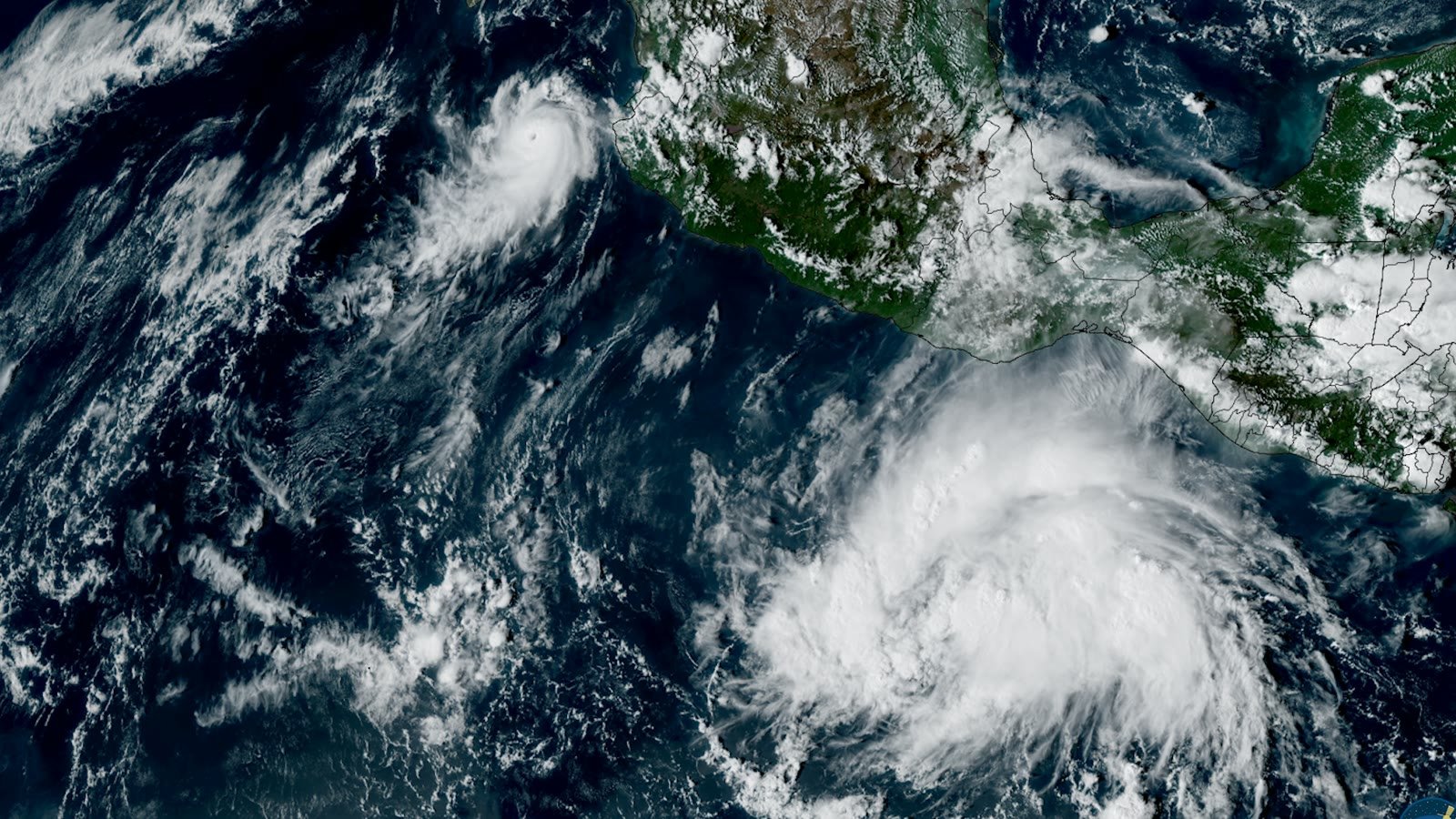
A hotel should deploy its hurricane protection as soon as a hurricane watch is issued for its area. Don't wait for the warning or a confirmed landfall point. In October 2026, Hurricanes Simon and Trudy made the case: both were forecast as major hurricanes over Jalisco and Colima, and both changed course. Deploying "for nothing" with a system your own staff installs costs a few hours. Running out of time can cost weeks of operations.
Two Hurricanes, Two Forecasts That Changed
Simon formed as a tropical storm on October 7, 2026, and reached Category 4 early on Saturday, October 10. President Claudia Sheinbaum announced it would make landfall on Sunday the 11th between La Huerta and Tomatlán, according to CNN en Español. That same day the forecast shifted. According to AP, Simon stalled off Cabo Corrientes, crawling parallel to the coast at about 7 km/h (4 mph). Projected landfall shifted to Sinaloa, then faded out. More in what Simon left behind in Puerto Vallarta.
Trudy formed on October 13, 2026, with early forecasts calling for Category 4 off Michoacán and Colima. According to AP, it peaked at Category 3 with 195 km/h (120 mph) winds, and the National Hurricane Center (NHC) kept a hurricane warning in place from Manzanillo to Cabo Corrientes. It pulled away as a tropical storm. Hotels in Manzanillo, Barra de Navidad, and the Costalegre faced two deployment decisions in one week.
Why Forecasts Change
A hurricane track is forecast as a cone of uncertainty. Its center line is the most likely path, not a promise. With a slow storm moving parallel to the coast, like Simon, small shifts in the steering pressure systems can move the landfall point tens or even hundreds of kilometers.
Rapid intensification made 2026 harder: according to Bloomberg Línea, Polo went from tropical depression to Category 5 in roughly 42 hours. When a storm can jump three categories between two advisories, the decision window shrinks exactly when uncertainty peaks (see lessons from the 2026 Mexican Pacific season). The takeaway: a protection plan has to work even when the forecast changes.
Watch, Warning, and Mexico's Color Alerts
- Hurricane watch: hurricane conditions are possible. The National Weather Service typically issues it 48 hours before the first tropical-storm-force winds.
- Hurricane warning: hurricane conditions are expected, typically 36 hours before those winds. By then, the NWS says, preparations should be done.
- SIAT-CT alert system: Mexico's Civil Protection agency uses five colors—blue, green, yellow, orange, and red—based on arrival time and intensity. It doesn't replace your own trigger.
Most people miss this: both clocks count down to tropical-storm-force winds, not to the eye. From about 63 km/h (39 mph), working on ladders, on rooftops, or with large screens is already dangerous. A hotel that plans to deploy "once there's a warning" really has about half the time it thinks it has.
The Cost of Being Wrong in Each Direction
A good protocol doesn't guess. It makes erring on the safe side cheap.
- Fabric screens deployed "for nothing." With hurricane fabric screens on permanent anchors, deployment means a few hours of in-house labor, then takedown and storage. Hurricane Solution screens weigh roughly 1 kg per 3 m² (about 2.2 lb per 32 sq ft), and hotel staff put them up themselves. For a mid-size hotel, that's one or two maintenance shifts (estimated), with no outside crews.
- Plywood deployed "for nothing." Plywood is bought for every alert, means drilling walls, rarely survives reuse, and needs extra crews. With Rachel, Simon, and Trudy inside three weeks, a hotel relying on it could have paid for the improvised fix three times in one season.
- Not deploying, and the storm hits. One failed opening in a major hurricane lets in wind and water, pressurizes the interior, and can take a whole floor out of service for weeks. At a 200-room hotel with a 180 USD average rate and 70% occupancy, each day of full closure means about 25,000 USD in lost room revenue (estimated), before repairs.
With a fast-deploying system, erring on the safe side costs hours. Erring the other way costs weeks.
Three Illustrative Scenarios
Common patterns, not specific hotels.
- The hotel with a written trigger. "Watch in our area = deploy." The team deploys Saturday morning, before the wind picks up. Simon never arrives, and on Monday they take everything down and store it. Same with Trudy: a few hours of work, zero rooms out of inventory.
- The hotel that waited for the warning. The warning arrives with landfall announced for early the next morning, and half the staff has already gone home. The lobby and oceanfront rooms get covered; the kitchen and service doors don't. Simon never arrives, but sideways rain floods the kitchen and storeroom.
- The hotel that got tired. After deploying for Rachel and Simon with no impact, management skips Trudy. Trudy veers off. But that's the same logic that, sooner or later, lines up with the storm that does hit.
Alert fatigue was the real risk of 2026. Make your trigger written, leadership-approved, and automatic. If every alert becomes a debate, you'll lose it on the day it matters.
How Long It Really Takes to Protect a Hotel
What counts is the whole property, including openings nobody sees, not one screen. Four factors drive it:
- Anchors already in place: with permanent anchors, you just hang and tension. Without them, every storm means drilling.
- Labeled screens stored on site: hunting for the right screen at 2 a.m. is the classic way to burn your time.
- Trained staff: a protocol that depends on the chief engineer fails the week he's on vacation.
- The full building envelope: service doors, kitchens, laundry rooms, mechanical rooms, and vents. One uncovered opening can pressurize an entire area.
Hurricane Solution designs every installation so hotel staff can deploy it in hours, with training and a written manual. The operations director of a hotel in Puerto Morelos (Hurricane Delta, Category 2, October 2020) put it this way: "When Delta made landfall in Puerto Morelos in 2020, our hotel was completely protected. Our neighbors took weeks to reopen. We reopened on the third day." Details on our hotel hurricane deployment page.
The stretch from Manzanillo to Cabo Corrientes went through three alerts in three weeks—Rachel in late September 2026, then Simon and Trudy in October. Storms often run parallel to this shore, producing more alerts than impacts—and more temptation to relax. We saw it with Rachel in Manzanillo and on the Costalegre.
When to Deploy: Comparing Triggers
| Deployment trigger | Working time available | Risk | Recommended for |
|---|---|---|---|
| Tropical storm watch with forecast intensification | Maximum | More deployments without impact | Beachfront properties, large glass areas |
| Hurricane watch | Ample (~48 h to tropical-storm-force winds) | Some deployments without impact | Every hotel with a permanent system |
| Hurricane warning | Reduced (<36 effective hours) | Staff gone, weather worsening | Last-resort deadline only |
| Confirmed landfall | Minimal or none | Very high | Not recommended |
How to Write a Deployment Protocol
- Trigger: a hurricane watch for your area or a SIAT-CT yellow alert or higher, whichever comes first. For beachfront properties, add a tropical storm watch with forecast rapid intensification.
- Owners: a named lead and a named backup, so nothing hinges on one person.
- Sequence: the most exposed openings and critical areas (kitchens, electrical rooms) first, written in the manual.
- Takedown: inspect anchors, fabric, and seals, take photos, and store by opening. Those records also serve as documentation for insurers.
Drill it every year before May 15, when the Pacific season begins. If your team needs more than 24 hours to cover the whole envelope, or depends on buying materials, the priority is getting a permanent system in before next season.
Conclusion
Simon and Trudy didn't make landfall where expected. Landfall is defined late, if ever. With certified protection on permanent anchors that your team deploys in hours, the rule is simple: hurricane watch means deploy. Here's how we handle it for hotels.
Hurricane fabric protection systems are custom-engineered based on high-velocity wind-load calculations, opening spans, mounting substrates, and motorization requirements. Contact our engineering team directly for a precise project calculation: message us on WhatsApp.
Frequently Asked Questions
Should I deploy at the hurricane watch or the warning?
At the watch. The warning counts down to tropical-storm-force winds, so it leaves less safe time than it seems.
What if I deploy and the hurricane changes course?
Take down, inspect, document, and store by opening. With a reusable system, it only costs staff time.
How many times can a hurricane fabric screen be deployed?
They're built for repeated seasons. The warranty is 5 years on HS-875, 7 on HS-1250, and 10 on HS-1500.
Does Mexico's SIAT-CT alert replace the NHC watch?
No, they complement each other. Use whichever triggers first.
Is plywood worth deploying at the watch?
It beats nothing, but it costs money every alert, damages walls, and its fasteners loosen during long events.