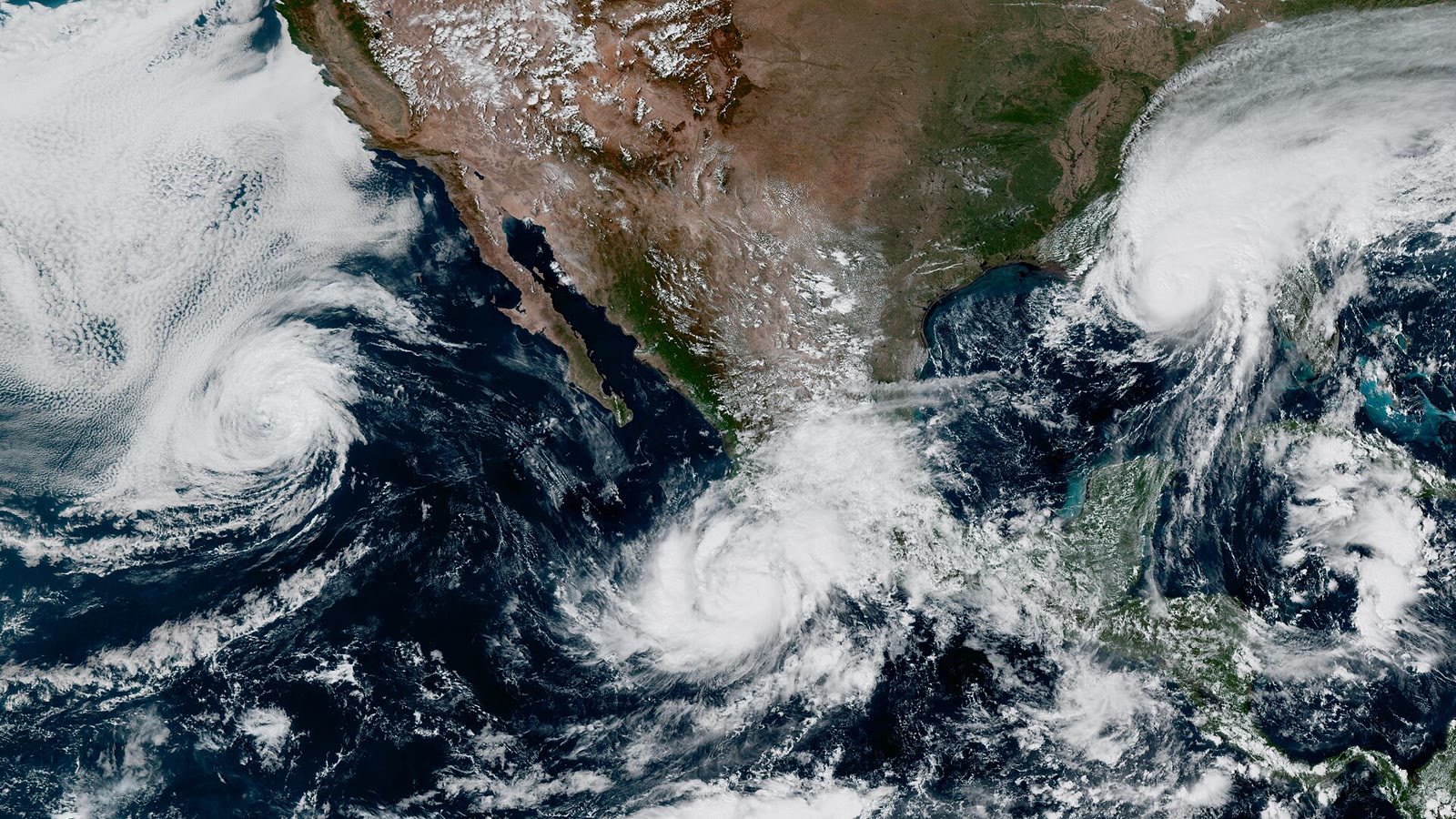
Mexico's 2026 Pacific hurricane season was exceptional. Five consecutive hurricanes reached major status, Polo set the eastern Pacific record for time at Category 5, and in October 2026 Simon and Trudy threatened Jalisco and Colima days apart. Most reported damage came from water, not broken windows. And a damage-free season doesn't prove your protection works. Often the eye simply passed far away.
A season far outside the norm
According to data cited by N+ in mid-October 2026, the last five Pacific hurricanes up to that date—Nolo, Odalys, Polo, Rachel, and Simon—all became major hurricanes, with winds of at least 178 km/h (110 mph). Trudy then also became a major hurricane off Guerrero and Michoacán.
The cause was El Niño. A warmer equatorial Pacific weakens the upper-level winds that tear storms apart. In a normal year, each hurricane churns up cold water and leaves a wake that slows the next. In 2026 the warm water ran so deep it fed one storm after another. The Atlantic saw the opposite: Isaias didn't become its first hurricane until October 7, 2026, the latest start of the satellite era.
Storm by storm
Polo: intensification that leaves no time
According to Bloomberg Línea, citing SMN data, Polo went from tropical depression to Category 5 in about 42 hours and spent more than 48 hours there, an eastern Pacific record. It made landfall at Las Barrancas, Comondú, Baja California Sur, as a Category 2 with 175 km/h winds and 205 km/h gusts. The lesson is speed. If your protection depends on buying materials or hiring crews, you'll run out of time. See what to inspect in Los Cabos after Polo.
Rachel: far offshore, still deadly
According to AP, on October 1, 2026, Rachel reached Category 3 about 380 km (235 miles) south of the tip of Baja California, with 193 km/h winds, moving at 6 km/h. Wind wasn't the worst of it. According to Euronews (October 12, 2026), its remnants caused floods and landslides in Baja California, with at least four dead and people missing in Ensenada and San Felipe. The category on the map doesn't predict damage on the ground, as Manzanillo also saw.
Simon: Category 4 off Jalisco, for days
Simon went from tropical storm to Category 4 in under two days, with winds near 250 km/h. But according to AP on October 11, 2026, the eye stayed offshore, crawling parallel to the coast at about 7 km/h. In Barra de Navidad, reported 7- to 8-meter (23- to 26-foot) waves destroyed part of a malecón retaining wall (Azteca Jalisco). In La Manzanilla, beach restaurants were buried in sand and rock, and Puerto Vallarta's airport shut down.
Trudy: the threat that veered away
According to AP on October 16, 2026, Trudy reached Category 3 with 195 km/h winds, and the National Hurricane Center held a warning from Manzanillo to Cabo Corrientes. It changed course and left as a tropical storm. Many owners went through two major-hurricane alerts in a week with no direct hit and decided "it never hits here." That's the most dangerous takeaway of the season. If the eye passed 80 km (50 miles) away, your system was never tested.
What a fabric screen can't solve
Most publicly reported Pacific damage in 2026 came from water. No hurricane fabric screen, however certified, stops a seven-meter wave. What a screen or AquaGrid mesh does is keep wind and wind-borne debris from breaking windows and doors. That prevents the internal pressurization that lifts roofs, as Odile showed in Los Cabos (2014) and Otis in Acapulco (2023).
| Risk | Does a hurricane fabric screen solve it? | What it takes |
|---|---|---|
| Glass broken by wind or debris | Yes | Certified opening protection |
| Internal pressurization | Yes, with full coverage | Full building envelope |
| Wind-driven rain | Largely | Protection + seals + drainage |
| Surf and storm surge | No | Civil engineering and elevation |
| Inland flooding | No | Storm drainage and siting |
What separates a property that reopens from one that closes
- The hotel that prepared. On Banderas Bay, with anchors installed, screens labeled by room, and a written protocol, maintenance deploys in hours under the Simon watch. It loses the precautionary closure days, but has no broken glass or water, and reopens with the airport.
- The hotel that waited. No plywood, no crews, and staff leave to protect their homes. Only ocean-facing windows get covered. Wind-driven rain enters through the kitchen and service doors. Result: a week of cleanup and rooms out of inventory.
- The remote owner. A Nuevo Vallarta owner living in Canada told the manager to "close everything if something's coming," without defining what or who. During Simon, the manager had twelve units and never reached this one.
Hurricane Solution designs for the first case. A screen weighs roughly 1 kg per 3 m² (about 2.2 lb per 32 sq ft), your own staff deploy it, and every installation includes training and a manual. Our storm performance record covers more than 30 storms since 2008, with zero failures on properly executed installations. Documented failures happened when the structure gave way first or when we didn't install.
What a season like this costs
In late October 2026, Simon and Trudy damage was still under assessment. The cost logic is clear, though. A two- to three-day precautionary closure is unavoidable either way. What changes is what follows: with interior water or glass damage, a hotel can lose one to four extra weeks of partial inventory (estimate). At 200 rooms, a 180 USD rate, and 70% occupancy, each day offline is about 25,000 USD in room revenue (estimate). And the same coast had alerts for Rachel, Simon, and Trudy in under three weeks. Without rapid deployment, you pay for improvisation three times.
Why duration matters as much as category
The Saffir-Simpson scale measures peak wind, not how many hours it sat over your property. A slow storm like Simon causes:
- Anchor fatigue: hours of cyclic loading defeat fasteners not designed for the real substrate. That's why anchoring is engineered for the building, not just the screen.
- Sustained pressure differential: if an opening fails early, the roof and walls take load from inside for hours.
- Standing water: drainage built for a 30-minute downpour fails under 12 hours of wind-driven rain.
That's why ASTM E1996 Missile Level E matters: a 9-lb 2×4 at 80 feet per second, versus 50 for Level D, meant for hospitals. Hurricane Solution's HS-1500 was tested to that level (Level E). In 2026 the right question was "how many hours will it sit here?"
Each destination had a different season
- Los Cabos: Polo landed north and Rachel passed south—two threats, no hit, which tends to relax preparation.
- Puerto Vallarta and Riviera Nayarit: Simon closed the airport and malecón. Kenna (2002) and Lidia (2023) already disproved the idea that the bay shields it.
- Costalegre: hit hardest by surf—Barra de Navidad, Melaque, La Manzanilla, and Pérula.
- Manzanillo: alerts for Rachel, Simon, and Trudy. In 1959, a Category 4 destroyed about 40% of its homes.
Reactive vs. preventive
A reactive approach buys materials on the alert, relies on outside crews, and covers what it can. A preventive one has anchors installed, custom screens stored by opening, a protocol with named owners, and a clear activation trigger. For hotels, that includes service entrances, kitchens, and laundry.
Hurricane fabric protection systems are custom-engineered based on high-velocity wind-load calculations, opening spans, mounting substrates, and motorization requirements. Contact our engineering team directly for a precise project calculation: WhatsApp or our contact page.
Conclusion
The comfortable reading of 2026 is that the big storms stayed out. The useful one is that the coast from Los Cabos to Acapulco faced major-hurricane threats several times in a month, from storms that intensified faster than any improvised plan. Reach May 15, the start of the Pacific season, with the system installed, the team trained, and the protocol written.
Frequently Asked Questions
When does the Pacific season end?
Officially, November 30. With a warm ocean, storms can form until then.
If my property had no damage, should I check anything?
Yes: anchors, screen condition, storage, protocol, and who's responsible. Undamaged doesn't mean tested.
Does a hurricane fabric screen protect against surf?
No. It protects openings from wind and debris. Surf requires civil works.
What system fits a beachfront property?
One tested to ASTM E1996 Level E, like the HS-1500. Farther inland, certified Cat 5 or Cat 3 systems may fit; a technical assessment confirms it.
When should I install for 2027?
Between November and April. Anchors usually go in over 1 to 3 days; after that, your team deploys in hours.