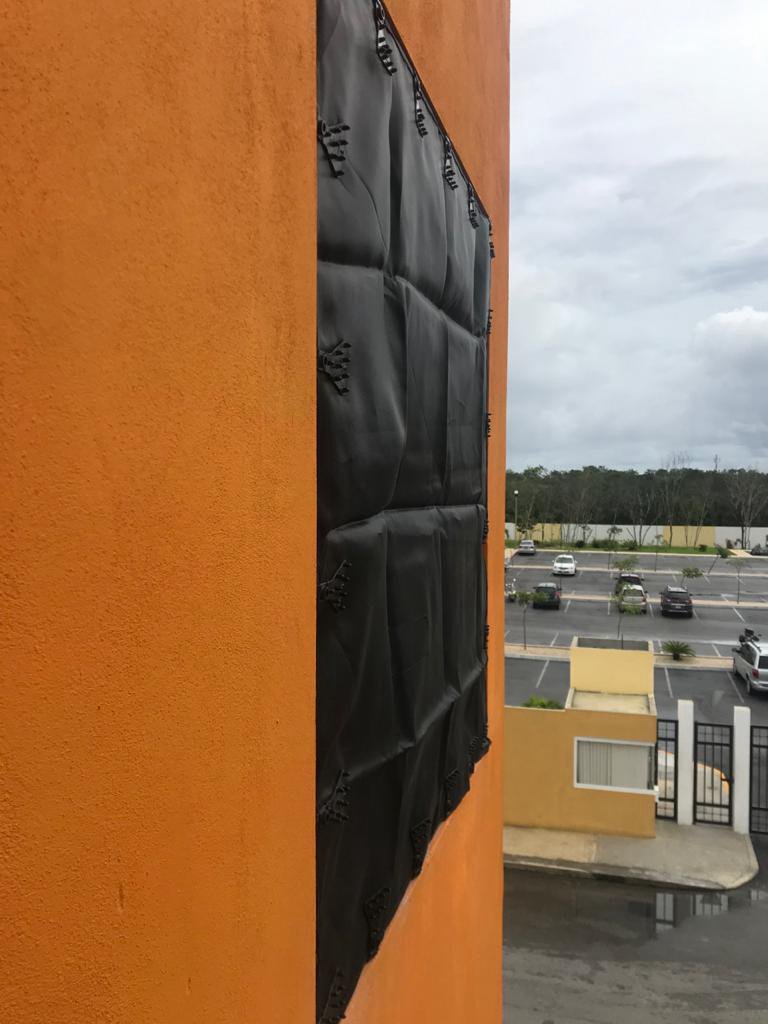
Quick Answer
Polypropylene is an economical material with limited resistance, useful only in low-exposure scenarios and always as part of a certified system. Ballistic nylon, on the other hand, is engineered to withstand extreme impact, sustained wind pressure, controlled deformation, and prolonged exposure to coastal environments. During a real hurricane, especially a category 4 or 5, this difference can determine whether an opening stays protected or fails and allows internal pressurization of the building.
The decision should never rest on the material's name alone. It must rest on the complete system: fabric, stitching, anchoring, certification, installation, deployment, and maintenance. For beachfront properties, hotels, real estate developments, and large openings, the difference between polypropylene and ballistic nylon isn't aesthetic or commercial — it's an engineering difference that can protect or compromise the entire asset.
Why the material matters more than you think
When someone sees a hurricane shutter or protective mesh installed over a window, the common reaction is to assume all systems work about the same. From a distance, many look alike: tensioned fabric, some anchors, a visible cover over the glass. That perception is dangerous because it shifts the decision to price, color, installation time, or appearance. But during a hurricane, appearance has zero value if the system can't withstand impact, pressure, and fatigue.
Hurricane protection is a discipline of performance, not image. The system must behave correctly under conditions unlike normal rain or a strong seasonal wind. It must absorb projectile impacts, distribute energy without breaking, stay anchored under positive and negative pressure, resist saltwater exposure, and retain its properties after years of sun exposure. That combination of demands is exactly where the difference between an economical material and one engineered for extreme conditions appears.
In practice, many owners aren't comparing protection against protection — they're comparing a visually reassuring solution against an engineered system. Both can look similar before the storm but behave very differently during the event. In coastal markets like Cancún, Playa del Carmen, Tulum, Los Cabos, Puerto Vallarta, or Acapulco, this difference isn't theoretical — it's the kind of difference discovered when there's no time left to change the system.
That's why specialized companies like Hurricane Solution don't evaluate only the visible material. They assess distance to the sea, building height, opening size, type of use, deployment speed, staff capacity, and real wind exposure. The material is one part of the system; final performance depends on how it combines with engineering, anchoring, and installation. Learn more about our hurricane protection systems.
Perception vs. reality: the mistake of comparing by appearance
The common perception is simple: if the fabric looks thick, feels sturdy, and covers the window, it must work. That logic seems reasonable to a buyer who hasn't seen an opening fail during a hurricane, but it's not an adequate way to evaluate protection. An anti-cyclonic system isn't tested by hand or by visual impression — it's tested by impact, pressure, repetition, deformation, fatigue, and exposure.
The reality is that two materials can look similar and respond in opposite ways under load. Polypropylene may feel strong under normal conditions but lose performance due to UV degradation, elongation, fatigue, or rupture under impact. Ballistic nylon, when part of a certified system, is engineered to absorb energy, deform in a controlled way, and maintain structural continuity under extreme loads. That ability to deform without breaking is one reason high-strength technical materials are used in applications where failure isn't acceptable.
The average buyer asks how much it costs per square meter. The sophisticated buyer asks what happens when an object strikes the fabric at high speed, how the load distributes to the anchors, what certification backs the complete system, how the material behaves after five seasons of salt exposure, and what happens if an opening isn't properly protected. That difference in questions produces an enormous difference in the final decision.
In one sentence: two systems may look alike before a hurricane, but the material, certification, and anchoring determine which one keeps working when the building actually needs it.
The real enemy: projectiles, pressure, and internal pressurization
During a hurricane, wind doesn't arrive alone. It carries objects: branches, roof tiles, metal fragments, sign debris, outdoor furniture, broken glass, aluminum profiles, and any loose element the storm turns into a projectile. In a strong event, damage doesn't necessarily start because wind pushes against a concrete wall — it starts when an opening fails.
An opening can fail from direct impact or differential pressure. If a projectile breaks a window or a door gives way from frame deformation, air rushes into the building at enormous speed. That's when internal pressurization occurs. Pressure that was outside the building now acts from within, pushing against roofs, ceilings, interior walls, and façades. Meanwhile, exterior wind may be generating suction on the roof. The combination of internal pressure and external suction is one of the most dangerous failure sequences in structures exposed to hurricanes.
That's why opening protection isn't an accessory — it's a component of the building envelope. If a single opening is compromised, the entire structure's condition changes. A hotel can have solid concrete, good finishes, and new glass, but if one critical window fails and lets wind in, the building stops behaving as a closed system. The resulting damage isn't proportional to the window's size; it can be exponential.
The NOAA National Hurricane Center provides constant information on tropical cyclones and hurricane risk, but the protection decision isn't made once the bulletin is active — it's made months earlier, when it's still possible to select the right material, install it properly, and train the team that will need to deploy it.
Polypropylene: an economical solution with clear limits
Polypropylene is a widely used polymer because it's lightweight, economical, easy to manufacture, and versatile. It has useful applications in packaging, fibers, plastic components, and certain textile products. In hurricane protection, it can appear in lower-cost solutions, lightweight systems, economical mesh, or products marketed as temporary protection. The problem isn't that polypropylene is "bad" in every context — the problem is that it's often used or sold as if it could perform under conditions it wasn't designed for.
In interior, low-exposure properties located far from the coastline with small openings, a properly designed and certified polypropylene system can have a reasonable application within a limited range. But when placed against the sea, in hotels, high-value developments, exposed terraces, or large façades, the margin for error disappears. There, the system must withstand impact, pressure, salinity, fatigue, and repeated deployment. Covering the window isn't enough; it must remain intact under extreme load.
Polypropylene typically presents four main challenges: limited impact resistance, sensitivity to UV degradation, lower energy dissipation capacity under extreme load, and greater dependence on the rest of the system to compensate for its limitations. In an environment like the Riviera Maya, where sun, humidity, and salinity attack materials every day, degradation doesn't happen only during the storm — it happens slowly between seasons. The system may look visually acceptable until pushed to maximum performance.
The commercial consequence matters. An owner may believe they bought protection because they installed a visible tarp or mesh. But if the material isn't part of a certified configuration, if the anchors don't properly transfer load, and if the fabric doesn't resist real impact, the result is an illusion of protection. That illusion can be more dangerous than having nothing, because it creates confidence where technical review should exist instead.
When polypropylene can make sense
An honest comparison shouldn't turn polypropylene into an absolute enemy. There are scenarios where it can be part of an appropriate solution: properties farther from the sea, small openings, buildings with less direct exposure, controlled budgets, and systems engineered and certified for the specific risk level. In those cases, polypropylene can offer a reasonable cost-benefit ratio as long as it's used within its real limits.
The key is not extrapolating. A material working in an interior residence doesn't mean it should be used in a beachfront hotel. Working for a small window doesn't mean it's adequate for a glass lobby or an exposed terrace. Having lab resistance under certain conditions doesn't mean the complete system will work if the anchors, stitching, or deployment aren't designed for the same load.
In Hurricane Solution's product line, for example, the concept of segmenting systems by risk level responds precisely to this logic. Not every property needs the same system, but every property needs the selected system to match its real risk. Technical evaluation should define whether a property can use a lower-category solution or needs a superior system like ballistic nylon or AquaGrid for large openings.
Ballistic nylon: engineered for extreme conditions
Ballistic nylon belongs to a different category of technical materials. Its value isn't that it sounds more premium — it's how it behaves under load. It was originally developed for applications where impact resistance, tension, and durability were essential. In hurricane protection, those same characteristics become critical because the system must absorb energy without losing continuity.
Ballistic nylon doesn't work like a rigid barrier trying to stop everything through brute force. It works as a high-resistance surface that can deform in a controlled way, distribute impact energy, and transfer load toward the anchor points. That combination is fundamental because during a hurricane, impacts don't happen cleanly or predictably. An object can strike at an angle, wind direction can change, pressure can be sustained for hours, and the system can receive repeated loads.
When ballistic nylon is part of a certified system, performance doesn't depend on the fabric alone. It depends on the system's complete architecture: weave pattern, stitching, reinforcements, anchoring, spacing between fixation points, installation tension, and compatibility with the existing structure. That's why certified hurricane protection systems must be evaluated as a whole. An excellent fabric poorly anchored can fail. A strong anchor with inadequate fabric can also fail. Real safety appears when all components are designed to work together.
For properties where failure isn't acceptable — beachfront hotels, premium residences, real estate developments, or buildings with large glass openings — ballistic nylon offers a clear advantage: greater absorption capacity, higher impact tolerance, and better expected performance in extreme environments.
The critical difference: how they fail under real pressure
The difference between polypropylene and ballistic nylon is best understood by observing the failure mode. In hurricane protection, it's not only whether a material "breaks" or "doesn't break" — what matters is how it deforms, how much it stretches, whether it loses tension, whether it transfers load correctly, whether it maintains continuity after an impact, and whether it can keep functioning after the first hit.
A lower-performance material can fail suddenly or deform until it loses protective capacity. If the fabric stretches too much, it may touch the glass or allow the impact to reach the opening. If it tears at one point, the failure can spread. If the system loses tension, wind pressure can generate repetitive movement that accelerates fatigue. In all these cases, the result can be the same: the opening becomes compromised.
Properly specified ballistic nylon tends to behave differently. Its controlled flexibility allows it to absorb energy without breaking immediately. Its strength helps distribute load over a larger area. And its performance under tension lets the system work as a technical membrane, not a simple fabric. This difference is critical in category 4 or 5 hurricanes because the system doesn't face a single force — it faces impact, positive pressure, negative suction, rain, salinity, vibration, and repetition.
The discussion isn't "polypropylene vs. nylon" as if it were a catalog preference. The real question is: which material keeps the building envelope intact when the storm tries to break through? That's the question that should guide the purchase.
Certification matters more than the material's name
A frequent mistake is assuming a material's name guarantees performance. It doesn't. Some products use technical terms to create a sense of security without impact, pressure, or complete-system testing. There are also correct materials installed incorrectly. Certification matters because it forces the move from commercial promise to evidence.
In markets with high hurricane exposure, references like the Florida Building Code, Florida Product Approval, Miami-Dade Product Control Search, and Miami-Dade Product Approval help explain why product evaluation shouldn't be limited to isolated materials. The logic behind these approval systems centers on components and systems that must demonstrate performance under specific conditions. For protection systems, standards like ASTM E1886 and ASTM E1996 are frequently used as reference for cyclic pressure and projectile impact.
For a hotel, development, or premium property, asking for certification isn't excessive — it's a minimum risk management practice. The right question isn't "What material is it made of?" but "What certification does the complete system have in the configuration it will be installed in?" That question completely changes the conversation with the supplier.
If the supplier can only talk about thickness, weight, appearance, or generic resistance, evidence is missing. If they can show test reports, spec sheets, usage limits, performance category, installation method, and system documentation, the conversation starts to have technical grounding.
Hurricane tarps vs. hurricane mesh: format doesn't replace material
Another common confusion is believing the main difference is between tarp and mesh. In reality, tarp and mesh describe formats or usage configurations, not necessarily performance level. A tarp can be made from superior or inferior material. A mesh can be technical and certified or an economical solution without sufficient backing. So the question shouldn't be just "tarp or mesh?" but "what material, what system, what certification, and what application?"
Hurricane tarps usually offer more complete coverage, especially for large windows, sliding doors, exposed façades, and openings where the main goal is protecting the envelope against impact and pressure. They're very useful in hotels, beachfront residences, buildings with large glass surfaces, and areas where direct exposure demands maximum resistance.
Hurricane mesh can allow more visibility, ventilation, and operational handling in certain applications. It works well when maintaining a sense of openness is important or protecting spaces where daily operation matters. But again, its effectiveness depends on the material, certification, and anchoring system.
For hotels and resorts, the decision usually requires a combination. A hotel may need ballistic nylon for beachfront rooms, an AquaGrid-type system for large lobby openings, HS Rain Protection for terraces and restaurants, and lighter solutions in interior areas with less exposure. The right system is rarely a single product applied to the entire building without analysis.
Applications by property type
The right material depends on risk, but also on the property's use. A family residence, a 500-room hotel, a pre-sale development, and a beachfront restaurant don't share the same priorities. All need protection, but not all need the same configuration.
For hotels and resorts, protection must consider operational continuity, deployment by the property's own staff, storage, part identification, installation speed before an alert, and documentation for insurers. The material must resist, but it must also be operable. A system requiring a crane, external specialists, or too many hours can be technically strong yet operationally useless.
For premium residences, residential hurricane protection must balance aesthetics, ease of deployment, real protection, and minimal visual impact during the rest of the year. A beachfront villa owner doesn't want a solution that ruins the architecture, but can't accept a visually discreet solution that fails under impact either.
For commercial properties, protection must consider revenue continuity. Restaurants, shops, offices, and operating spaces don't just lose windows when systems fail — they lose sales days, inventory, reputation, and the ability to serve customers. Here, the system's cost should be compared against the total cost of closure, not just the maintenance budget.
Why hotels almost never should choose by price
In a hotel, the protective material isn't evaluated the same way as in a home. A hotel has guests, staff, operators, insurers, contracts, reputation, and daily revenue streams. If a system fails during a hurricane, the damage doesn't end with physical repair. It can include cancellations, temporary closure, occupancy loss, reputation problems, conflicts with operators, and insurance complications.
That's why a hotel choosing polypropylene purely on cost may be making a financially irrational decision, even if it seems to save money upfront. If the system sits on the beachfront, protects occupied rooms, or covers critical operating areas, the initial savings can be irrelevant compared to the cost of failure.
Ballistic nylon, when matched to the risk level, should be understood as an operational continuity tool. It doesn't just protect glass — it protects room inventory, the reservation calendar, operator confidence, insurance documentation, and the ability to reopen quickly after the storm. That's why the correct analysis isn't cheap material vs. expensive material; it's insufficient system vs. a system that preserves operations.
In one sentence: for a hotel, the material isn't purchased by the square meter; it's evaluated by the cost it prevents when the building needs to keep functioning after the storm.
The developer's perspective: material also affects asset value
For real estate developers, material choice affects more than safety — it affects commercial positioning. A development that communicates certified protection, adequate category systems, and high-performance materials has a stronger argument for international buyers, brokers, investors, and insurers. In areas like Cancún, Playa del Carmen, and Tulum, where buyers increasingly assess climate risk, this argument can influence sales speed and quality perception.
The wrong material creates the opposite effect. If a buyer discovers the protection system was chosen for cost, lacks clear certification, or doesn't match the property's real exposure, confidence drops. In premium projects, confidence is part of the price. Protection isn't seen only as safety — it's seen as evidence that the developer understands the coastal environment and is building for the long term.
This connects directly to development value. A project that integrates correct protection from the design phase can coordinate anchoring, storage, aesthetics, maintenance, and technical documentation. A project that tries to add protection at the end usually faces adaptations, additional costs, and less clean solutions. The difference shows up both in operations and in the sales narrative.
Cancún, Playa del Carmen, and Tulum: same hurricane, different risks
The Riviera Maya shouldn't be analyzed as a uniform block. Cancún, Playa del Carmen, and Tulum share hurricane exposure but present important differences in construction type, density, buyer profile, proximity to the sea, building height, and operational priorities.
In Cancún, the concentration of hotels and international chains gives the material decision a strong institutional component. Protection must align with hotel operations, insurance, evacuation protocols, and brand standards. Here, ballistic nylon and higher-category systems usually make sense in high-exposure zones, especially beachfront façades and large glass surfaces.
In Playa del Carmen, the mix of residences, condominiums, boutique hotels, and vacation developments demands more segmented solutions. Some beachfront properties need high-resistance materials. Others, located inland, may use systems optimized according to distance from the sea and opening size. The key is not applying a generic solution to properties with different risk profiles.
In Tulum, the market combines design, nature, luxury, and coastal exposure. Many properties have large openings, natural materials, semi-open spaces, and a strong dependence on visual experience. The challenge is integrating protection without destroying the architecture. This requires flexible systems, resistant materials, and anticipated design. An economical solution poorly integrated can be as problematic aesthetically as it is insufficient technically.
Coastal environment: UV, salinity, and wear between storms
A common mistake is thinking hurricane protection is only tested during the hurricane. In reality, the system starts being tested from the day it's installed. Sun, humidity, salinity, heat, and daily rain all work on materials, stitching, anchors, and mechanisms every day. A material that loses resistance due to environmental exposure can arrive weakened at the event that truly matters.
In coastal areas, UV radiation can deteriorate fibers and coatings. Salinity can accelerate corrosion in metal components if they aren't adequate. Humidity can affect storage and maintenance. Daily wind can generate vibration and fatigue. That's why the material should be evaluated not only for its initial resistance, but for its ability to maintain performance through years of marine environment.
Ballistic nylon, in systems designed for coastal use, offers an important advantage when combined with adequate coatings, stitching, and anchors. It's not enough for the fabric to be strong on day one — it must remain reliable after seasons of use, washing, storage, and deployment. This is another reason why certification, warranty, and maintenance matter as much as the commercial spec sheet.
For terraces, restaurants, and outdoor spaces where daily rain affects revenue, HS Rain Protection addresses a different part of the problem: not just protecting during hurricanes, but maintaining operations during rain, wind, and sun. This distinction helps clarify that coastal protection isn't a single product, but a continuity strategy.
Case study: two properties, two materials, one storm
Imagine two similar beachfront properties. Both have large ocean-facing windows, exposed terraces, and rooms with sliding doors. Both installed protection before the season. From a distance, both appear prepared.
The first property chose an economical polypropylene system without clear certification for its exposure level. The decision was made because the system was cheaper, looked clean, and promised sufficient resistance. The anchoring method wasn't reviewed in detail, full documentation wasn't requested, and no deployment drill was conducted.
The second property chose a certified ballistic nylon system for its critical openings, with adequate anchors, labeled parts, and trained staff. The initial cost was higher, but the system was integrated into the building's storm protocol and documented for management and insurance purposes.
When the storm arrives, both properties deploy protection. During the first hours, both seem to hold. Then the impacts begin. In the first property, a section of the system deforms, loses tension, and allows a projectile to compromise the opening. The glass fails. Wind enters. Internal pressurization occurs. The damage stops being about one window and becomes building damage.
In the second property, the system absorbs impacts and transfers load to the designed anchors. There may be noise, movement, and minor exterior damage, but the opening stays protected. The building keeps its envelope intact. The next day, the financial difference is enormous: one property is assessing major repairs; the other is cleaning up and returning to operations.
The lesson is simple: during the storm, the price paid per square meter stops mattering. The only thing that matters is whether the system keeps working.
Comparison Table: Polypropylene vs. Ballistic Nylon
| Criteria | Polypropylene | Ballistic Nylon |
|---|---|---|
| Initial cost | Lower | Higher |
| Impact resistance | Limited or system-dependent | High when part of a certified system |
| Typical use | Interior zones, lower exposure, small openings | Beachfront, hotels, premium residences, large openings |
| UV/salinity performance | Must be verified carefully | Better expected performance in coast-designed systems |
| Failure mode | Can tear, stretch, or lose tension | Controlled deformation and load distribution |
| Recommendation | Only within certified range and appropriate exposure | For critical or high-exposure applications |
| Key question | Is it truly certified for my risk level? | Is the complete system properly installed and documented? |
How an owner or developer should decide
The decision shouldn't start with "how much does it cost?" It should start with a risk assessment. Location, distance to the sea, building height, opening size, type of use, ease of deployment, and cost of operational disruption determine what material makes sense.
For an interior residence with moderate openings, a certified system of appropriate category may be sufficient without reaching the highest level. For a beachfront hotel, a premium villa, a development with large glass surfaces, or an exposed restaurant, failure tolerance is much lower. There, the material must be selected with conservative judgment.
The evaluation must also include who will deploy the system. An excellent material that can't be installed in time doesn't protect. A system requiring external specialists when the whole city is preparing for a storm can fail due to logistics before failing due to engineering. That's why Hurricane Solution systems are designed for deployment by the property's own staff, with training and a written manual when applicable.
The final decision must be documented: which system was chosen, why it matches the risk, what certification it has, how it's installed, who deploys it, how long it takes, and how it's maintained. That documentation is useful for owners, managers, insurers, investors, and future buyers.
Checklist before buying any system
- Ask for the complete system's certification, not just a material description.
- Confirm whether the system was tested for impact and pressure, not just generic resistance.
- Ask what happens to the warranty in saline environment and UV exposure.
- Verify the anchors match the type of wall, frame, or structure.
- Ask how long real deployment takes and who can do it.
- Request written instructions and labeling per opening.
- Confirm whether the system applies to beachfront, interior zone, hotel, residence, or large opening.
- Don't accept phrases like "withstands hurricanes" without documentation.
- Compare the system's cost against the cost of failure, not against the cheapest product.
- Check Hurricane Solution's FAQ page if you need initial guidance before a technical evaluation.
Quick decision map
If your property is beachfront, has large windows, operates as a hotel, generates daily revenue, or represents a high-value asset, you should evaluate higher-performance systems, especially ballistic nylon or specialized solutions for large openings like AquaGrid. In this scenario, the priority isn't saving on initial cost, but protecting continuity, structure, and asset value.
If your property is inland, away from the coast, with small openings, it may be reasonable to evaluate lower-category systems as long as they're certified and match the real risk. The mistake would be assuming "inland" means "no risk." Wind can channel between buildings, projectiles can travel from neighboring properties, and a single opening can generate internal damage.
If you're a hotelier or developer, the decision must include operations. The system must resist, but it must also deploy on time with real staff under real conditions. The question isn't only which material is stronger, but which system protects all critical openings before the storm arrives.
Conclusion
The difference between polypropylene and ballistic nylon isn't a minor materials discussion. It's a discussion about real performance during the most demanding moment a coastal property can face. Polypropylene can have a place in specific low-exposure solutions, as long as the system is properly designed and certified. But when it comes to hotels, developments, beachfront properties, large openings, or assets where failure isn't acceptable, ballistic nylon offers far superior protective capacity within a certified system.
The most common mistake is buying what looks sufficient. The right criterion is buying what has been designed, tested, and installed to withstand the property's real risk. During a hurricane, the storm doesn't evaluate price, appearance, or commercial promises. It evaluates material, anchoring, pressure, impact, and envelope continuity.
In an environment like the Mexican Caribbean, where hurricanes are part of operational reality, choosing the right material isn't optional. It's an engineering decision, an asset-protection decision, and a business continuity decision. A tarp that fails isn't just a tarp that tears — it can be the start of a damage chain that compromises the entire property. That's why selection must be based on information, certification, and technical evaluation, not assumptions.
Frequently Asked Questions
Is polypropylene good enough for category 5 hurricanes?
It shouldn't be assumed that any polypropylene works for category 5. It may exist within certified systems for specific risk levels, but high-exposure, hotel, or beachfront properties normally require a higher-performance solution. Certification of the complete system is essential.
Is ballistic nylon indestructible?
No. No material is indestructible. Its advantage is that it's engineered to withstand far more severe conditions than conventional materials, especially when part of a certified system with adequate anchors and professional installation.
What matters more: the material or the certification?
Both matter. A good material without certification or a correct system doesn't guarantee protection. Certification proves the assembly was evaluated under specific impact and pressure conditions.
Is hurricane mesh always made of ballistic nylon?
No. Mesh is manufactured from different materials. That's why it's important to review the spec sheet, certification, recommended use, and exposure range.
What happens if I only protect some windows?
The property remains at risk. A single compromised opening can let wind in and cause internal pressurization. Protection should be analyzed as a complete envelope.
Is ballistic nylon worth the cost difference?
In critical properties, hotels, developments, and beachfront zones, usually yes. The correct comparison isn't against the cheapest system, but against the cost of failure, closure, repair, and lost revenue.