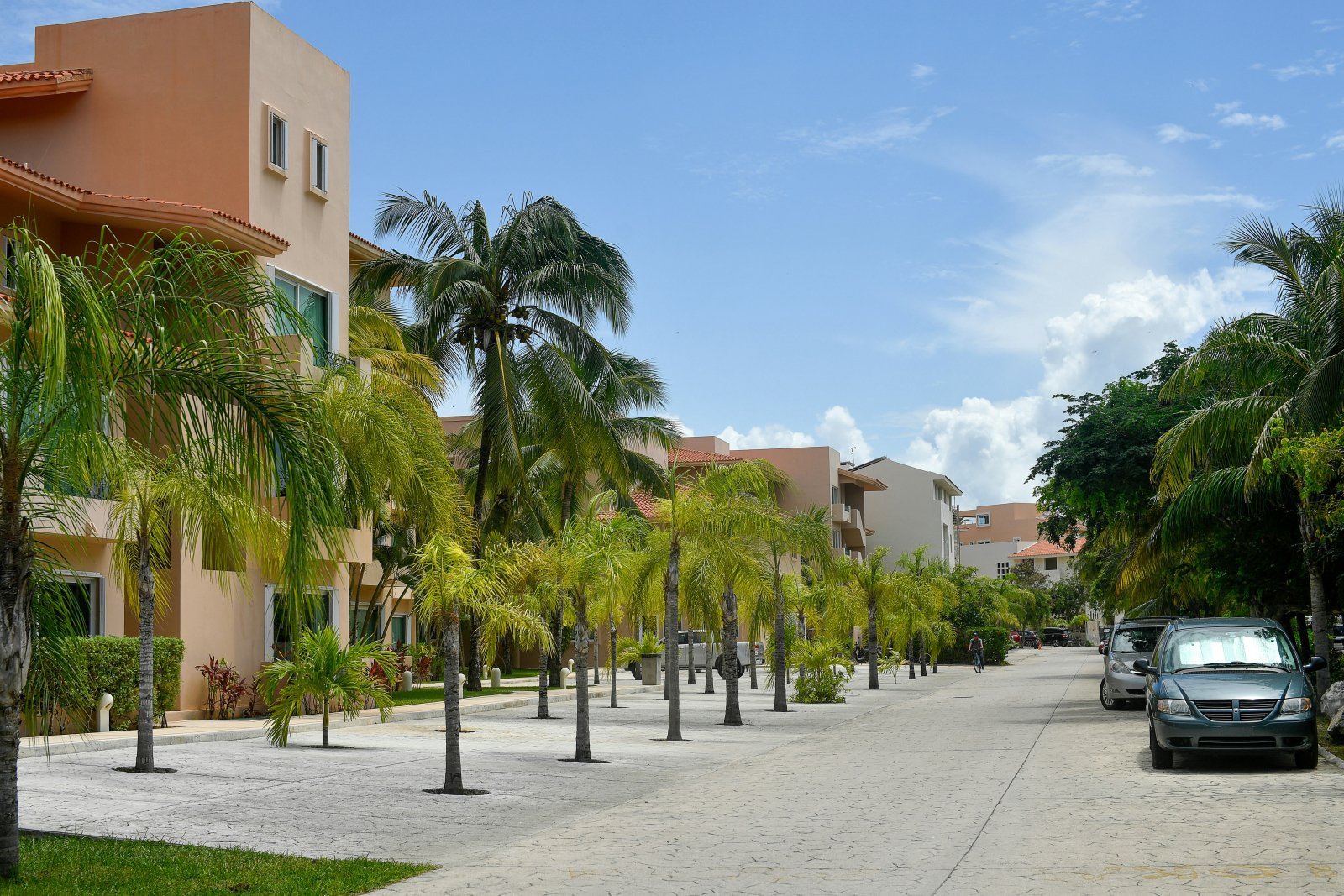
In Puerto Aventuras, installing hurricane protection is almost never a technical problem: certified systems adapt to nearly any construction, from condos in Chac Hal Al to villas in Bahía Yanten. The real obstacle is usually administrative, namely your phase's gated-community rules. The answer is not to avoid protection out of fear of the rules, but to choose low-visual-impact systems, submit a request with complete technical documentation, and frame protection as a safety improvement for the entire phase.
Why the rules are the first obstacle, not the installation
Puerto Aventuras is not one community with one set of rules: it is a series of phases and developments, each with its own management, its own horizontal-property regime and, in many cases, specific restrictions on what may be modified on a property's exterior. For anyone wanting to protect their investment, learning to navigate those rules matters as much as choosing the right system.
How Puerto Aventuras is organized
The development grew in phases starting in 1988, and each later phase was designed with its own aesthetic and construction standards, including the recent Phase IV developments with dual access control and reinforced security. The most exclusive areas, such as the Bahía Yanten canals and the gated residentials of Punta Matzoma, tend to have the strictest rules on visible modifications, because aesthetic uniformity sustains those properties' value.
That is why the right question is not "can I install protection in Puerto Aventuras?" (the answer is almost always yes), but "which rules apply to my specific phase, and which system complies without needing an exception?"
Why HOAs resist, and why that is good news
When a phase management initially rejects a request, it is almost never because it opposes safety: it is because it is responsible for preserving the community's uniform appearance, one of the factors that sustains every property's value. A request like "I want to put something on my window" triggers resistance because it provides too little information. A request with complete technical documentation, photos of similar installations in the retracted state, reference to the ASTM E1996 standard, and an explanation of the low visual impact gives management exactly what it needs to approve with confidence.
The submission strategy that works
Step 1: Request your phase's specific rules in writing
The first mistake is assuming the rules are uniform across Puerto Aventuras. They are not. Request in writing your phase or condo rules on exterior modifications and identify exactly what they define as a "facade modification." In many rulebooks, anchors installed in a window's interior frame, without altering the visible facade structure, do not qualify as a modification requiring special approval.
Step 2: Submit complete technical documentation
A well-prepared request includes: technical system specifications (with reference to the ASTM E1996 standard), photos or renders of the system in both the retracted and deployed states, an explanation of how it integrates with the existing frame without visible structural modification and, if possible, examples of approved installations in other phases or in comparable Riviera Maya communities.
Step 3: Frame it as a collective safety benefit
An individual request competes with the idea of a "personal aesthetic modification." Presented as a contribution to the safety and property value of the entire phase, especially alongside a standardization proposal for other interested owners, it completely changes the conversation with management.
Step 4: Propose a phase standard, not just your case
The most successful strategy is to propose that management adopt a specific certified system as an approved standard for the whole phase, rather than evaluating each request in isolation. This gives a clear, consistent criterion, reduces the administrative burden, and often speeds up your project because it becomes the reference case.
Why retractable fabric systems get the most approvals
Among all options, retractable fabric systems with frame-embedded anchoring, such as the HS-875, HS-1250 and HS-1500 from Hurricane Solution, are consistently the ones with the highest approval rate under strict rules. The reason is simple: in the retracted state they are practically invisible. The anchors are installed in the interior frame of the window or door, not on the exterior facade, and the fabric is stored rolled in a low-profile compartment that does not alter the appearance during the more than 340 storm-free days a year. This contrasts with permanent panels or fixed structures, which do have constant visual impact and face more resistance in premium phases like Bahía Yanten or Punta Matzoma.
The financial argument that convinces any management
Beyond safety, there is a convincing financial argument: certified protection has a documented positive impact on resale value. Riviera Maya real estate data show that properties with certified protection installed and documented can list between 8% and 15% above comparable unprotected properties, a premium that benefits the whole phase if adopted as a collective standard. For a phase with 30 to 40 properties, that differential applied collectively can represent several hundred thousand dollars of additional equity for the community. This is the kind of argument that turns a "allow or not" discussion into a "how best to implement for everyone" one.
Real scenario: from initial rejection to phase standard
A representative case involved an owner in a phase with strict rules whose first request was rejected on the grounds that "any additional element on the windows" violated the aesthetic rulebook. Instead of abandoning the project or installing without authorization, the owner requested the exact text of the rules in writing, identified that the restriction referred to modifications of the visible facade structure (not to anchors in the interior frame), and submitted a second request with complete technical documentation, including photos of similar systems in other gated communities in the retracted state. Management approved the project and later adopted the system as a recommended standard for other owners in the same phase, eliminating the need to repeat the process case by case.
The cost of delaying the decision out of uncertainty
A variable many owners do not quantify is the cost of indecision. Those who postpone installation for 2 or 3 seasons while assessing whether their HOA will approve the project remain exposed with no mitigation. If Quintana Roo records, according to National Hurricane Center data, a significant event every 4 to 7 years, postponing the decision 2 or 3 years represents a considerable fraction of that risk interval with no protection, an opportunity cost rarely considered.
What to do if management rejects the initial request
If, after a well-documented request, management rejects the project, there are three further paths. First, request a formal meeting with the owners' board or assembly, since many rule decisions require assembly approval and not just the administrative team. Second, consult a lawyer specialized in horizontal property and condominium regime in Mexico, who can assess whether the rules actually prohibit the proposed system or whether the initial reading was broader than allowed. Third, when the rules are restrictive about the exterior but permit interior modifications, evaluate installing anchors only in the interior frame of the openings, which in many cases does not require the same approval as a facade modification.
Conclusion
Puerto Aventuras' gated-community rules are not an insurmountable obstacle: they are a variable that requires the right submission strategy. Owners who request their phase's specific rules, submit complete technical documentation, frame the request as a collective benefit, and choose low-visual-impact systems like retractable fabric with embedded anchoring consistently obtain the approval they need to protect their investment. See more cases and options for your home in our residential section.
Frequently Asked Questions
Do all Puerto Aventuras phases have the same rules on modifications?
No. Each phase and development has its own management and specific rules. You must request your exact phase's rules before submitting any request.
Which system has the highest approval rate in Puerto Aventuras?
Retractable fabric systems with anchoring embedded in the interior frame, practically invisible when retracted and not altering the visible exterior facade.
How long does HOA approval take?
With a complete technical documentation package, approval usually takes 2 to 4 weeks, depending on the meeting schedule of each phase's management or assembly.
What do I do if my phase rejects the initial request?
Request a formal meeting with the board or assembly, consult a lawyer specialized in horizontal property to assess whether the rules truly prohibit the system, and consider presenting the project as a collective standard for the whole phase.