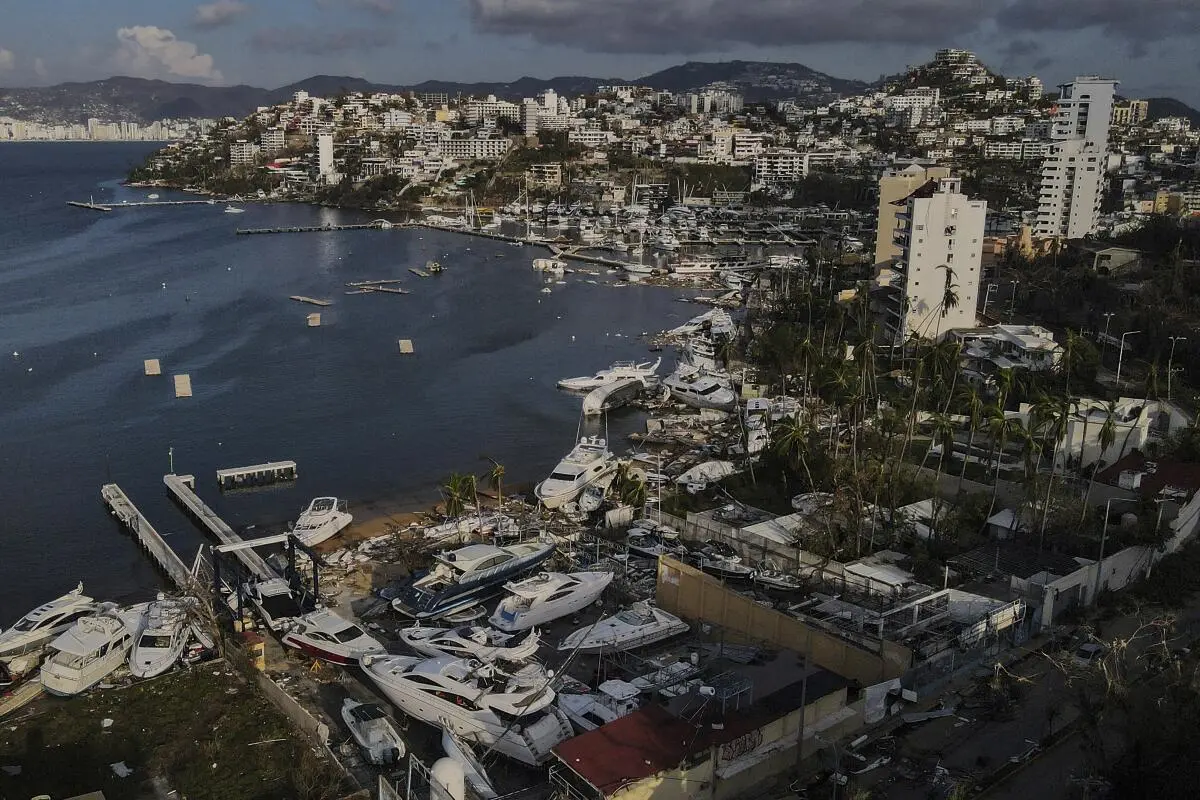
Hurricane Otis came ashore at Acapulco on October 25, 2023—the first Category 5 hurricane on record to make landfall on Mexico's Pacific coast. It left an uncomfortable engineering lesson behind. The city's buildings were designed to survive earthquakes, not hurricane-force wind, and the damage landed almost entirely on what nobody had protected: glass facades, window framing, ceilings and drywall partitions. Seismic strength does not stand in for opening protection. They are two different problems, and they need two different solutions.
What set Otis apart from any earlier hurricane in Mexico
Otis gave none of the usual days of warning. It became a tropical depression on October 22. Between the morning of the 24th and the small hours of the 25th, it went from a tropical storm with winds near 85 km/h (53 mph) to a Category 5 with sustained winds of 270 km/h (168 mph) and gusts to 330 km/h (205 mph). That is rapid intensification—a gain of at least 55 km/h (35 mph) in 24 hours or less—and Otis cleared the threshold by a wide margin. Only Hurricane Patricia (2015), also in the Pacific, ramped up faster in this hemisphere.
UNAM researchers logged winds barely above 100 km/h at nine in the morning on October 24, ordinary tropical-storm numbers. Twelve hours later it was a full Category 5. Civil protection protocols assume far more lead time and had no scenario for this, as UNAM researcher Jorge Zavala acknowledged publicly. Landfall came at 1:25 a.m. on October 25, with Acapulco's hotels running near 50% occupancy.
The core lesson: earthquakes and wind are different problems
The finding engineers cite most often after surveying the city is counterintuitive. Most buildings did not collapse. Guerrero is earthquake country, and its building code pushes structures to survive ground motion, which indirectly gave them decent general wind resistance. The frame was not the problem. Almost everything hanging off it was.
Damage concentrated overwhelmingly in non-structural elements: glass facades, window framing systems, suspended ceilings and drywall partitions. The damage report from UNAM's Institute of Engineering describes windows breaking again and again, from both extreme wind pressure and wind-borne debris. Once they broke, wind and rain reached the interior and ruined finishes, HVAC equipment, ceilings and unit contents.
The pattern engineers documented
Newer buildings with wide panoramic glass facing the water fared considerably worse than buildings set back from the shore or built with less glass in the facade. Within each building, the face parallel to the shoreline—the one aimed at the ocean and the prevailing wind—was consistently the worst hit.
That is large-scale field evidence for what hurricane engineering already predicted: the more unprotected glass a facade carries, and the more directly it faces the water, the more damage concentrates there in an extreme wind event.
What held and what failed in Acapulco during Otis
| Element | Observed performance | Technical explanation |
|---|---|---|
| Main structure (columns, beams) | Generally held | Designed for seismic loads, with general wind resistance as an indirect benefit |
| Unprotected windows and glass facades | Repeated failure | No specific design against wind-borne debris or extreme wind pressure |
| Window framing systems | Frequently torn away | Anchors never sized for hurricane wind loads |
| Drywall partitions | Frequent collapse | No structural capacity against internal pressurization |
| Properties with certified protection installed | Minimal damage reported | Designed specifically for impact and wind pressure |
Why almost no property had protection installed
Before Otis, hurricane shutters and storm panels were all but nonexistent in Acapulco. The city had never taken a storm of that size, and industry estimates put the share of buildings in Mexico with any certified protection system at roughly 2%. These systems were already routine in Cancún and Los Cabos, where Hurricane Wilma (2005) and Hurricane Odile (2014) drove adoption. In Acapulco, before 2023, hardly anyone saw the need.
After the storm, the Colegio de Ingenieros Civiles de México began openly urging hotels and residential buildings in Acapulco to install hurricane protection, citing Cancún and Los Cabos as the precedent. The recommendation goes past shutters: better facade coatings, reinforced window framing and stronger glass, to cut both the physical damage and the recurring cost of rebuilding the same components after every event.
The number that sums it up: 100% of buildings damaged
The Cámara Mexicana de la Industria de la Construcción reported that virtually every building in Acapulco suffered damage of some degree after Otis. Severity varied enormously—total loss for informally built housing in high-risk areas, cosmetic facade damage for hotels with sound structures. Direct economic impact was estimated at $16 billion, far above the $1.1 billion attributed to Hurricane Paulina in 1997, the region's previous benchmark event.
Two neighboring hotels in Acapulco Diamante
Post-event engineering documentation describes a pattern repeated along the coast: two hotels of similar size and age, a short distance apart on the same stretch of beach, with radically different outcomes. The first had floor-to-ceiling glass and no protection at all. Nearly every oceanfront room lost its windows, water got in, and the property sat closed for months. The second had a comparable share of glass but hurricane shutters installed—an unusual call in the region before 2023. Damage there stayed in the unprotected areas, while the covered rooms reported little or none.
That contrast, documented in several regional reports, is the most direct field evidence that opening protection—not general structural strength—separated a recovery measured in weeks from one measured in months.
Rebuilding without protection rebuilds the risk
Repairing an Otis-damaged property without adding certified protection puts the same exposure straight back in place. Glass, framing and water-damaged finishes, multiplied across every affected room or unit, add up to serious money left open to the next extreme wind event—something meteorologists call increasingly likely given the rapid intensification trend in the region.
For hotels and commercial developments the math is blunter still. Every room out of service is lost revenue for the full repair period, and RevPAR afterward suffers not only from the physical damage but from how the travel market reads the destination's risk for seasons to come.
What owners in Acapulco should do now
- If the structure is seismically sound but the openings are bare, the facade is the immediate priority, not more structural reinforcement.
- In a post-Otis rebuild, write certified protection into the scope instead of restoring things exactly as they were.
- In new construction, design the facade around protection from the start, above all on oceanfront glass.
- If the property came through undamaged but unprotected, assess it before the next season rather than after it.
- For hotels and large developments, commission an engineering assessment that separates general structural capacity from opening protection against wind and wind-borne debris.
Hurricane Solution assesses facades on exactly those terms: hurricane protection sized opening by opening, for hotels and residential properties alike.
Frequently Asked Questions
Why did Otis catch authorities and residents so off guard?
Rapid intensification. It went from tropical storm to Category 5 in under 24 hours, leaving almost no preparation window compared with a gradually developing hurricane.
Did Acapulco's buildings need structural reinforcement?
Broadly, no. Most main structures held up thanks to the region's seismic design. The damage concentrated in facades, windows and other non-structural elements with no specific wind protection.
What changed in the recommendations for hotels after Otis?
The Colegio de Ingenieros Civiles de México started actively promoting hurricane shutters and reinforced window framing for hotels, citing their established use in Cancún and Los Cabos.
Could another Otis happen in Acapulco?
Meteorologists note that rapid intensification is growing more common in the Mexican Pacific as coastal waters warm, which makes permanent protection a wiser plan than counting on long advance warning.