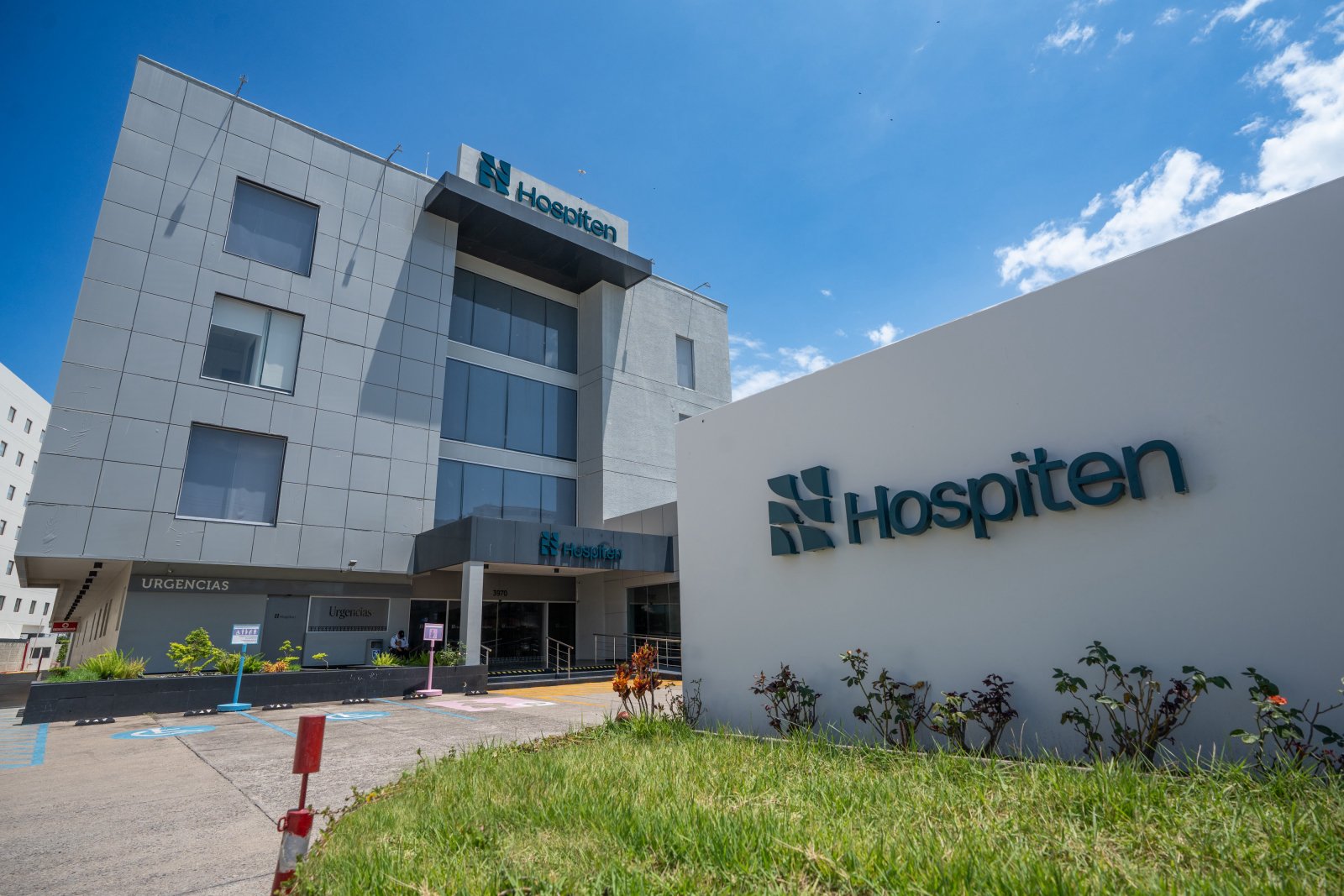
A hospital faces a condition no other building shares: demand for its services can rise at the very moment the storm threatens the structure. You cannot evacuate it or shut down operations. That is why opening protection is not measured by the cost of replacing glass, but by clinical continuity.
Mexico's Safe Hospital Program (Secretaria de Salud) states it clearly: hospitals must remain accessible and operating at full capacity during a threat and immediately afterward. The real asset is not the facade, but what lies behind it: emergency, imaging, operating rooms, electrical rooms, medical gases and circulation routes.
Large entrances create a different engineering problem
Hospitals use large glass facades, double-height atriums and wide access points for emergency and ambulances. That architecture creates spans that do not exist in a residential window: eight, twelve or more meters between points capable of receiving load.
The mistake is scaling a conventional screen without changing the logic: every load a screen receives must end in the structure, and as surface area and the distance between supports grow, so do the demands on the system and its anchors. The fabric can be strong without the assembly being able to work over a wider span.
The commercial rule for management, procurement and maintenance is simple:
- If the opening exceeds roughly 4 meters between structural points, stop asking for a bigger tarp and request a large-opening engineering review.
The published threshold
Hurricane Solution publishes 3.8 meters between anchor points as the point beyond which an opening must be analyzed as large format. The 4 meters is the rounded commercial version of that threshold.
AquaGrid: when the span becomes the problem
AquaGrid was developed for openings that a solid system should not resolve by simply increasing dimensions. Instead of blocking almost all wind across a giant surface, it uses an approximately 50% open mesh: part of the flow passes through the mesh, reducing the load transferred to anchors and structure.
Its technical sheet publishes a tensile strength of 7,800 lb and applications documented by Hurricane Solution beyond 20 meters between anchor points. It is a solution proven in the real world, not an automatic system: each hospital requires review of dimensions, structure, substrate, exposure, access and deployment method.
The four mechanisms an opening must control
A hospital opening must control four phenomena: wind, projectiles, wind-driven rain and internal pressurization. The National Hurricane Center warns that hurricane winds turn exterior materials into projectiles; the reference standard ASTM E1996 evaluates envelope protective systems against debris. The takeaway for procurement: evaluate the complete system -material, connections, anchors, substrate, structure and installation- because a single failure can open a route to the interior.
Size and consequence are distinct variables
The largest opening may be the most obvious engineering problem, but the one with the greatest consequence may be smaller. An emergency access has a disproportionate operational value compared with a lobby facade. That is why each opening should be classified by exposure, vulnerability and clinical consequence, not just by square meters.
System comparison
| Option | Conventional openings | Openings >4 m | Hospital consideration |
|---|---|---|---|
| Impact glass | Can be excellent as a complete system | May require a specific curtain wall | Permanent, but does not solve every opening |
| Shutters / panels | Useful depending on design | Complex in large format | Weight, storage, operation |
| Certified solid tarp | Very effective within its range | May reach span limits | Light and deployable |
| AquaGrid | Generally unnecessary on small spans | Designed for large openings | Requires specific engineering |
The real cost of a hospital failure
The cost of a failed opening goes far beyond the glass: diagnosing soaked equipment, closing areas, diverting patients, overtime, cleanup, recovery and reduced clinical capacity. The useful formula is: repair + clinical disruption + lost capacity + recovery + strain on staff. Physical cost matters; preserved clinical capacity matters more.
Protection that cannot be deployed in time is not protection
A hospital cannot assume unlimited staff during an alert. The plan must define who authorizes, which zones close first, which access points stay active, where the pieces are stored, which tools are used and who verifies assembly. A drill in calm weather should uncover problems before maintenance is competing with clinical and emergency tasks.
Cancun and Puerto Vallarta: the same need on two coasts
CENAPRED reminds us that for the 2026 season tropical cyclones can endanger hospitals and clinics. In both Cancun and the Riviera Maya and in Puerto Vallarta and Bahia de Banderas, modern clinics use lobbies, glass walls and access points that exceed conventional spans. If a solution requires engineering, custom fabrication and coordinated installation, the process must start before there is a named storm. Learn about Hurricane Solution's commercial protection approach.
Frequently Asked Questions
What is the best hurricane protection for a hospital?
There is no single product. It is a per-opening strategy: appropriate solid systems on conventional spans and AquaGrid evaluation on large openings, all within a complete-envelope and continuity strategy.
Why do the 4 meters matter?
Hurricane Solution publishes roughly 3.8 m as the special-review point. The 4 meters is the simple rule for management and procurement: above that span you must review large-format engineering instead of asking for a bigger tarp.
Can AquaGrid protect a 10 or 20 meter entrance?
Hurricane Solution documents applications beyond 20 m, but each project must be designed for its geometry, structure and exposure. It is never assumed that any span can be solved without engineering.
Is a hospital with impact glass already protected?
Not necessarily. Glass, frame, anchor, doors, joints, other openings and technical areas must all be evaluated. The envelope is a system, not a single piece.
Does AquaGrid have Level E certification?
That simplification should not be made. Hurricane Solution documents Level E on specific systems such as HS-1500; AquaGrid is a separate solution for large openings and must be justified by its own engineering, proven in the real world.
To see these criteria on real projects, read the U.S. Navy hospital in Guam case study and the DIF Solidaridad case study.