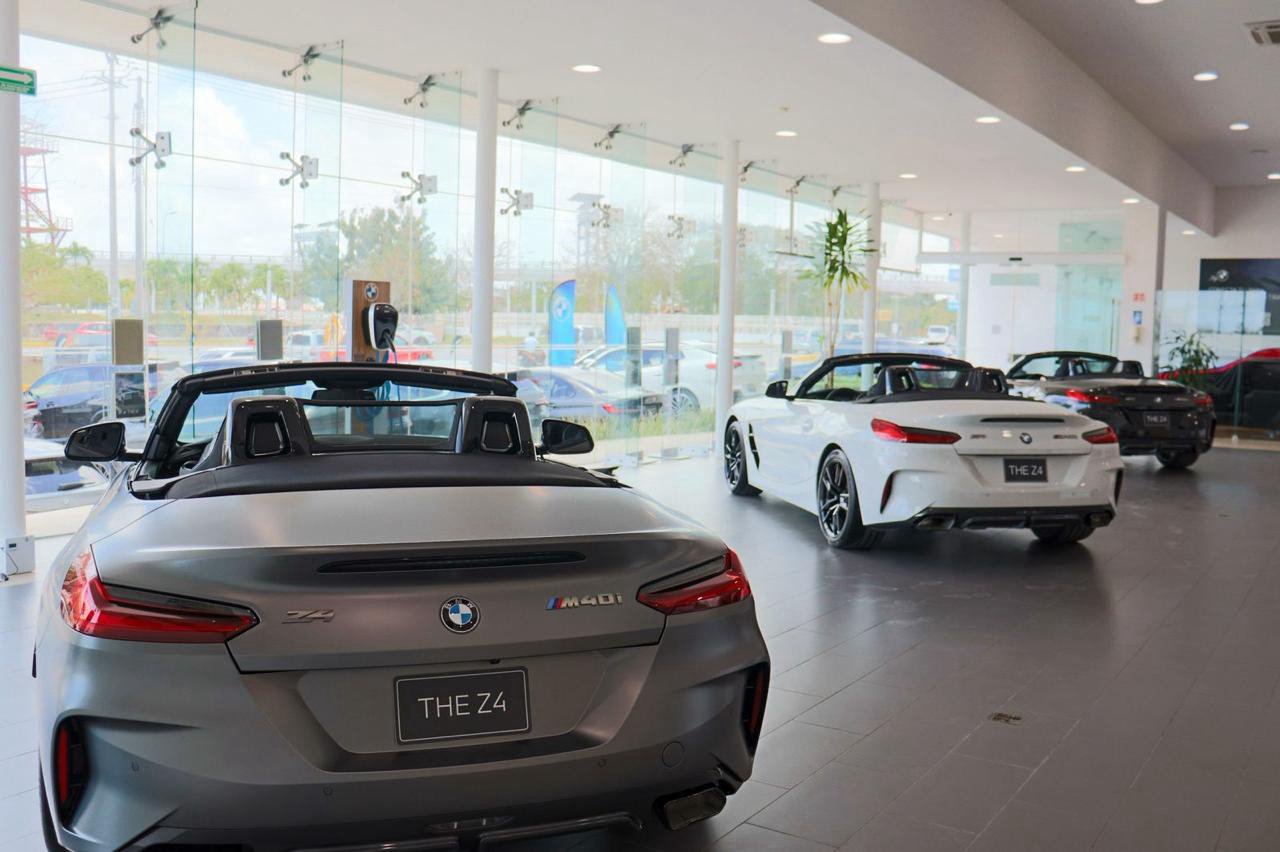
Car dealerships in Cancún face one of the hardest challenges in commercial hurricane protection: huge glass facades built to display vehicles and create visibility from the street. When the distance between anchor points exceeds roughly 4 meters, the opening should no longer be treated as a conventional window.
The problem almost every dealership shares
Modern dealership architecture wants the opposite of what is easy to protect: large glass surfaces, double heights, wide entrances and few structural elements interrupting the facade. It all makes commercial sense, but it clashes with a protection system that needs frequent anchor points.
A two-meter window and a twelve-meter showroom are not the same problem. As the span grows, the exposed surface changes, the possible deflection changes and the way force reaches the fixing points changes. In hurricane protection, the size of the opening is an engineering variable, not just "more fabric".
Why anchor points matter
A hurricane system does not float in front of the building: all the force it receives ends up in the structure through the anchors. That is why material strength alone never tells the whole story. You can have very strong fabric and still have a poorly designed system if the loads transferred to the anchors are excessive.
This principle underlies the reference standard ASTM E1996, which covers exterior windows, curtain walls, doors and impact-protection systems in hurricane regions: protection is evaluated as a whole, with impact and pressure, not as an isolated fabric sample. At a dealership, the receiving structure may be concrete, steel, tubular steel or curtain wall, and someone must know where it anchors and what capacity that point has before promising the screen will hold.
The 3.8-meter limit (rounded to "4 meters")
Hurricane Solution publishes roughly 3.8 meters as the span beyond which its conventional systems stop being the normal solution; for communication we round it to 4 meters. It does not mean a 3.81 m opening will fail automatically, but that you can no longer assume a conventional system is adequate: you must calculate, verify the structure and use a system designed for those conditions.
The rule also helps purchasing: a quote may say "hurricane mesh" or "hurricane fabric", but if it does not state the maximum span between anchors, a decisive question is missing. The finished size of the fabric does not prove the engineering limit of the assembly.
The dangerous mistake: "if they can install it, it must work"
Installable does not mean engineered. There are installations where conventional screens were pushed far beyond their engineering spans. On a calm day both systems look convincing; the difference appears when the loads they were, or were not, designed for arrive. That is why, on large facades, the right question is not "can you cover it?" but "can you show how the system handles the span?".
AquaGrid: changing the physics instead of fighting it
Solid systems try to block almost all the wind load, which is correct on conventional openings. On a giant opening, trying to take all that force creates loads that are hard to manage on anchors and structure. AquaGrid starts from a different concept: its weave is approximately 50% open, allowing controlled passage of part of the wind while the mesh keeps acting as a barrier against wind-borne debris.
It is not about "letting the hurricane through", but about controlling how much force the screen tries to take: when the total force to be transferred decreases, the feasibility of the support system changes. AquaGrid's technical documentation states a tensile strength of 7,800 lb, and the company has documented projects with spans greater than 20 meters. AquaGrid does not eliminate engineering; it exists precisely because engineering must be respected, and every large opening is reviewed individually.
Why this matters especially in Cancún
Cancún does not have to imagine what a major storm can do: the National Hurricane Center documented severe conditions during Hurricane Wilma in 2005. What matters for a dealership is that a commercial facade can stay exposed to wind and rain for a prolonged period, and that wind can turn signs, cladding and outdoor objects into projectiles.
Behind the glass there is not just flooring and furniture: there are new vehicles, customer cars, diagnostic equipment, computers, parts, offices and delivery areas. The practical question is which part of the business would be exposed if the main facade fails.
The showroom is not the only problem
A serious dealership reviews the entire property: workshop doors, service access, side windows, offices, warehouses and administrative entrances. The best strategy is not to install AquaGrid across the whole dealership, but to use the right system for each opening. A conventional window can be protected with appropriate solid systems; a 12-meter facade may require AquaGrid. A professional survey classifies each opening as conventional, special or large opening so the investment is efficient.
System comparison
| System | Conventional openings | Very large spans | Visibility | Showroom logistics |
|---|---|---|---|---|
| Metal panel | Can work | Very complex | No | Heavy and bulky |
| Shutter | Can work | Limited by system/structure | Limited | May affect aesthetics |
| Certified solid fabric | Excellent in its range | Reaches load and span limits | Variable | Easy on suitable openings |
| AquaGrid | Possible, usually unnecessary | Designed for large spans | Open | High adaptation to large facades |
How much does it cost and what should a dealership ask for?
There is no responsible universal rate. The price depends on the width and height of the opening, the distance between structural points, the condition of the concrete or steel, the need for reinforcement (tubular steel), the height and access, the number of large openings and the manufacturing and import logistics. Each screen is manufactured in the United States and shipped to Mexico. That is why a serious quote starts with photographs, dimensions and a technical review, not a generic price per square meter. See more options in commercial protection.
If you could only do one thing: measure the largest real distance between structural points capable of receiving anchors. If it exceeds roughly four meters, do not ask for "a bigger tarp": ask for a specific large-opening engineering review.
Frequently Asked Questions
What is the best hurricane protection for a car dealership in Cancún?
It depends on your openings. Conventional windows and doors can be protected with appropriate solid systems. Large facades with more than roughly 4 meters between anchor points should be evaluated as large openings and may require AquaGrid.
Why do the four meters matter?
Hurricane Solution publishes roughly 3.8 meters as the point where its conventional systems stop being the normal solution and the opening requires special evaluation. The "four meters" is only a simple communication rule.
Can a ten-meter fabric be installed?
Physically it may be possible to make and install it. What matters is whether the system was designed to work with that distance between anchors and the corresponding loads.
Is AquaGrid a solid fabric?
No. It is an open-weave structural mesh (approximately 50% open) that allows controlled passage of part of the wind and reduces the forces transferred to structure and anchors; it has been real-world tested, and it is not a solid fabric.
Can AquaGrid protect openings larger than 20 meters?
Hurricane Solution documents applications and engineering capacity greater than 20 meters on specific projects. Each opening must be reviewed individually.