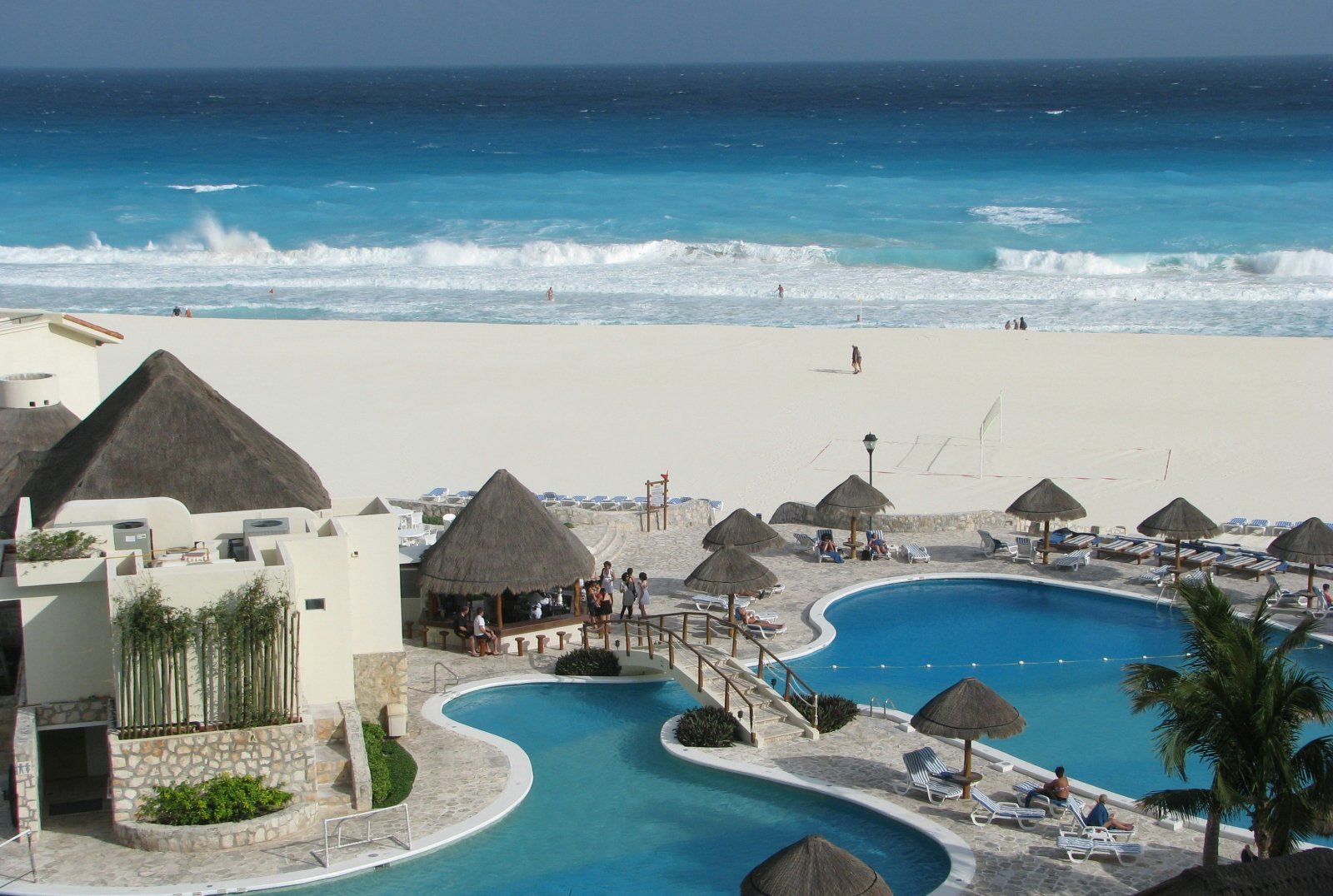
Canal-front and oceanfront homes in Puerto Aventuras face hurricane-protection challenges that simply do not exist inland: large-format openings facing directly into the prevailing wind, private docks that require extra preparation, constant salt exposure from the proximity to water and, in many cases, phase regulations that limit modifications visible from the canal. The correct answer combines systems certified to the ASTM E1996 standard designed for large openings, marine-grade anchors that resist the accelerated corrosion of the canal environment and a protocol that coordinates the home with the dock area.
The National Hurricane Center (NOAA) records that the Yucatán Peninsula, where Puerto Aventuras sits, has experienced significant tropical cyclones on average once every 3 to 4 years over the last three decades. For canal-front properties that risk concentrates differently from the rest of the community, which is why the generic approach to hurricane protection for the Riviera Maya falls short.
Why canal homes are a different case
Large-format openings facing the water
The central design element of a canal villa is the visual connection to the water: floor-to-ceiling windows in the living room, large-format sliding doors onto the terrace and, frequently, additional openings on the second level with the same orientation. A documented villa in Bahía Yanten, with 612 m² of construction on an 855 m² lot, repeats this pattern on both levels. Because Puerto Aventuras canals run perpendicular or at an angle toward the coast, that canal-facing façade is precisely the one that receives the prevailing wind and concentrates the largest vulnerable surface of the whole property. This is not about protecting a few windows, but the entire façade that defines the value and design of the home.
The private dock and the risk to vessels
A canal villa usually includes a private dock of 18 to 21 meters for mooring medium to large vessels. This introduces a risk found in no other residential zone of the Riviera Maya: simultaneous damage to the home and to the moored vessel during the same event. Hurricane Solution specializes in protecting the home's envelope; preparing the vessel and dock requires additional coordination with the Puerto Aventuras marina operator. Both elements must be synchronized within the same 48-to-24-hour window before projected impact.
Accelerated salt exposure
Every coastal property in Quintana Roo suffers degradation from salt air, but canal homes have even greater exposure due to close, permanent contact with a brackish body of water connected to the Caribbean. Standard grade 304 stainless steel can show visible corrosion in 12 to 24 months in this environment, whereas marine-grade 316 stainless steel keeps its structural integrity for 15 to 20 years under the same conditions. Specifying the correct hardware grade is not optional: it is the difference between a system that still works in year ten and one that fails silently long before.
Phase regulations that limit what is visible from the canal
Puerto Aventuras is organized into phases, each with its own construction rules. The newest and highest-value zones, such as Bahía Yanten and Punta Matzoma, often have strict regulations about what may be installed on façades visible from the canal or common areas, to preserve the uniform aesthetic. That makes the choice of system not only technical but also a compliance matter: retractable fabric systems with frame-embedded anchors, practically invisible when inactive, achieve the most consistent approval versus bulky or permanently visible solutions.
The correct technical solution for a canal villa
Full envelope, not just the front façade
The most common mistake is protecting only the front openings toward the access street and leaving the canal façade unprotected, whether for cost or by underestimating that risk. It is exactly the opposite of what hurricane physics suggests: the canal façade receives the greatest direct wind exposure because the canals connect to the open sea and act as corridors that channel it. Full-envelope protection must include, without exception, the floor-to-ceiling windows facing the water, the main terrace sliding doors and any second-level opening with the same orientation.
Multi-tension systems for large openings
Windows 4 to 6 meters wide and double- or triple-panel sliding doors require systems certified to the ASTM E1996 standard, designed for that scale. A simple point anchor, adequate for a 1.5-meter window, does not distribute wind load evenly across a 5-meter opening and creates concentrated failure points where pressure is highest. Hurricane Solution's multi-tension systems distribute the load across multiple anchor points along the entire protected surface, keeping resistance uniform under extreme differential pressure.
Coordinated protocol between home and dock
When an alert is issued, the protocol must coordinate two simultaneous lines of action: deploying the home's protection and preparing the dock and vessel. A good protocol assigns specific times within the 48-to-24-hour window: for example, opening protection completed before the 36-hour mark and the final decision on the vessel (relocation or reinforced mooring) before the 24-hour mark, while navigation inside the canal is still safe.
Real scenario: the villa that protected only the front façade
Consider a villa in Bahía Yanten that, when installing protection for the first time, chose to protect only the access-façade openings to reduce the initial cost, leaving the floor-to-ceiling canal-facing windows unprotected. During a Category 2 hurricane with sustained winds of 155 km/h, the prevailing wind entered directly through the canal corridor and concentrated pressure on the unprotected façade. One of the large-format windows gave way, allowing water in at an estimated 60 liters per hour for nearly 5 hours: about 300 liters of salt water inside.
The result was damage to the living-room floors, a built-in entertainment system and the ground-floor electrical installations, with a repair cost of $38,000 USD, more than double what protecting the full envelope from the start would have cost. It is the exact illustration of why partial protection of the front façade is a false economy for this type of property.
The extra risk of vessels with no protocol
A medium vessel (30 to 45 feet) without adequate preparation — standard mooring lines instead of reinforced ones, insufficient fenders for the swell generated inside the canal — can suffer damage from impact against the dock or excessive movement in sustained winds of 130 km/h or more, even without losing its mooring entirely. Repairing hull, fenders and mooring systems after a Category 2 event can range from $8,000 to $35,000 USD depending on severity. Combined with the risk to the home, this reinforces why opening protection and vessel preparation must be treated as a single process, not two disconnected projects.
The specific cost of protecting a canal villa
Hurricane fabric protection systems are custom-engineered based on high-velocity wind-load calculations, opening spans, mounting substrates, and motorization requirements. Contact our engineering team directly for a precise project calculation.
Conclusion
Canal-front and oceanfront homes in Puerto Aventuras present a risk profile and complexity that a generic approach cannot solve. The large-format openings facing the water, the private dock, the accelerated salt exposure and each phase's regulations demand a solution designed for those conditions. For these owners, full-envelope protection with certified marine-grade systems is not a luxury: it is the only effective way to protect the most valuable and most exposed asset in the community. See also our residential solutions and our frequently asked questions.
Frequently Asked Questions
Why are canal homes in Puerto Aventuras harder to protect?
Because they combine large-format openings facing directly into the prevailing wind, a private dock that introduces additional risk, accelerated salt exposure from constant proximity to water and, in many cases, phase regulations that limit which system can be visibly installed.
Does Hurricane Solution also protect the dock or only the home?
Hurricane Solution specializes in protecting the home's envelope: windows, doors and large-format openings. Preparing the dock and vessel requires additional coordination with the marina operator, but both protocols must be synchronized on the same schedule.
What type of anchor is recommended for a canal villa?
Marine-grade 316 stainless steel, which resists the accelerated corrosion of the canal environment for 15 to 20 years, versus 3 to 5 years for standard grade 304 steel under the same conditions.
Is it necessary to protect the entire canal-facing façade or only some openings?
It is necessary to protect the entire canal-facing façade. That façade usually receives the greatest direct wind exposure, since Puerto Aventuras canals act as corridors that channel wind from the open sea.