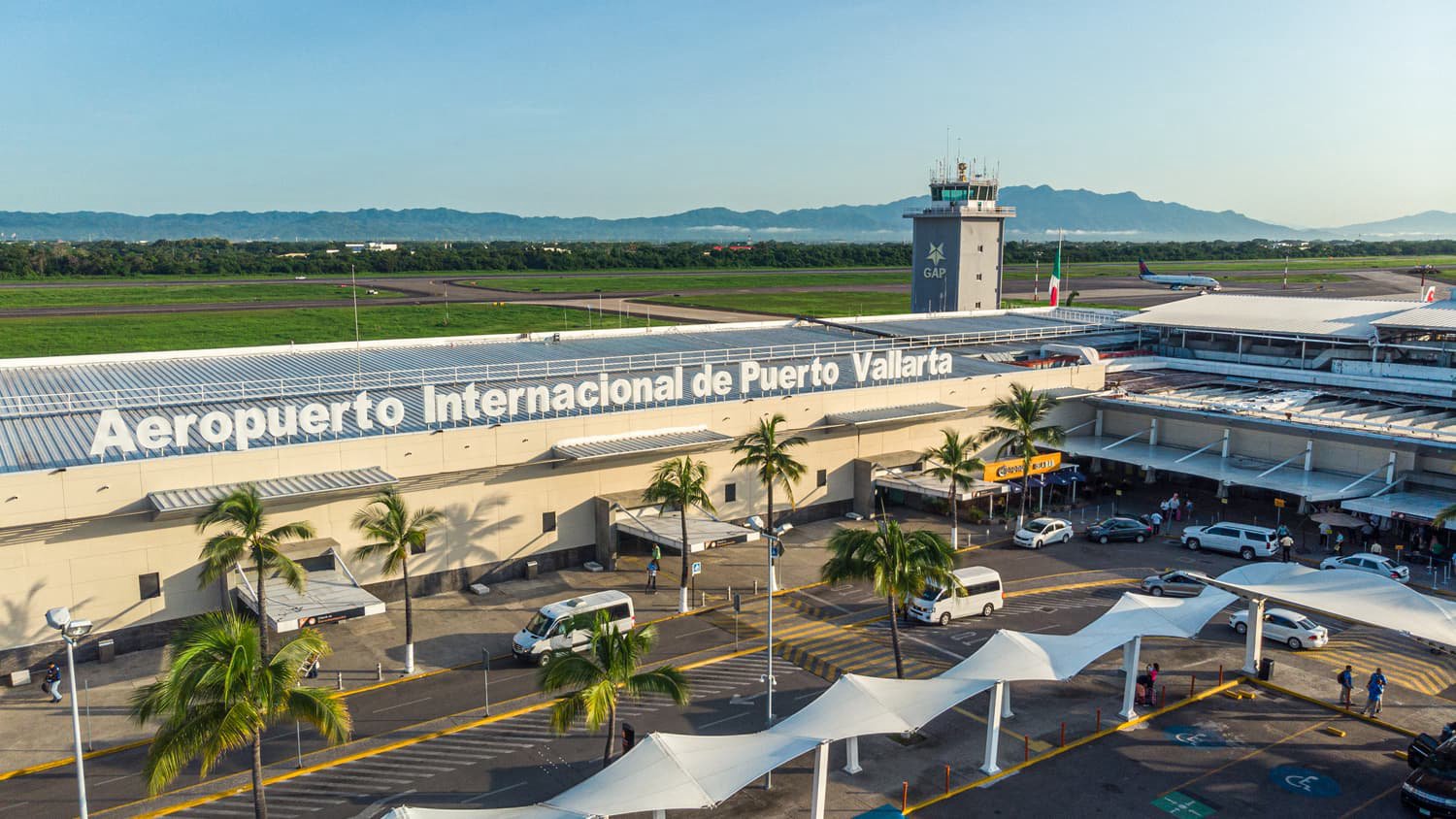
The Cancún and Puerto Vallarta airports combine large glazed facades, oversized access points and a critical need to keep operating. In terminals, hangars, double-height lobbies and vehicle entrances, the distance between structural points easily exceeds the span a conventional screen was designed for. When that happens, protecting the opening no longer resembles covering a window.
The large-opening problem
An airport is built to move people, baggage and aircraft with the least possible friction. That mission produces tall halls, curtain walls, automatic doors and spaces with few intermediate supports: excellent for mobility, difficult for commercial hurricane protection. The more column-free an opening is, the harder it becomes to find where to transfer the loads of a solid screen.
That is why an airport opening is assessed by distance between supports, geometry, receiving structure, anchoring, exposure and consequence of failure, not just square meters. A two-meter window and a fifteen-meter entrance are not the same problem even though both have glass.
The 4-meter rule
The first engineering question is not how strong the fabric is, but how far apart the points that can actually hold the system are. A textile with extraordinary tensile strength can still be part of an inadequate installation if the total force reaching its ends exceeds what the assembly can handle.
Hurricane Solution publishes roughly 3.8 meters between anchor points as its special-review threshold. The easy-to-remember commercial rule rounds that value: if the actual span exceeds about 4 meters, stop the conventional quote and request engineering. It does not mean everything fails at 3.81 m; it means the answer stops being standard and needs specific review.
In an airport this appears at main entrances, curtain walls, double-height halls, maintenance doors, vehicle access, hangars and waiting-area facades. The fact that a screen "can be made large" and looks taut in calm conditions proves nothing about its performance during the storm.
AquaGrid: reducing load to make the span possible
AquaGrid starts from a different strategy than the solid screen. Instead of blocking nearly all of the wind mass against a giant surface, it uses a roughly 50% open weave: part of the flow passes through the mesh and the load transferred to anchors and structure is reduced.
Its technical documentation publishes a tensile strength of 7,800 lb and applications above 20 meters on specific projects. AquaGrid is real-world proven and uses the ASTM E1996 standard as a reference; no figure makes a span automatic, and each opening requires review of structure, anchoring and loads. Where there are no supports every few meters, you change the physics of the solution instead of improvising supports or endlessly enlarging a solid screen.
Wind is not the only problem: projectiles
Airports contain plenty of signage, equipment and exterior elements. As wind increases, loose pieces become dangerous debris. The FAA's Foreign Object Debris program defines FOD as objects capable of injuring people or damaging aircraft. AquaGrid aims to combine two functions across large spans: reducing wind load and maintaining a physical barrier against storm-driven objects.
Comparing approaches
| Approach | Small opening | Large airport span | Load on structure |
|---|---|---|---|
| Conventional solid screen | Adequate within its engineering | Reaches its limits quickly | Takes most of the pressure |
| Rigid panel | Can work | Logistics and weight get complex | High demand on fasteners |
| Shutter / roll-down | Useful in designed applications | Limited by size and support | Depends on tracks and structure |
| AquaGrid | Usually unnecessary | Designed for large spans | Reduces load via open weave |
The real product: operational continuity
An airport does not buy protection only to keep its glass; it buys risk reduction to preserve capacity. A compromised facade lets in water and debris, and forces cleanup, drying, inspections and temporary closure of areas. The impact can be thought of as affected area times downtime, times area dependency, times recovery cost. A large zone with redundancy can be less critical than a small opening that exposes a system with no alternative.
What it costs and why proactive wins
There is no serious price per square meter without reviewing the opening. A large-format airport project is quoted by engineering, structure, height, access, anchoring, logistics, panel count and schedule, plus operational variables that rarely appear in a home: work windows, security coordination, sterile areas, lifting equipment, night work and internal permits.
The difference between reactive and proactive fits in one phrase: the forecast should activate the plan, not create it. You measure, classify, calculate, fabricate, install, train and document months ahead, in the same advance-preparation logic as the FAA's airport emergency plans.
The highest-value action today
If an operator in Cancún or Puerto Vallarta could do only one thing: identify today every opening with more than about 4 meters between structural points capable of receiving load. That list immediately reveals where a conventional strategy stops being appropriate and where an AquaGrid review should begin. The right question is not "who can cover this facade?" but "who can prove the solution was designed for this span and that our team can deploy it when we need it?".
Frequently Asked Questions
What is the best hurricane protection for an airport?
It depends on the opening. Solid systems can be appropriate for windows and doors within their engineering range. Large facades, entrances and hangars with more than about 4 meters between anchor points should be evaluated as large openings and may require AquaGrid.
Why does the four-meter limit matter?
Hurricane Solution publishes roughly 3.8 m as the threshold for changing the evaluation of its conventional systems. Four meters is the rounded commercial rule so the buyer knows when to stop a standard quote and request engineering.
Can AquaGrid cover more than 20 meters?
Hurricane Solution documents applications above 20 meters on specific projects. That does not mean every geometry is automatically approved: each opening needs review of structure, anchoring and loads.
Why can an open mesh be better for a huge facade?
Because it reduces the effective surface trying to stop the wind. Less transferred load can make possible a span that would be very hard to handle with a solid screen.
Should an airport wait for a named storm to start?
No. Large openings require survey, engineering, fabrication and coordination. The forecast should activate a system that is already installed and trained, not create it from scratch.