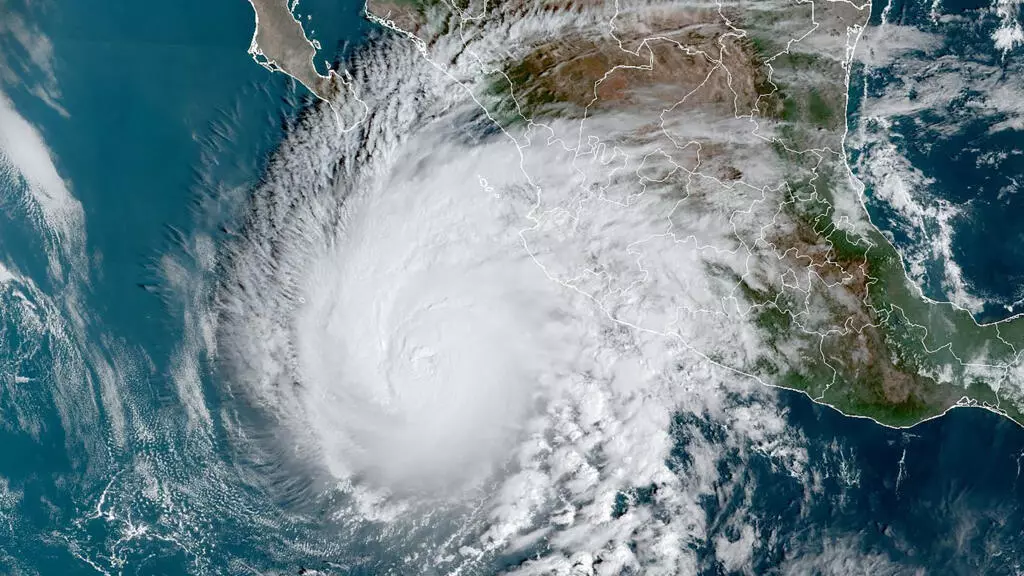
Hurricane Odile came ashore near Cabo San Lucas on the night of September 14, 2014 as a Category 3 storm, with sustained winds of 205 km/h (127 mph) and gusts to 250 km/h (155 mph). More than a decade later it is still the region's reference event—not for how much glass broke, but for what the broken glass set in motion.
The night of September 14, 2014
Odile peaked at Category 4 over the Pacific and landed as a Category 3 next to Cabo San Lucas. It moved slowly, holding hurricane-force winds over the region for hours. CONAGUA reported sustained winds of 205 km/h with gusts to 250 km/h. Authorities opened 164 shelters across the five municipalities of Baja California Sur with capacity for 30,000 people, and hotels in Cabo San Lucas and San José del Cabo took in a comparable number of stranded travelers.
Windows blew out of luxury hotels, ground floors flooded, and entire local neighborhoods were leveled. Reports from that week counted 135 people treated for minor injuries from flying glass or falling debris, and CENAPRED put direct infrastructure damage at 240 million pesos or more. The Los Cabos and La Paz airports stayed closed for several weeks.
Why one broken window is never just one broken window
Engineering teams that surveyed the region afterward—including researchers from the UNAM Institute of Engineering and the Mexican Academy of Engineering—confirmed in the field what wind engineering already knew on paper. When a window or glass door fails, the damage does not stop at the glass. Wind pours through the opening and pressurizes the interior, pushing roofs and walls outward from the inside.
That explains the pattern across properties hit by Odile: the serious structural damage—lifted roofs, collapsed walls—followed the earlier failure of one or more large windows. The building envelope works as a single system. One weak point compromises the whole structure, not just the wall it sits in. Every credible hurricane protection system is designed around that fact.
What changed in local standards after Odile
From partial coverage to the full envelope
Before 2014, owners routinely protected only the largest or most visible openings—main window walls and front doors—and left secondary windows, service doors, and skylights bare. Odile showed why that fails. One unprotected opening is enough to pressurize the entire building.
Verifiable certification, not nominal ratings
The storm pushed local suppliers toward Miami-Dade and ASTM E1996 certification. Several now point to how their systems held up during Odile, or during Tropical Storm Lidia in 2017, as field evidence rather than lab paperwork alone.
Faster reopening where protection was already in place
Within seven weeks the region reopened 3,000 hotel rooms, 70% of its restaurants, and 80% of its recreational activities—a fast recovery given the scale of the damage. Properties that had invested in protection before the storm made up a disproportionate share of that early reopening. The rest spent extra weeks competing for scarce labor and materials, replacement windows included.
The pattern repeated property by property
Post-event documentation is consistent. Properties with large unprotected sliding doors took disproportionate damage compared with similar properties that had protected theirs, even at comparable exposure. Construction quality was not the variable. What mattered was whether the largest openings—the glass doors that open interiors onto oceanfront terraces, standard in the region's luxury architecture—had certified protection. Opening size and orientation to the prevailing wind weigh as much as overall build quality when you decide where to spend.
Before and after Odile
| Aspect | Common practice before Odile (2014) | Reinforced standard after Odile |
|---|---|---|
| Scope of protection | Main or most visible openings only | Full envelope: every significant opening |
| Performance evidence | Lab certification alone | Certification plus a documented record in real storms |
| Large sliding doors | Often left without specific protection | Top priority given size and wind exposure |
| Choosing a supplier | Mostly a price decision | Includes checking past installations and performance |
| Season planning | Reactive, after a storm watch | Proactive, with the system installed before June |
The cost that never reaches the repair invoice
Physical damage was only the first bill. Damaged rooms earned nothing for the length of the repair. Effective occupancy dropped while power, water, and airports came back online. Regional RevPAR suffered from the risk perception left in the travel market the following season, not only from the damaged properties themselves. And the labor and material shortage that follows a hurricane stretches repairs out exactly when speed matters most.
- Revenue per square meter: what each area of a property earns; it falls to zero in any space out of service.
- Effective occupancy: the share of inventory actually sellable after an event.
- RevPAR: revenue per available room, the metric that best captures rate and occupancy together during recovery.
- Full envelope: protecting every opening as one system so a single failure cannot compromise the rest.
Owners and managers who use these terms read quotes and damage reports on the same footing as the industry, instead of settling for generic "wind resistance" claims.
What to check on a Los Cabos property today
- Large openings facing the prevailing wind come first, starting with sliding doors and full-height window walls.
- If only the visible openings are covered, closing that gap is worth more than any other upgrade.
- Before you buy, ask for the certification records (Miami-Dade or ASTM E1996) opening by opening, not just for the main facade.
- For hotels and developments, audit every elevation. A project with 95% of its openings protected carries the same practical pressurization risk as one with none.
- Put the work on the calendar before the season opens. Ordering and installing in June means competing with every other owner on the peninsula for the same crews and the same materials.
For hotel properties, the usual scope of work is laid out on the hotel protection page; for private homes, on the residential protection page.
A decade on, Odile still sets the standard in Los Cabos: cover every significant opening, not only the ones people see, and ask for a performance record in real storms alongside the catalog certification.
Frequently Asked Questions
When did Hurricane Odile hit Los Cabos?
On the night of September 14, 2014, making landfall near Cabo San Lucas as a Category 3 storm with sustained winds of 205 km/h (127 mph).
Why did so many luxury hotel windows fail?
Most properties protected only their most visible openings. Large unprotected glass—sliding doors above all—proved especially vulnerable to wind-borne debris and wind pressure.
What is internal pressurization and why does it matter?
It is the sudden pressure rise inside a building when wind enters through a broken opening. That pressure pushes roofs and walls outward from the inside and can bring down structures that would have survived the wind outside. It is the reason a single unprotected opening puts the whole envelope at risk, and the reason partial coverage buys far less safety than the percentage suggests.
How do I verify that a Los Cabos property is properly protected?
Ask for certification records (Miami-Dade or ASTM E1996) covering every significant opening, not just the main facades, and confirm that no large opening has been left bare.