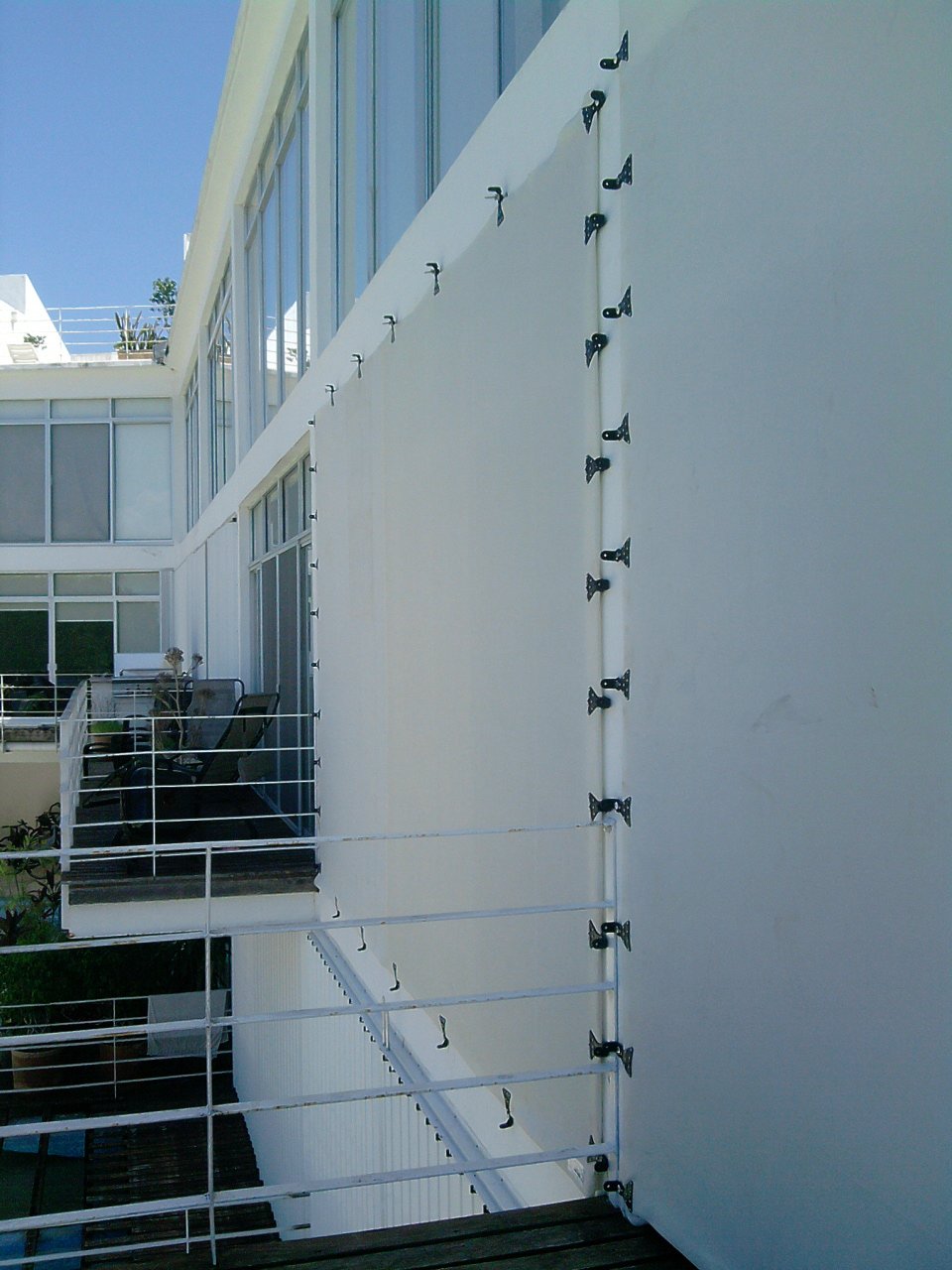
Neither system wins across the board. Certified hurricane fabric usually costs less, weighs less, and goes up faster on very large openings. Metal shutters—roll-down or accordion—stay on the building year-round, need no off-season storage, and disappear into the architecture. The right call depends on how big your openings are, whether you want a temporary or permanent system, and whether the property is a private home or a commercial operation with strict design standards, like a hotel in the Cancún Hotel Zone.
Why the choice matters in Cancún
Cancún and the Riviera Maya combine two things that sharpen this comparison: oversized openings—picture windows, sliding doors, terraces open to the Caribbean—and a hurricane season capable of sustained winds up to 295 km/h (183 mph), the figure NOAA recorded during Hurricane Wilma in 2005. At that margin, fabric versus shutters is not a styling preference. It decides whether the building envelope survives the storm intact.
Hurricane fabric: what it is and when it wins
Certified storm panel fabric is woven from high-density polypropylene engineered to stop wind-borne debris. The systems most common in the region use controlled porosity—roughly 98% solid, 2% open—so some light and visibility get through while rain and flying debris do not.
- Cost: typically the lowest price per square meter of protected opening, which matters on wide facades.
- Weight and install: far lighter than metal panels, so it needs less supporting structure and goes up faster, even on curved or irregular openings.
- Storage: it is temporary. You need somewhere to keep it and a yearly routine for putting it up and taking it down.
- Large openings: very efficient on hotel terraces, palapas, and picture windows, where a custom rigid system gets heavy and expensive fast.
Metal shutters: roll-down and accordion
These mount on the opening itself and stay there all year, operated by hand or by motor.
- Cost: a higher upfront investment than comparable fabric, but no recurring storage and reinstallation bill each season.
- Looks: retracted, they are all but invisible—the deciding factor for boutique hotels and luxury homes.
- Durability: built in heavy-gauge aluminum, they often carry warranties up to 10 years and outlast fabric by a wide margin.
- Deployment: because they are fixed in place, closing up takes almost no time. That matters for remotely managed properties with no one on site to install a temporary system before every watch.
Side-by-side comparison
| Criterion | Hurricane fabric | Metal shutters (roll-down/accordion) |
|---|---|---|
| Upfront cost | Lower per m² protected | Higher initial investment |
| Weight and installation | Light, quick to install | Heavier, structural install |
| Storage | Must be stored off-season | Permanent, no storage |
| Integrated appearance | Visible when deployed | Hides in its housing |
| Very large or irregular openings | Very efficient | Custom fabrication costs more |
| Typical service life | Several years, replaced periodically | 10+ years with warranty |
| Best for | Picture windows, terraces, hotels with wide facades | Luxury homes, remotely managed properties |
Large homes: cost, curb appeal, and storage
In a home with double-height windows, multi-meter sliders, and open terraces, unit price rarely settles the budget. What settles it is the combination of area to protect, install complexity, and how often you use the system. A house with 15 or 20 large openings usually lands on a mix: metal shutters on daily-use openings, fabric on lower-traffic areas such as palapas and outdoor terraces.
Appearance is what tips the decision fastest at the high end. A beachfront development or a design-driven boutique hotel leans toward metal shutters because, once installed, they leave the building looking the same the other eleven months of the year. Fabric means a visible deployment and a temporary change to the facade. If you are setting the standard for a house, our residential protection page covers what to protect first.
Hotels: deployment time decides
Once a property has dozens or hundreds of openings, the question becomes how many staff hours it takes to close everything before the storm arrives. Lighter fabric lets a small crew cover more area per hour. Motorized shutters close in minutes at the push of a button, but only if the investment is already in place on every single opening.
That is why many Hotel Zone properties settle on a hybrid: motorized shutters on main facades and high-traffic guest areas, certified fabric on secondary zones, storage rooms, and seasonal openings where permanent hardware cannot be justified.
Two hotels, one storm watch
Two similar beachfront properties get the same watch, 72 hours out. The first installed motorized shutters on its 180 oceanfront rooms three seasons ago. The maintenance manager triggers a full close from one central panel in under an hour, and the crew spends the rest of the window securing outdoor furniture and briefing guests.
The second deferred the investment and relies on screwing up plywood. Six people have to cover 180 openings, compete for materials with every other property nearby, and beat the clock. They rarely reach 100% before conditions deteriorate, which leaves rooms exposed during the highest-risk hours. The difference is not only the material. It is whether the system can be deployed with the crew and the hours you actually have, not the ones in the printed contingency plan.
The math does not end with one storm
The most common mistake in evaluating return is measuring it against a single hurricane. Cancún and the Riviera Maya see some significant weather event nearly every season, even when it never reaches major hurricane strength. An unprotected property racks up repeated repairs at the same weak points—the same windows, the same sliders—because the underlying problem was patched, never fixed.
An oceanfront room that takes on water, even with no structural damage, typically sits out of inventory for 3 to 10 days while the interior dries, electrical is checked, and finishes are repaired. If one storm hits 30 or 40 rooms in a 180-room property, that is 15% to 20% of operating capacity gone for the following week—exactly when replacement demand peaks. Add the less visible costs: insurance premiums tend to climb after repeat claims, and several clients report better terms once certified protection is documented, though outcomes vary by carrier. Guests who had a bad night in a storm often do not rebook, and maintenance staff spend more of the year on reactive repairs than on prevention.
How to choose
- Large or irregular openings on a tight budget: certified hurricane fabric.
- Luxury home or boutique hotel with a high design bar: integrated metal shutters.
- Remotely managed property: motorized shutters, which remove the need for anyone on site.
- Hotel or development with dozens of openings: a hybrid system, zone by zone.
On large projects, ask the supplier for a zoned deployment plan—main facade, secondary areas, storage—with an estimated close time for each, and confirm the system chosen for main facades has documented hotel work behind it. Our hurricane protection page lays out the full scope.
Frequently Asked Questions
Is hurricane fabric as safe as metal shutters?
Both can meet ASTM E1996 when properly certified. The real difference is not safety but day-to-day practicality and service life.
How long does installing metal shutters on a large home take?
It depends on the number of openings. Since the system is permanent, installation is a one-time project of several days; after that, closing up before a storm takes minutes.
Can I use fabric on a double-height window?
Yes. That is one of the cases where fabric beats a rigid system, as long as it is properly anchored and certified for the size of the opening.
What do luxury hotels in Cancún prefer?
Almost always a hybrid: integrated metal shutters on main facades for appearance, certified fabric on secondary areas for cost and flexibility.