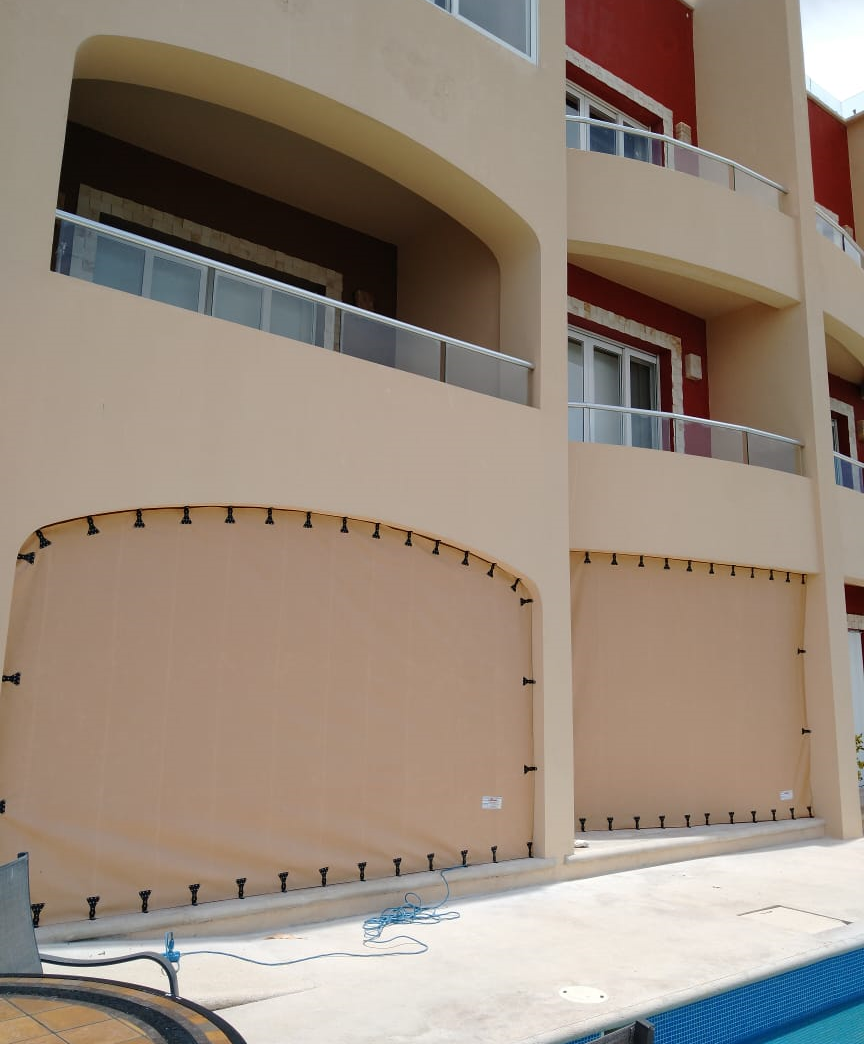
Three systems compete for the same openings in Los Cabos: hurricane fabric, accordion shutters, and roll-down shutters. None of them wins on every count. The right answer depends on opening size, the property's design standard, and whether someone has to be on site to close the system. Then there is a fourth factor that barely registers elsewhere—salt corrosion.
Why Corrosion Matters as Much as Wind Here
The corridor between Cabo San Lucas and San José del Cabo faces the open Pacific. Humidity carries salt inland year-round, and much of Palmilla, Pedregal, and Querencia sits on bluffs or elevated lots where effective wind speeds run higher than in sheltered areas.
Extreme wind arrives a few times per season. Salt works 365 days a year. A system has to survive the hurricane, but first it has to reach the hurricane in working condition. A rusted hinge, a seized track, or a weakened anchor can bring down a well-engineered system during a moderate storm—not because the design was wrong, but because the metal was already gone.
So the question for a supplier here is not only how much wind the system takes. It is what corrosion treatment the metal carries, and how long that treatment lasts on the front row of oceanfront.
Hurricane Fabric: Best Value on Large Openings
Certified hurricane fabric is woven from high-density polypropylene, which does not corrode the way metal does. It performs best on open oceanfront terraces, palapas, and oversized panoramic glass, where building a custom rigid system drives the price up fast.
- Main advantage: lowest cost per square meter (per sq ft) and real flexibility on large or irregular openings.
- Maintenance: inspect the anchors and metal hardware, not just the fabric.
- Limitation: it needs off-season storage and someone available to install it before each watch.
That maintenance point gets skipped more often than it should. Because the fabric itself is not metal, owners assume the whole system is corrosion-free. In practice, the most common failure point on poorly maintained fabric systems in Los Cabos is a corroded anchor, not torn fabric.
Accordion Shutters: Permanent at a Mid-Range Price
Accordion shutters fold sideways into fixed tracks on either side of the opening. They stay mounted all year, so there is nothing to store and they close far faster than any removable system. Several regional suppliers, Baja Storm Panel among them, sell accordion systems certified to Miami-Dade standards with corrosion treatment specified for marine environments.
- Main advantage: permanent, no storage, quick to close.
- Design trade-off: the side track stays visible even when the shutter is stacked, which may or may not suit the architecture.
- Best for: medium to large openings where owners want a permanent system without paying for motorized roll-downs.
Roll-Down Shutters: Invisible and Remotely Operated
Roll-downs coil upward into a housing mounted above the frame and all but disappear when they are not in use. That is why they dominate high-end homes in Palmilla, Pedregal, and Querencia: they leave the facade untouched for the other eleven months. They run manually or on a motor.
- Main advantage: the cleanest integration, plus motorized operation for remotely managed homes.
- Cost: a higher upfront investment than fabric or accordion, especially motorized.
- Best for: luxury residences, boutique hotel front elevations, and absentee-owned properties.
Fabric, Accordion, and Roll-Down Compared
| Criterion | Hurricane fabric | Accordion shutters | Roll-down shutters |
|---|---|---|---|
| Upfront cost | Lowest per m² | Mid-range | Highest, especially motorized |
| Corrosion resistance (maintained) | High in the fabric, medium in hardware | High with proper treatment | High with proper treatment |
| Storage | Needs off-season space | None, stays mounted | None, stays mounted |
| Visual integration | Visible once deployed | Side track stays visible | Nearly invisible when stowed |
| Deployment speed | Moderate, installed by hand | Fast | Very fast, especially motorized |
| Best for | Terraces and oversized glass | Mid to large openings, mid budget | Luxury homes, remote management |
The Hybrid Approach: Spend Where It Pays
Picture a corridor residence with a double-height living room facing the water, bedrooms opening onto private terraces through sliders, and an infinity pool framed by glass. Owners at this level rarely pick one system. They mix: motorized roll-downs in the living room and bedrooms, where appearance and remote closing matter most, and certified fabric on the pool deck and low-traffic terraces, where a permanent system costs far more without a matching visual payoff.
When budget forces a choice, installers here agree on the order: cover the large openings facing the prevailing wind and direct wave action first—usually the sliders and window walls on the oceanfront elevation—before service openings. That comes straight from internal pressurization. One unprotected large opening compromises the whole building envelope, however well the small ones are covered. See hurricane protection for how that priority is set.
What Choosing Wrong Costs in Salt Air
Metal without adequate corrosion treatment on the front row of oceanfront can show visible degradation—rusted hinges, seized tracks, weakened hardware—in a noticeably shorter span than the identical system a few kilometers (a couple of miles) inland.
Replacing a full system after premature degradation usually costs more, within a few years, than the gap between standard corrosion treatment and a marine-grade spec. Saving on the spec sheet comes back later—as replacement parts, or as a failure during the exact event the system was bought for.
Reactive or Proactive: The Human Dependency
Any system that needs a person on site to close it—fabric to mount, panels to bolt—adds a failure point that never shows up on a spec sheet. What happens if the owner is out of the country when the watch is issued, or staff cannot reach the property because of the same weather that created the risk?
Motorized systems, roll-downs above all, remove that dependency. They close remotely, on a schedule, or through a home automation controller. For homes managed from the United States, Canada, or Mexico City, that detail often outweighs appearance. See residential protection for automation options.
What to Verify in a Quote
- Corrosion treatment: what coating protects the aluminum or steel—anodizing, powder coat, or another—and what salt exposure it is rated for.
- Full envelope: every significant opening treated as one system, not piecemeal.
- Miami-Dade certification: the benchmark regional suppliers cite for impact and pressure performance, alongside ASTM E1996.
- Motorized or manual: whether the system can be triggered remotely or needs someone standing there.
How to Decide
- Primary living areas with a high design standard → roll-down, motorized if possible.
- Secondary or low-traffic areas → certified hurricane fabric.
- Mid budget, no need for a fully hidden system → accordion shutters.
- Any area on a remotely managed property → motorized over manual.
Hotels and developments apply the same logic elevation by elevation. Oceanfront and windward faces justify motorized roll-downs for closing speed; service elevations can run certified fabric at lower cost without breaking the envelope. That method is laid out under hotel solutions.
Frequently Asked Questions
Which system holds up best against salt corrosion?
Treated properly, aluminum accordion and roll-down systems both perform well. Coating quality and regular maintenance decide it, not the system type.
Is hurricane fabric enough for a luxury home in Palmilla?
On terraces and secondary areas, yes. For primary elevations, most homes at that level choose roll-downs for the clean look and remote closing.
How much more does a motorized roll-down cost than a manual one?
The motor adds a significant amount upfront. It also removes the need for anyone to be on site, which is the deciding factor for absentee owners.
Can I use one system across the whole property?
You can, but on large homes with very different openings, a hybrid setup usually delivers better value.
Which closes fastest before a storm?
Motorized roll-downs, then accordions. Fabric is slowest: it has to be mounted by hand ahead of each watch.