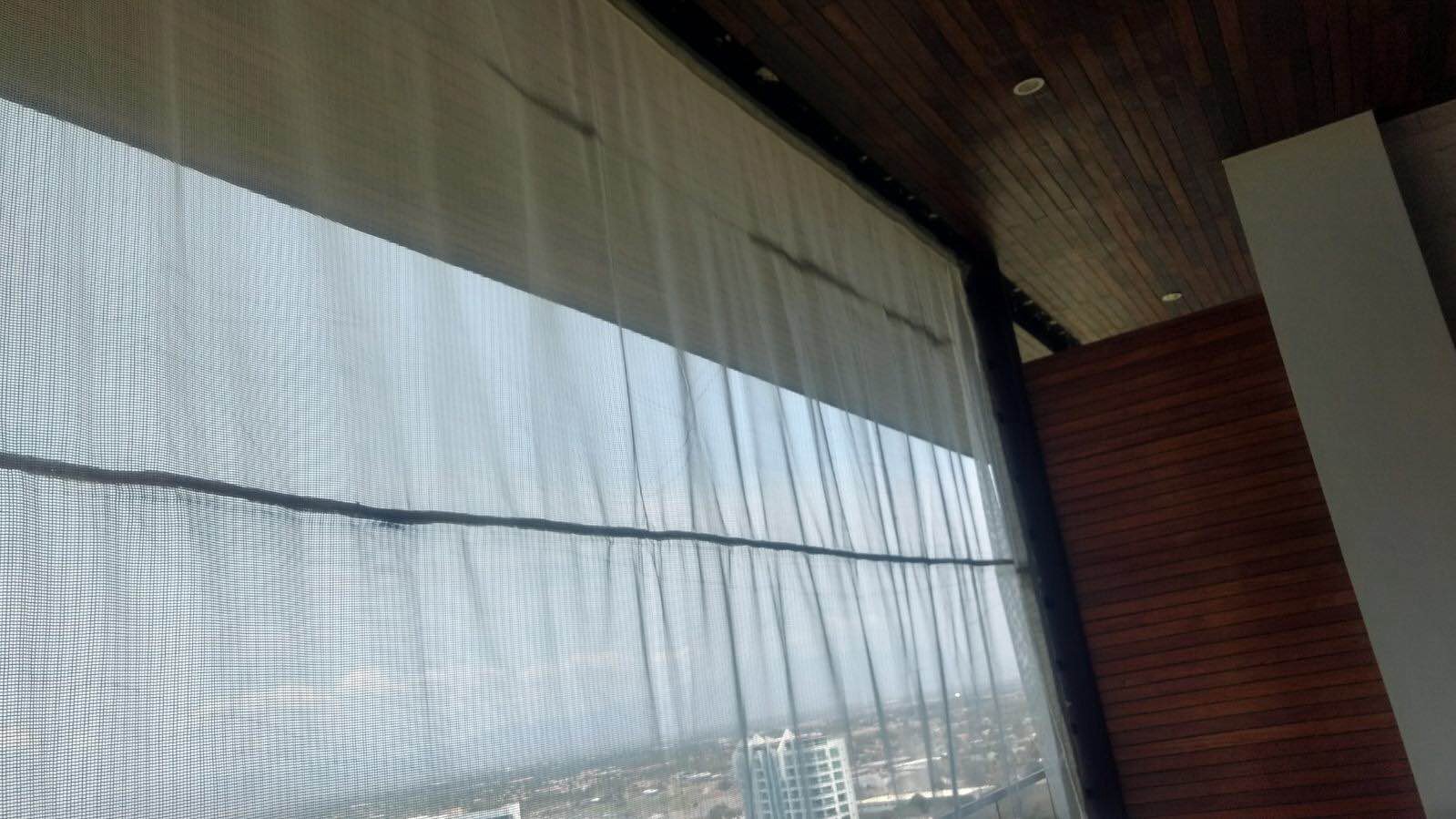
Most hurricane protection systems block 100% of the wind. For a window or a sliding door, that is exactly what you need. But when the opening is a large-format glass facade, an atrium, or a span several meters wide, that same principle becomes a physics problem. AquaGrid is the Hurricane Solution system designed for that scenario: large openings or irregular geometries where a solid surface simply stops being viable.
The problem: when solid stops being viable
Solid-fabric systems —like the HS-1500, HS-1250, or HS-875— work by blocking virtually all of the wind that reaches the opening. All of that force is transmitted, with no reduction, to the anchors and to the building's structure. On standard openings that is no problem. But at large scale, the total load can exceed the capacity of any reasonable anchor, no matter how strong the fabric itself is. The limit, then, is not the material: it is how much force can be safely transferred to an anchor point before that point, or the structure behind it, gives way.
The solution: let half the force pass through
AquaGrid starts from a different principle. Its knit fabric is engineered to be 50% open: it lets half of the wind load pass directly through the mesh instead of building up against it. This drastically reduces the force transmitted to anchors and structure, and makes it feasible to protect openings that, with a solid system, would demand entirely impractical reinforcements.
That reduction does not compromise the system's core function: the mesh still stops wind-borne debris —the main mechanism of structural damage during a hurricane— and still significantly reduces the effective wind speed passing through it. Against the intuition that "more blocking means more protection," at large scale a system that lets a calculated portion of the force pass through can be safer than one that blocks it entirely, because it turns an impossible-to-anchor load into a structurally viable one.
The numbers: documented wind reduction
Documented engineering tests show the mesh's effect on wind speed and pressure. A sustained wind of 180 mph (Category 5, with an unprotected design pressure of 70.62 psf) is reduced, once it passes through AquaGrid, to an effective speed of about 99 mph and a pressure of just 26.13 psf: roughly 63% less pressure on the protected structure.
The pattern holds across the whole scale. A 120 mph wind (Category 3, 31.39 psf unprotected) drops to an effective speed of 66 mph and 11.6 psf; a 90 mph wind (Category 1, 17.66 psf) drops to 49.5 mph and 6.53 psf. In every case, the mesh does more than stop projectiles: it transforms the wind exposure category that the structure behind it actually experiences.
The strength of the mesh
Beyond reducing load, the mesh itself is documented with a tensile strength above 7,800 pounds, the highest recorded in the hurricane protection industry. Under the reference protocol ASTM D-6637-01B —a strip tensile test originally developed for geogrids in geotechnical engineering— laboratory tests on 8-inch samples document averages between 8,166 and 8,548 pounds per linear foot, depending on the weave direction, with individual loads of up to 949.85 pound-force per sample. That it is evaluated under a geotechnical protocol, and not only under textile standards, reflects that AquaGrid behaves more like a structural reinforcement element than a conventional textile cover. AquaGrid is not a product with its own laboratory certification: it is a technology proven in the real world, whose anchoring engineering is developed in accordance with the reference criteria of ASTM International and the Florida Building Code.
Span capacity: from 3.8 to over 20 meters
The combination of open design and high strength lets AquaGrid cover openings that start around 3.8 meters between anchor points —already beyond the typical range of most solid systems— and that, in documented projects, have exceeded 20 meters of continuous span. Being able to scale from large openings to exceptionally wide spans within a single engineering system is what has no direct equivalent in the industry. The question stops being "how strong is the fabric?" and becomes "is there even a system capable of covering this opening?".
A real case: a facade with no solution on the market
A case from Hurricane Solution's hotel projects illustrates it: a Riviera Maya hotel had a 14-meter glass facade for which, in the words of its general manager, "the system did not exist" on the market. Adapting a solid fabric would have created an impractical anchor load at that scale; the solution was to design an AquaGrid application calculated specifically for that exact opening.
What projects is AquaGrid designed for?
AquaGrid is intended for architects, developers, and hotel operators facing openings outside the standard range: floor-to-ceiling glass facades, atriums, irregular structural spans, and any surface that clearly exceeds the span of a window or door. By design, it is not the choice for smaller standard openings, where the line's solid-fabric systems (HS-1500, HS-1250, and HS-875) offer the most cost-efficient solution. Because each application is calculated for the project's exact geometry, it requires a structural engineering evaluation, not a catalog quote; ideally it is brought in from the architectural design phase, while the optimal anchoring can still be coordinated.
Frequently Asked Questions
Does AquaGrid protect the same as a solid cover?
It protects with a different principle: instead of blocking all the wind, it reduces its effective speed and pressure by letting half of the load pass through the mesh, stopping debris and drastically lowering the force that reaches the structure.
What is the smallest recommended opening?
Around 3.8 meters between anchor points. For smaller openings, the solid-fabric systems (HS-1500, HS-1250, HS-875) are usually more cost-efficient.
How large an opening can AquaGrid protect?
In documented projects it has covered spans of more than 20 meters, a scale with no direct equivalent among the industry's solid-fabric systems.
How strong is the mesh?
It is documented with more than 7,800 pounds of tensile strength, with laboratory results of up to about 8,548 pounds per linear foot under the reference protocol ASTM D-6637-01B.
Does every project need its own engineering design?
Yes. Unlike a catalog system, each AquaGrid application is designed for the exact geometry and conditions of the project's opening.
Is "AquaGrid" the technical name or the commercial one?
It is Hurricane Solution's commercial name for this high-strength knit-mesh technology; technically it is a specialized knit fabric, much like how "aramid" is the generic name behind brands such as Kevlar.