The modern automotive showroom was designed to be open: glass facades, tall entrances, double heights and as few columns as possible. That design sells cars, but it creates a hurricane-protection problem that a residential system cannot solve by “adapting” something meant for small windows.
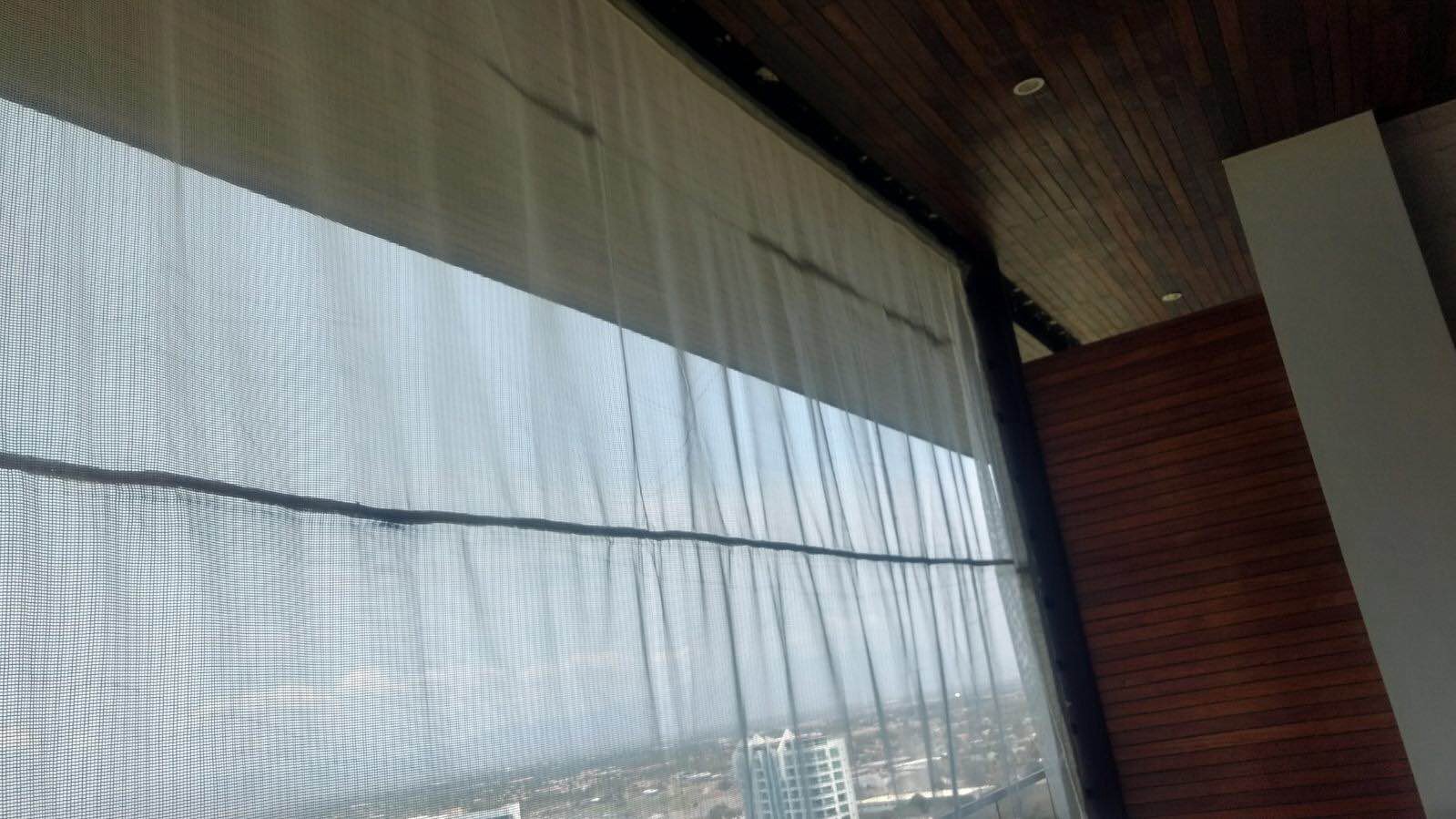
AquaGrid is Hurricane Solution’s system for large openings that exceed roughly 3.8 meters between anchor points, where a conventional solid screen is no longer viable. It is positioned for car dealerships, lobbies, hospitals and large-format facades, with documented applications over 20 meters.
What makes AquaGrid different
Its difference is not “being a stronger mesh.” It uses an approximately 50% open weave that lets part of the wind flow pass through, reducing the load transferred to the structure and anchors. Hurricane Solution publishes a tensile strength of 7,800 lb. It is a system proven in the real world; standards such as ASTM E1886 and ASTM E1996 are references for how performance is analyzed (impact and pressure on the assembly), not certifications owned by the product itself.
Why 3.8–4 meters is the turning point
Beyond that span between anchors, the project must be treated as a large opening. An increasingly large solid screen captures more pressure surface, and that force must reach the anchors; without intermediate supports, it may require reducing load or adding support. AquaGrid is recommended because past roughly 4 meters the load transfer changes, not because the showroom “needs stronger fabric.”
What 50% open means
The intuition that an open mesh “protects less” confuses water-tightness with wind engineering. AquaGrid does not aim to seal the facade: it reduces the energy reaching the opening, slows relevant debris and lowers the load on the assembly. On a small window that benefit is unnecessary; on a 15-meter facade it may be exactly what makes the project possible.
7,800 lb and more than 20 meters
Tensile strength matters, but it does not make the system “indestructible”: a complete system still depends on anchors, structure, geometry and installation. The documented capacity beyond 20 meters does not mean any gap is automatically covered; it means the solution category exists and the project can be engineered rather than dismissed or improvised.
How it compares to other options
| Solution | Strength | Main limitation | Best use |
|---|---|---|---|
| Solid screen | High protection, compact | Captures large load as the span grows | Conventional windows and doors |
| Shutter | Integrated, familiar | Tracks, weight and structure | Compatible openings |
| Metal panel | Rigid | Storage and handling | Small/medium openings |
| Impact glass | Permanent | Construction and assembly cost | New build or major retrofit |
| AquaGrid | Reduces load and covers large spans | Requires specific engineering | Showrooms and facades >3.8 m |
A solid screen is excellent on conventional openings, but it does not scale without limit: as the span grows it demands more from the fixing points. Shutters and panels can be impractical due to weight, tracks, storage and visual impact. Impact glass can be optimal in new construction, but replacing an entire facade is a major intervention. AquaGrid gives up blocking 100% of the flow to gain large-span capacity: it is only better when the problem is an opening too large for the solid solution.
Aesthetics and deployment
A dealership sells design, and a heavy permanent system affects the showroom’s image, especially for premium brands. AquaGrid is deployed when there is a threat and removed afterward; the anchors are integrated discreetly, but the mesh does not stay covering the vehicles all year. This way, safety and aesthetics stop being opposing goals.
“It can resist” and “we can put it up in time” are two different tests. Before each event, the team must know how long deployment takes, which pieces go on each opening, where they are stored and in what order they install. For large facades it helps to plan nearby components, discreet permanent anchors, specific training and rehearsing beforehand.
Cancun and Puerto Vallarta
Cancun already knows severe hurricanes (Wilma was documented by the National Hurricane Center), and new showrooms are more open and more dependent on electronics, climate control and customer experience: protecting the facade protects that interior infrastructure. In Puerto Vallarta, open architecture and Pacific exposure create the same large-span problem. A future storm’s track is unknown; the showroom’s geometry is not, and that variable can be solved today.
Manufacturing and buying for groups
Each screen is produced at the factory in the United States and shipped to Mexico, so dimensions must be defined before manufacturing: there is site survey, production, shipping, installation and training. AquaGrid is quoted per project. A group with several branches can set a corporate standard: openings under 3.8 m are evaluated with conventional systems, and larger ones are escalated to large-format engineering, with a manual and training per site. Before buying, request final dimensions, substrate, anchor spacing, support criteria, mounting method, deployment plan, warranty and which parts fall outside the scope. See also our commercial protection.
Frequently Asked Questions
Is AquaGrid only for car dealerships?
No. It is also used in hotel lobbies, hospitals, hangars and other large openings.
What is the minimum size to use it?
There is no universal minimum, but it is recommended when the opening exceeds roughly 3.8 m between anchors or the geometry makes a standard system unviable.
Can it cover more than 20 meters?
Hurricane Solution documents applications over 20 m. Each project needs individual review.
Does the open mesh let rain in?
It is designed mainly for wind and debris load, not as a fully waterproof barrier; the building’s strategy must account for water management.
Does it stay installed all year?
It is normally deployed for a storm threat and removed afterward, keeping the dealership’s normal aesthetics.