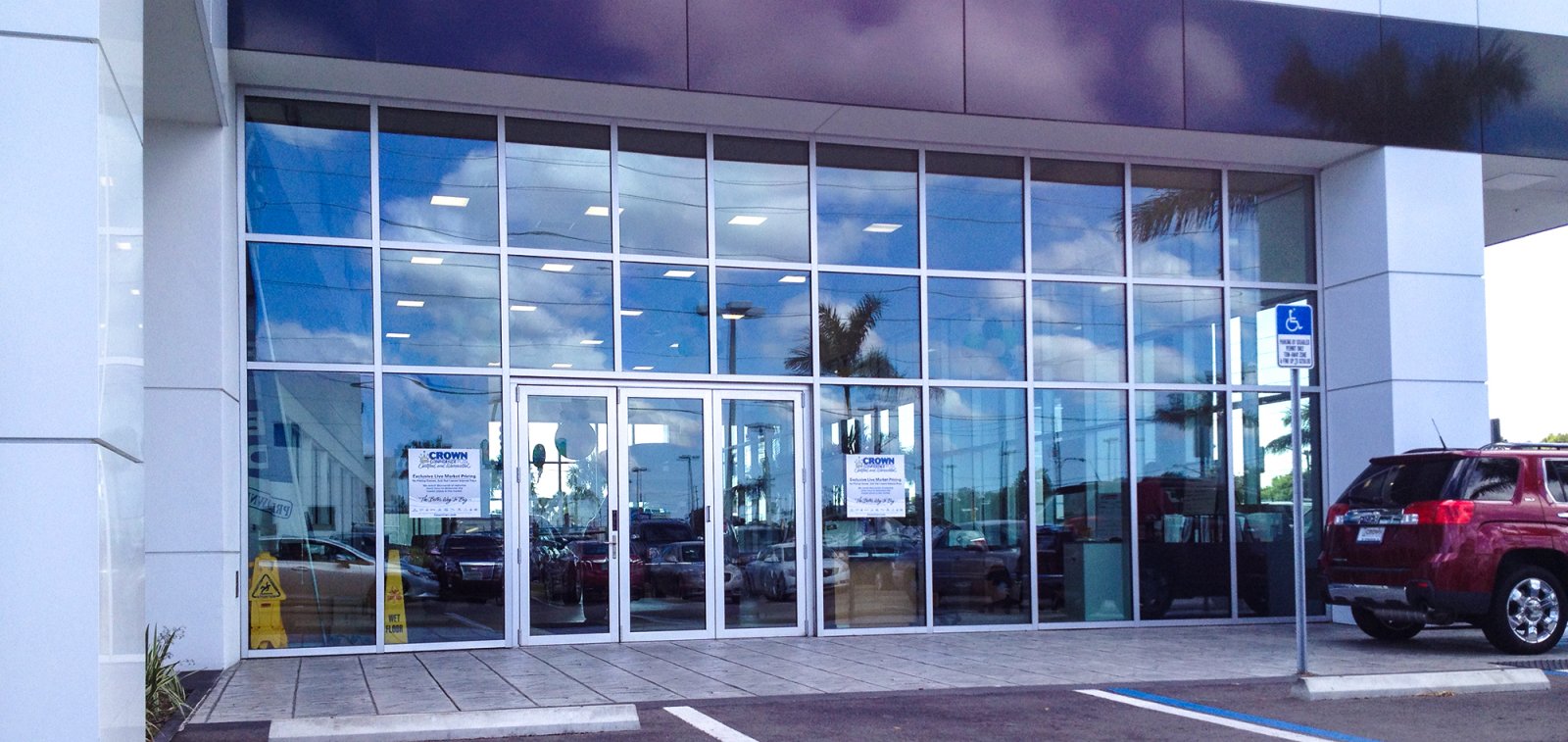
A hurricane screen can be manufactured at 10, 12, or 15 meters and still be outside its engineering limits. In the large car showrooms of Cancun and Puerto Vallarta, the decisive question is not "can you make it?" but "what anchor spacing does the system's engineering allow?".
The 4-meter rule is a decision threshold, not marketing
Hurricane Solution publishes roughly 3.8 meters as the engineering limit of its conventional systems, rounded to four meters. It is not a magic line where a screen works at 3.79 m and collapses at 3.81 m. It is a signal: above that span between structural points capable of receiving anchors, the opening must be reviewed as a special project, not purchased as if it were a conventional window.
The load does not disappear: it travels to the structure
When wind hits a surface, the force is transferred. A solid screen carries the load to its anchors, the anchors to the concrete or steel, and the building finally receives it. That is why talking only about fabric strength can be misleading when the problem is a giant span. Real strength depends on the entire load path:
- Exposed surface and wind pressure (which changes with speed, height, geometry, and location on the facade).
- Anchor spacing and expected deflection.
- Hardware, connections, and terminations.
- Capacity of the receiving structure.
The "sail effect" on large-format facades
The more surface presented to the wind, the more force the supporting system must control. A very large solid screen can fail not because of weak fabric, but because the total load exceeds what the geometry, hardware, or structure can manage. In a showroom this is critical: the same architectural decision that removes columns to gain visibility and light also removes the points where a conventional system could discharge force.
Strong fabric does not guarantee a strong system
The material matters, but so do the seams, the clips or grommets, the screws, the anchoring to the substrate, and the substrate itself. The reference standards make it clear: ASTM E1886 evaluates the performance of exterior assemblies against impact and cyclic pressure, and ASTM E1996 defines criteria for windows, curtain walls, and protective systems in hurricane zones. A complete assembly is tested, not a marketing phrase. For a buyer, this becomes a rule: ask for evidence of the full system, not just the material spec sheet. If they show you a fabric test, ask about anchors; if they show an anchor, ask about the maximum span; if they show a certificate, ask whether it matches the same geometry you intend to install.
Why an open system changes the problem
AquaGrid uses a mesh that is approximately 50% open. That openness lets part of the airflow pass through instead of turning the entire facade into a solid barrier, significantly reducing the load that must be transferred to anchors and structure. Hurricane Solution publishes 7,800 lb of tensile strength and real-world-proven applications above 20 meters between anchor points; each project requires specific review. The strategy is what matters: when the problem is too much load over too large a span, it is sometimes better to reduce the load before trying to resist it. That is why a solid system can be ideal for a conventional window, while AquaGrid begins to make sense when blocking all the wind is precisely the problem.
Typical case: the 12-meter showroom
Picture a facade 12 m wide and 6 m tall, with floor-to-ceiling glass and load-bearing structure only at the ends. One company proposes a solid 12 m screen; another first asks whether there are intermediate points capable of receiving load. In the first approach, being able to manufacture 12 m is treated as the answer. In the second, the 12 m span is treated as the problem. If there are no adequate intermediate supports, the project is no longer standard: it may require AquaGrid, a new support structure, or a designed combination.
The substrate and false confidence
The quote talks about fabric and hardware, but the receiving structure determines what can be done. Anchoring to sound concrete is not the same as anchoring to a hollow element, a cladding, or a curtain wall not designed for that load; sometimes PTR (structural steel tubular profile) is needed to create resistant points. A proposal that omits this review can look cheaper until installation uncovers the problem. And there is a double risk: a system outside its limits makes management believe the risk is already solved, so no budget is assigned and no contingency is prepared. That false confidence can be as dangerous as the physical failure.
What to do in Cancun and Puerto Vallarta
Cancun faces the Atlantic and the Caribbean; Puerto Vallarta, the Mexican Pacific. Their cyclonic histories are not identical, but a commercial facade is designed for risk, not for the average of the quiet years. If your showroom exceeds roughly four meters between anchors:
- Measure the real span between structural points, not just the glass.
- Require the supplier to document the maximum span, the tested assembly, the hardware, the substrate, and who reviews the engineering.
- For automotive groups, classify the openings by span and consequence across all locations, using a single commercial protocol: conventional systems where appropriate and AquaGrid reserved for facades that exceed the standard range.
The market can install many things. The storm is what decides which ones were actually working within their limits.
Frequently Asked Questions
Does a conventional screen always fail above four meters?
It should not be read that way. The threshold is a signal to stop automatic selection and perform a specific review. Hurricane Solution publishes 3.8 m as the conventional limit and uses AquaGrid when the span exceeds it.
Why not simply add more anchors?
If adequate structural elements exist, that can be part of the solution. But many showrooms lack intermediate supports precisely because the facade was designed open.
What is PTR?
It is a structural steel tubular profile that can be used to create or reinforce support points when the existing structure does not offer an adequate anchoring path.
Does AquaGrid work in Puerto Vallarta?
Yes, it can be evaluated for large openings in Vallarta and Bahia de Banderas. The solution adapts to the local structure, exposure, and logistics.
What is the most important question for the supplier?
"What is the maximum span between anchors that your engineering allows, and how do you prove that my facade is within that limit?"