Why an Impact Test Does Not Tell the Whole Story
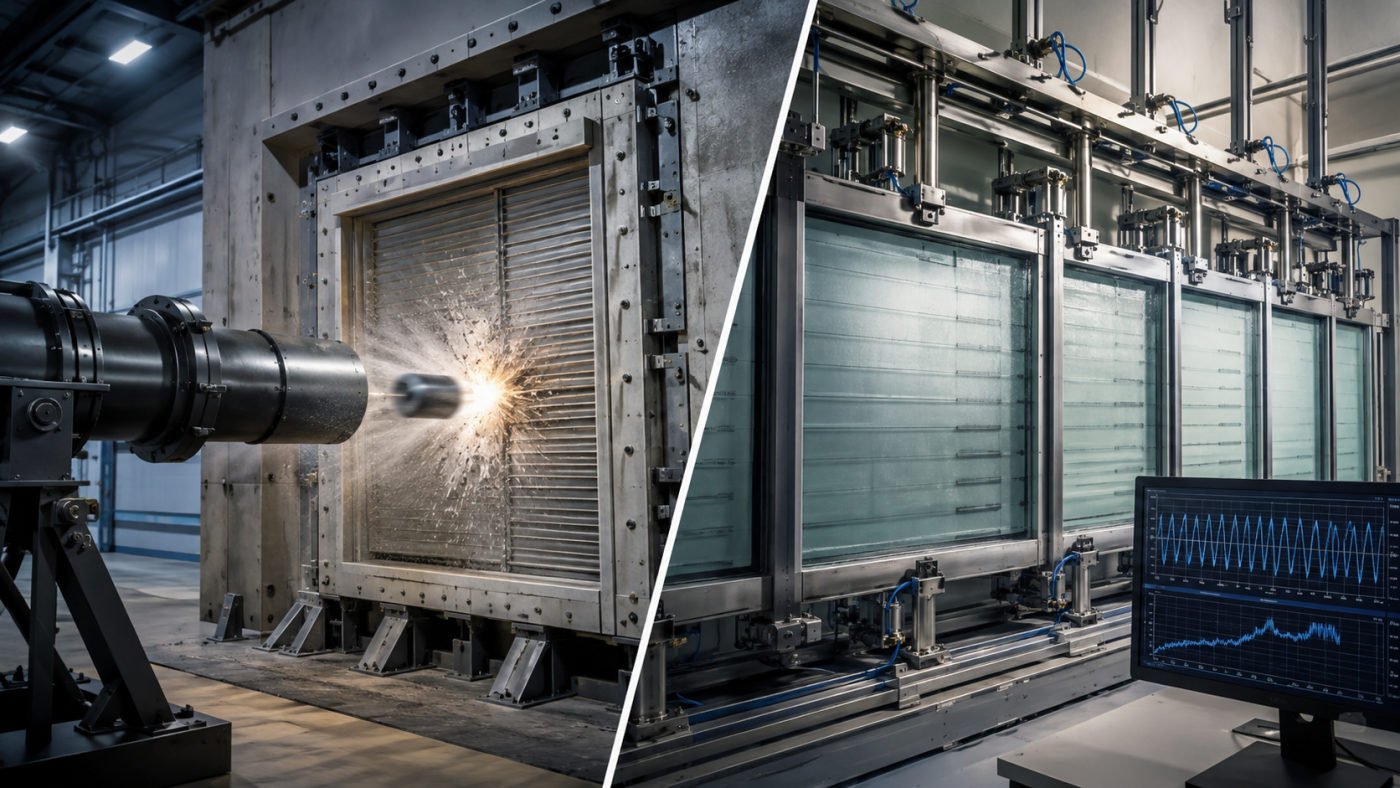
Almost every hurricane protection vendor has, at some point in the sales presentation, a video of a test cannon firing a projectile at their system. It is a visually convincing demonstration — the projectile hits, the system holds, and the implicit message is clear: "this works."
That video, however, demonstrates only one of the four things a certified system has to withstand. And mistaking that demonstration for "the system passed every test" is exactly the kind of assumption that can prove expensive when a real hurricane arrives.
Much of the commercial confusion in this industry comes from reducing a system's performance to a single impact image. This article organizes the conversation around four questions: why the tests required of a certified system are not redundant, what the cyclic load test reveals that the initial impact cannot show, why a real hurricane looks far more like hours of variable pressure than like a single blow, and what a buyer should request in order to know exactly what a system passed and what it did not.
The most common conceptual error in evaluating a protection system is thinking of a hurricane as a single impact event — something strikes, the system holds or it does not, and the story ends there. The reality of a Category 4 or 5 hurricane is far more demanding than that: it is hours of sustained wind, with variable gusts, and pressure that rises and falls constantly throughout the event.
The four tests a certified system must pass are not redundant with one another — each reveals a completely different failure mode. A system can withstand the initial blow of an impact perfectly and fail outright under cyclic loading, fatiguing after hours of sustained variable pressure.
The four tests, explained
It is worth understanding what each one evaluates, because they measure distinct technical capabilities, not versions of the same exam:
- Impact test — measures whether the system withstands a direct hit from a flying object, such as a projectile fired from a laboratory test cannon. It is the most visually dramatic test and, for that very reason, the one most used in marketing.
- Cyclic load test — measures whether the system withstands hours of sustained variable pressure, simulating the real wind of a hurricane that rises and falls in intensity throughout the event, rather than a single blow.
- Water test — measures whether the system prevents water infiltration under pressure, a damage factor as costly as wind in most hurricanes.
- Barometric pressure test — measures how the system behaves under the atmospheric pressure changes that occur as a hurricane passes, a factor rarely mentioned outside technical circles.
A system can pass the impact test without difficulty and still fail any of the other three. And a vendor can, entirely legally, show only the most favorable result — almost always the impact video — without mentioning whether the system was evaluated for, or passed, the other three.
Why cyclic fatigue is the test least often discussed
Of the four, the cyclic load test is the one that appears least in commercial materials, probably because it is the least visual — there is no dramatic moment of impact to film. It is, however, the one that most closely resembles the real behavior of a long-duration hurricane.
Over hours of sustained wind, a system does not receive a single pressure load — it receives thousands of pressure cycles that rise and fall with each gust. Materials or anchor points that hold up perfectly under a single load can fatigue and fail after enough cycles, the same way a metal paper clip bent repeatedly eventually breaks, even though each individual bend looked harmless.
In laboratory testing we have reviewed as part of evaluating competing systems, we have seen systems withstand the initial impact without trouble and then show clear signs of fatigue — anchor deformation, loosening of fastening points — after a prolonged period of cyclic pressure simulating an event lasting several hours.
What this means for a real property
The distinction between these four tests is not a laboratory technicality without practical relevance. It is the difference between a system that withstands the moment an object strikes the window and one that withstands the six, eight, or twelve hours a Category 4 or 5 hurricane can take to pass over a coastal property.
A system that fails from fatigue in hour three of an eight-hour event is no less dangerous than one that never withstood the initial impact — it simply fails later, frequently at the moment the owner has already assumed "the worst is over" and let their guard down.
Why solving two of three failure points is not reliable partial protection
A protection system has, in general terms, three points where it can fail: the fabric material, the anchor point into the structure, and the overall system design — how loads are distributed between the two. A common error is to assume that if two of those three points are well resolved, the system offers at least partial protection proportional to that fraction.
That is not how these three failure points behave. They do not average out against each other. A system with excellent fabric and a sound design, but a weak anchor point, can fail at the anchor point exactly as a system deficient in all three aspects would — because during a real hurricane the full chain is only as strong as its weakest link, not as strong as the average of its components.
What a laboratory found trying to reach the limit of a fabric
In strength testing conducted by independent laboratories on high-end hurricane fabrics, an interesting pattern has been documented: in several cases, the test machine reached its own capacity limit before the fabric showed any sign of failure. It is a result that sounds favorable — and it is, for the fabric specifically — but it also illustrates why evaluating only the material, without evaluating the complete anchoring system under the same extreme conditions, leaves an incomplete picture of how protected a property really is.
A fabric that withstands more than any real hurricane could demand is, in practice, as good as it needs to be. The anchor point, by contrast, is rarely tested with the same extreme rigor — and it is, statistically, where the majority of documented failures of hurricane protection systems occur.
Why this matters more for flexible materials than for rigid panels
The cyclic load test is particularly revealing for flexible fabric systems, precisely because their behavior under sustained pressure differs from that of a rigid panel. A well-designed fabric, with the correct elongation, can absorb part of the wind's energy by flexing slightly rather than resisting every gust completely rigidly — much as a seat belt with some elasticity protects better in a collision than a fully rigid chain would.
But that same flexibility, if it is not calculated correctly, can turn into accumulated fatigue over repeated load cycles. The difference between a fabric engineered to flex in a controlled way and one that simply stretches without control is exactly what the cyclic load test is designed to reveal — and it is information that an impact video, however dramatic, cannot show.
What to verify before trusting a system
- Does your system have documentation for all four tests separately, or only for the impact test?
- Do you know how much sustained cyclic pressure your system can withstand before showing signs of fatigue?
- Has a vendor shown you only the most favorable of the four test results, without the other three?
- Can you request the complete laboratory report, not just the promotional video of the impact moment?
Withstanding an initial blow and withstanding hours of sustained pressure are completely different technical capabilities, and a real hurricane demands both — not only the one that is easiest to demonstrate in a thirty-second video.
Closing
- The fact that a system stops a projectile in a laboratory does not, on its own, mean it can withstand the full behavior of a hurricane. A real event combines impact, hours of variable pressure, water intrusion, and barometric pressure changes, and each of those conditions demands a different capability from the system.
- That is why the buyer's responsibility does not end with watching a convincing video. It takes reviewing documentation for all four tests — impact, cyclic load, water, and barometric pressure — to know whether the system was genuinely evaluated as a whole or whether only the most eye-catching result is being shown.