The Lesson Olivia Left in Mazatlán, and Why It Still Applies
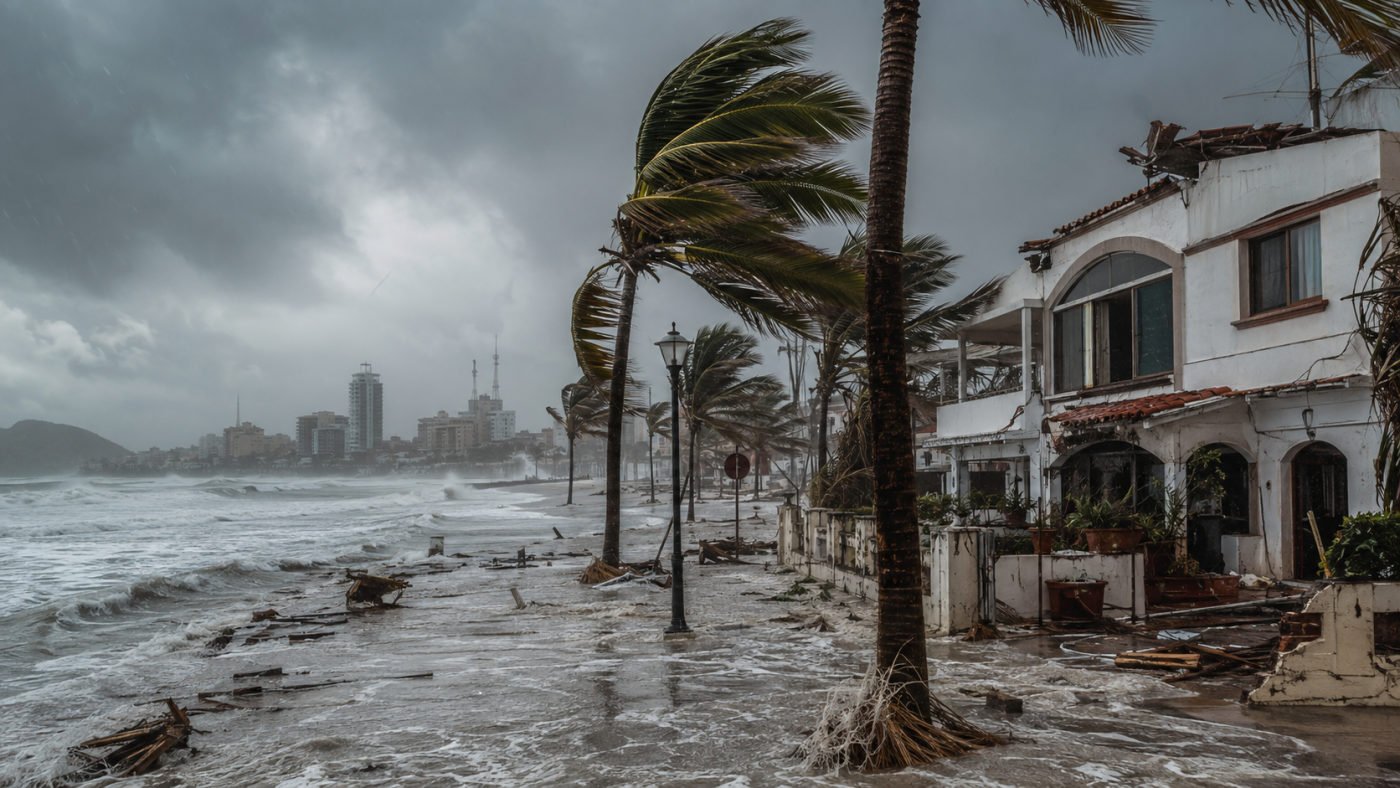
In conversations with property owners in Mazatlán, especially younger ones or those who bought in the last few years, I frequently hear a version of the same idea: "storms don't hit us as hard here as they do in the Caribbean." The city's own history says otherwise, and this is not a hypothesis — it is a documented event, with verifiable figures.
In October 1975, Hurricane Olivia struck Mazatlán as a Category 3. Nearly five decades later, it remains, according to local historical records, the most devastating hurricane documented in the city's history.
Revisiting Olivia is not a historical exercise undertaken for narrative interest; it is a way of assessing present-day risk. The case allows us to review what happened when the hurricane made landfall with no certified opening protection in place, why that absence in 1975 reflected a technological limitation rather than a negligent decision, what that precedent means for today's owners, and how to tell whether a property still depends on the same vulnerability that storm exploited almost fifty years ago.
Olivia destroyed close to 7,000 homes, left 30,000 people without housing, and is estimated to have caused 30 deaths. Economic losses, adjusted to present value, exceeded 96 million dollars. Written out today, those figures describe a major-scale catastrophe for any coastal city in the country.
It is worth being precise about what that number of destroyed homes actually means: these were not exclusively poorly built structures or improvised construction. In the vast majority of cases, this was conventional construction of the period with no certified opening protection of any kind — because internationally, that technology was only beginning to be developed in the 1970s.
Wind behavior during a Category 3 hurricane has not changed since 1975. The only thing that has changed is the availability of technology to confront it.
Why this is not a fact about the past, but a local test case
In any coastal city it is easy to treat the worst historical event as something that "already happened" and probably will not repeat at the same scale. The problem with that reasoning is that Olivia was not a hypothetical event predicted by a model — it was a real Category 3 hurricane, and Mexico's coastal cities remain, geographically, exactly as vulnerable to an event of that intensity as they were in 1975.
The difference between 1975 and today is not in the meteorological risk — it is in whether the available technology is being used. A Category 3 hurricane striking Mazatlán today, with no certified protection, has the same potential to cause physical damage to an unprotected window or door as Olivia did. The one variable that has changed in today's owner's favor is that a solution now exists which in 1975 simply did not exist anywhere in the world.
A pattern that repeats across generations of owners
Something I have observed consistently in Mazatlán is that the city's younger owners — those who bought or inherited property in the last two decades — tend to underestimate hurricane risk more than any other group. Not because they are less informed in general, but because they did not live through Olivia or any event of that magnitude directly, and the memory of that risk was not passed down with the same force it was, for example, in families who lost a home that year.
That generational gap in risk perception is, in practice, one of the most consistent factors I see behind the decision to postpone certified protection. It is not a lack of resources or of access to the technology. It is the sense, hard to justify with data but easy to understand emotionally, that "that is not going to happen to us."
September and October also remain the worst possible moment to start looking for protection in Mazatlán — not only because the peak of the season is near, but because it is precisely in those months that installer demand spikes across the entire Mexican Pacific coast, stretching lead times exactly when there is the least margin to wait.
What this also means for international hotel chains
This same historical pattern is relevant well beyond residential housing. International hotel chains operating in Mazatlán need to consider more than simply complying with the local building code — because the local code, in many cases, does not require the same level of opening protection that a market like Florida would demand, even though geographic exposure to hurricane risk is comparable.
A hotel in Mazatlán can lose a significant share of its effective occupancy after a single badly managed hurricane — not only from the immediate physical damage, but from the closure time needed to repair interiors, electrical systems, and common areas affected by internal pressurization, exactly the same mechanism that devastated thousands of homes in 1975, now applied at the scale of a modern hotel property.
Marina Mazatlán and Zona Dorada do not face the same risk equally
A common mistake in thinking about Mazatlán's risk is to treat it as a single level applicable to the whole city. In practice, areas such as Marina Mazatlán, with direct exposure to navigable canals and wind that can concentrate rather than disperse, face a different risk profile than Zona Dorada, with its own specific combination of hotel density and beachfront exposure.
This means a serious protection assessment cannot rest solely on the historical category of hurricanes that have struck the city in general — such as Olivia in 1975 — but has to consider how that same storm category behaves specifically in each area, given its development pattern, its proximity to inland bodies of water, and the type of construction that predominates there.
Why hardware degrades faster next to a canal
For properties on or near navigable canals in Mazatlán, there is an additional factor rarely discussed outside technical conversations: the hardware of any protection system installed beside a canal ages faster than the same hardware installed away from the water, because of the combination of constant humidity and prolonged exposure to dissolved salts in that area's marine environment.
This does not invalidate certified protection as a strategy — it makes it more important, not less — but it does mean that maintenance and periodic inspection of the anchoring must be more frequent at these locations than at an equivalent property away from the water. It is exactly the kind of area-specific detail a serious technical assessment should identify, instead of applying one generic recommendation to the entire city.
What a property manager should review before each rainy season
Whether or not a property has certified protection installed, there is a low-cost practice any property manager in Mazatlán can adopt immediately: use the ordinary rainy season as an early indicator of where the property will fail during a hurricane. Water infiltration during a normal seasonal rain, at a specific point in the building envelope, is almost always a warning sign of a vulnerability that a higher-intensity event will exploit far more forcefully.
Systematically checking window seals, door gaskets, and known infiltration points before peak hurricane season begins is one of the most economical ways to anticipate, months in advance, where to concentrate the protection budget available.
What to verify about your own property
- Do you know what hurricane category has directly struck your area in Mazatlán's documented record, beyond Olivia?
- Does your property currently have any level of certified protection, or does it depend, in practice, on materials similar to those available in 1975?
- Have you considered that the technology available today represents a protection gap the city can close — one that in 1975 could not prevent the disaster because it simply did not exist?
- Nearly 7,000 homes destroyed in a single event is not an abstract figure from a history book. It is documented evidence from the very city where you live or invest.
Closing
- Olivia remains an unavoidable reference for Mazatlán because it proves the city has already lived through a devastating hurricane, with thousands of homes destroyed and large-scale human and economic losses. What matters today is not repeating the figures as an archival curiosity, but understanding which part of that vulnerability was structurally unavoidable in 1975 and which part can already be mitigated with available technology.
- Wind behavior did not change; what changed is the ability to protect openings and to plan on the basis of a documented record. That is why a recent buyer and an international hotel chain share the same basic responsibility: to build the city's real history into their current risk assessment.