What the Evidence Actually Says About Plywood
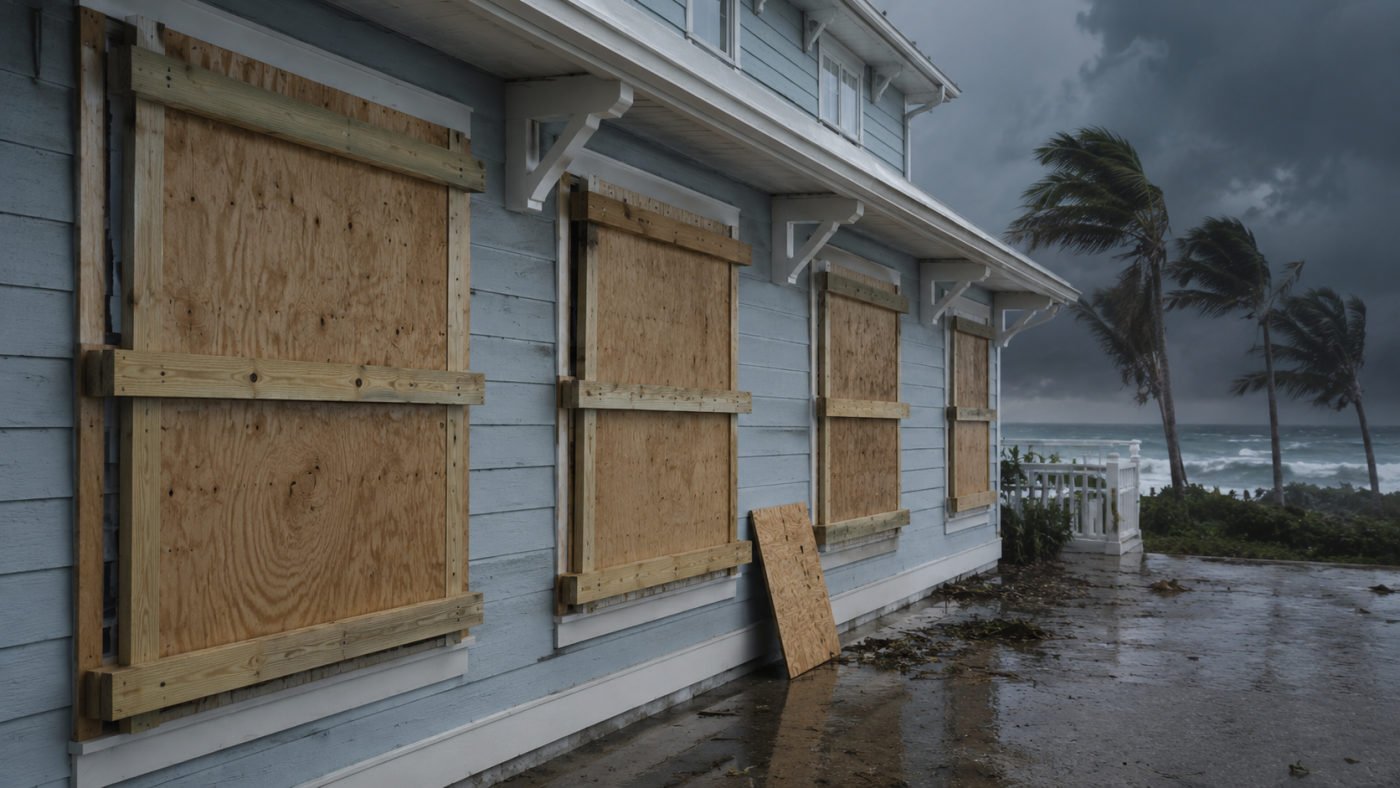
Every hurricane season, in hardware stores up and down the Mexican coast, the same scene repeats itself: owners buying plywood panels and nailing them over windows hours before a storm arrives. The practice is so widespread that many people take it for real protection, almost as a synonym for "getting ready for the hurricane."
The most rigorous engineering research ever conducted on this specific material says something different, and any property owner should know it before entrusting a building to a wood panel and a handful of screws.
The plywood discussion should rest less on habit and more on evidence. This piece therefore starts with the University of Florida research that forced a correction to the building code itself, reviews the wind speeds at which a typical installation can begin to fail, compares the apparent cost against the real cost across several seasons, and proposes the questions worth asking before trusting any protection system, plywood included.
A two-phase University of Florida research project, carried out for that state's building commission, rigorously tested how plywood panels actually behave under wind load. The finding was serious enough to force a correction to the fastening schedule specified by the building code itself.
If the official code table had to be corrected because it was not conservative enough, an improvised weekend installation — which is, in practice, what most real residential installations are — is even less likely to meet the minimum standard at all.
The specific result of the research: a 7/16-inch OSB panel spanning eight feet, fastened according to the original code specification — the one most owners were following without knowing it — can begin to fail at Category 1, barely 119 kilometers per hour, when the installation does not follow the updated fastening schedule exactly.
Why a flat panel fails sooner than it appears it should
Part of what makes this finding counterintuitive is that a wood panel, seen from the outside, looks robust — it is solid, it is stiff, it covers the window completely. What that appearance does not reveal is how the material behaves under sustained wind load, not only under a single point impact.
When wind presses on a flat panel fastened only at its edges, the panel deflects inward at its center. That deflection generates an additional force — known as catenary force — that adds to the direct wind suction. Most field installations never calculate that additional force; they simply screw the panel down following an approximate visual pattern, without verifying fastener spacing, washer size, or edge distance.
That is precisely the variable the University of Florida research identified as critical: spacing and fastener type determine whether the panel holds through Category 3 or fails at Category 1. And typical field fastening, the kind almost anyone does over a weekend with whatever is on hand, looks far more like the second case than the first.
Why plywood only looks inexpensive
The argument for plywood is almost always about up-front cost: a plywood panel costs a fraction of what a certified system costs. It is a valid argument if you stop the calculation right after the first season.
But plywood is not a one-time investment. It degrades with moisture, it warps in the sun, and in most cases it has to be partially or fully replaced every one or two seasons. On top of that, every time a storm advisory comes it has to be installed again — a labor cost that repeats each time, and that in areas where installer demand spikes just before a storm can end up costing more than the plywood itself.
A certified system, by comparison, is installed once, with permanent anchoring, and deploys in hours each season with no need to buy new material or contract emergency installation. The real cost comparison — not just the cost of the first panel — almost always favors the certified system over a three- to five-year horizon.
What a wood projectile fired in a laboratory reveals
Beyond sustained wind load, there is another revealing test: what happens when a wood projectile — the kind of debris a real hurricane sets in motion — is fired at a system from a certified test cannon. In laboratories of this type, certified systems have withstood the impact without being penetrated, while plywood panels fastened in typical fashion show significant failures under the same kind of impact.
The combination of both findings — early failure under sustained load and vulnerability to projectile impact — leaves a conclusion that is hard to qualify: plywood, installed the way the vast majority of owners install it, is not a hurricane protection material. It is protection only against the mildest wind of the season.
Why plywood is not a serious strategy in high-wind zones
In cities like Los Cabos, where direct exposure to high-intensity systems is particularly severe, the gap between what plywood can offer and what the property actually needs becomes even more evident. It is not only a question of peak resistance — it is a question of consistency. A wood panel can survive a minor storm without trouble and fail completely in the next one, depending on factors as variable as how recent the installation is, how exposed to sun and moisture the panel was between events, and how careful the fastening happened to be that particular time.
A certified system, in contrast, delivers predictable and documented behavior: the same resistance, event after event, because it was designed and tested specifically for that, not assembled differently every time a storm approaches.
The comparison almost nobody makes: plywood vs. certified system on the same street
After high-wind events in areas where both approaches coexist, the damage pattern is systematically different between neighboring properties. Those that relied on plywood frequently show detached panels, compromised windows, and water damage tied to the infiltration that occurs at the edges of a panel no longer sealed perfectly against the frame.
Properties with certified systems, exposed to the same storm, on the same street, show a consistently lower damage pattern — not because they were luckier, but because the system was designed and tested specifically for that level of demand, with laboratory documentation supporting that behavior before the storm arrives, not only afterward.
What to verify before trusting any system, plywood included
- Does your plywood installation follow the updated fastening schedule — long edges, corrected spacing, large washers — or the more common, outdated method?
- Has anyone calculated the additional catenary force a flexible panel generates as it deflects, or only the direct wind suction?
- Can your vendor, if you use a commercial system, produce laboratory certification specific to your installation?
- Are you comparing the cost of plywood only in year one, or including replacement, reinstallation, and repeated labor over three to five years?
- Category 1 is not an extreme storm — it is barely the starting point of hurricane season.
Closing
- The most rigorous research available on this material showed something uncomfortable: even the code's own fastening schedule had to be corrected because it was not conservative enough. That means a typical installation, improvised or repeated season after season, can fall well below the performance most owners assume it delivers.
- Plywood also looks inexpensive only when you look at the price of the panel in isolation. Once you add reinstallation, replacement, repeated labor, and the performance uncertainty at relatively moderate wind speeds, it clearly solves neither the resistance problem nor the accumulated cost problem over time.