How to Protect a Palapa Without Losing Its Architectural Value
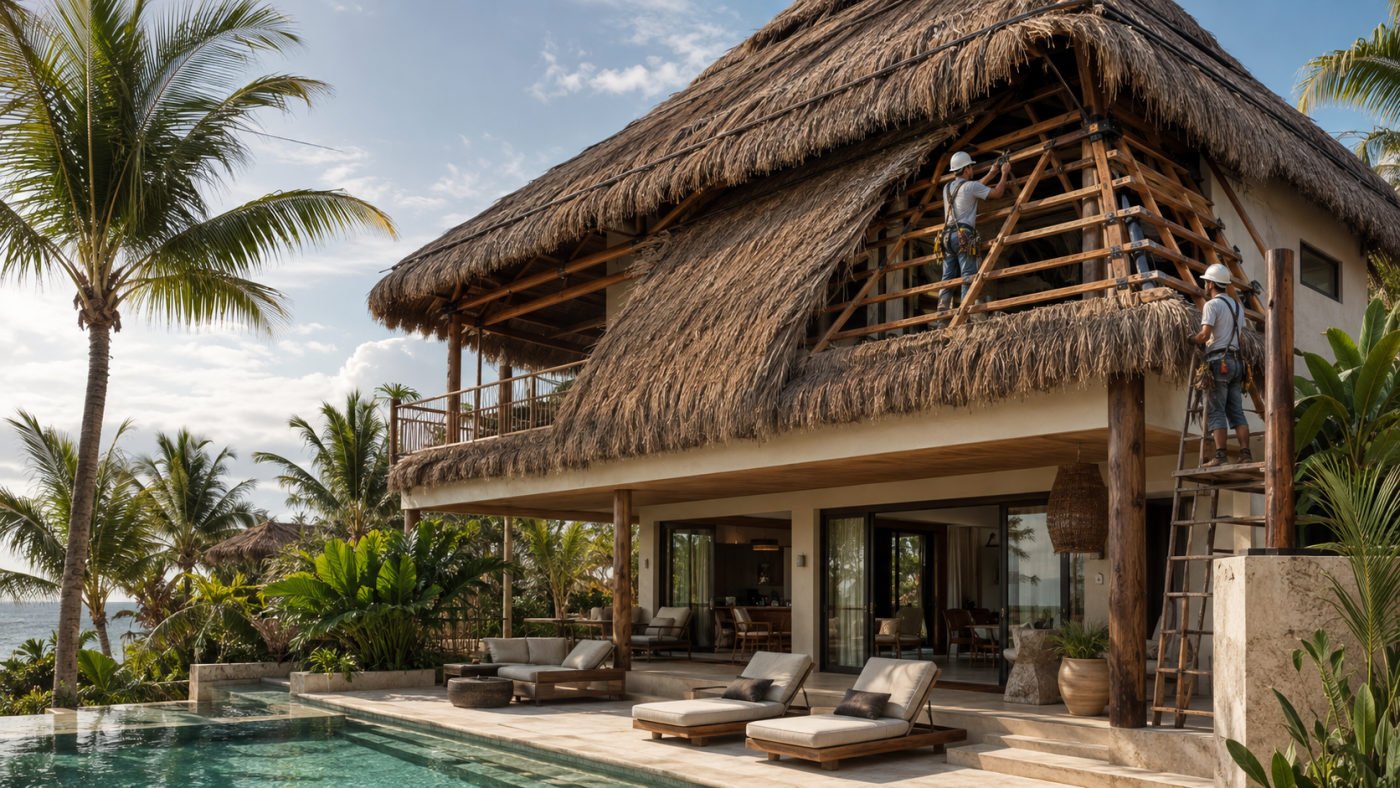
Almost every boutique hotel owner in Tulum I have worked with opens the hurricane protection conversation with the same unspoken concern: "I don't want it to look like a bunker." The concern is legitimate — the palapa, the palm-thatched roof that gives these properties their identity, is frequently the reason a guest chooses that hotel over a conventional chain.
The good news, and something this industry almost never states clearly, is that protecting a palapa does not require choosing between aesthetics and safety. It requires a strategy designed specifically for that type of structure — not the absence of a strategy, and not the replacement of the design with something generic.
The palapa discussion is usually framed as a false choice between preserving the character of the property and improving its wind resistance. This article addresses exactly that point: why a palapa behaves differently in a hurricane, what the preparation ahead of Beryl demonstrated at one Tulum hotel, how the structure can be reinforced without altering its appearance, what questions to ask before contracting the work, and how the cost of reinforcement compares with the cost of rebuilding after a loss.
Palm-thatched roofs over a timber frame, lacking the rigidity of a concrete slab, are significantly more vulnerable to wind than conventional construction. That is not a design flaw — it is a physical consequence of the material and the building technique, the same one that gives the palapa its distinctive architectural character.
Under sustained high-velocity wind, a palapa roof can lift and lose entire sections, while the timber frame supporting it can fail under sustained pressure or from direct debris impact. It is precisely the kind of vulnerability that a Category 4 or 5 hurricane exploits most easily.
Protecting a boutique palapa hotel does not require removing the palapa or replacing it with conventional materials. Reinforcement systems exist that are designed specifically for this type of construction, without altering the appearance that defines its commercial and architectural value.
What one Tulum hotel did before Beryl
One of the clearest cases of serious preparation I have seen in the area involved a boutique hotel with palapa structures that, months before Beryl approached the coast, had already completed a documented structural reinforcement of its roofs, combined with certified opening protection in the concrete-built areas.
When the storm advisory came, the hotel team did not have to choose between evacuating contents, reinforcing on an emergency basis, or closing indefinitely. The protocol already existed, the reinforcement had already been tested, and deploying additional protection on windows and doors took hours, not days.
That level of preparation was neither coincidence nor luck. It was the result of treating the palapa roof as what it is — the most exposed element on the property — instead of assuming that because it is "traditional" or "rustic," it would somehow be less vulnerable than modern construction.
How a palapa is reinforced without changing its appearance
Structural reinforcement of a palapa does not replace the material — it works with it. In general terms, it consists of strengthening the connection points between the timber frame and its base, improving the tie-down of the palm thatch so it resists wind uplift, and in some cases adding support elements that are not visible from the inside or the outside once the work is finished.
Done correctly, the result is a palapa that looks exactly as it did before the reinforcement — because making it look different was never the objective. The objective is for it to withstand forces that traditional palapa construction, on its own, was never designed to take.
On properties where palapa casitas and conventionally built rooms coexist — a common scenario in boutique hotels along this coast — the assessment and the reinforcement can be handled in the same technical visit, under a plan that covers both structure types instead of treating them as separate projects.
Why phasing protection means something different in a palapa hotel
In conventional hotels, protecting "in phases" usually means starting with the most heavily occupied rooms and working toward common areas over time. In a boutique hotel with palapa structures, that logic can be dangerously incomplete, because the palapa roof is not a secondary priority that can be deferred — it is frequently the single greatest structural risk on the entire property.
A well-designed phasing plan for this type of property begins by identifying which palapa structures carry the most risk — by size, by age, by direct proximity to the sea — and prioritizes reinforcing those structures before or at the same time as conventional window and door protection. Reversing that order, protecting first what is most visually obvious and leaving the palapa for later, is exactly the kind of decision that, in hindsight after a storm, proves the most expensive.
The cost of reinforcing compared with the cost of rebuilding
The cost objection almost always surfaces in this conversation, and the numbers are worth comparing directly. Structural reinforcement of a palapa, done preventively, carries a specific cost that is known in advance. Rebuilding an entire palapa after a hurricane destroys it — timber frame, palm thatch, and frequently interiors damaged by the loss of the roof — costs significantly more, on top of the closure time for that casita or area during reconstruction, time in which it generates no revenue.
On top of that, protection prices in areas like Tulum tend to rise as hurricane season approaches, the same way they do in other coastal cities — another practical reason to evaluate reinforcement months in advance instead of waiting until installer demand spikes.
How documented reinforcement affects property insurance
One benefit of palapa structural reinforcement that many owners do not consider at the outset is its effect on the property's insurance terms. Documented reinforcement — with technical reports, specifications for the materials used, and photographic evidence of the process — is exactly the kind of risk mitigation an insurer may require in order to maintain favorable coverage conditions, or to negotiate better terms at policy renewal.
Without that documentation, an insurer assessing the risk of a property with palapa structures has little way to distinguish between a correctly reinforced palapa and one that simply looks well maintained from the outside. The difference between the two, in terms of actual risk, is enormous — but it shows up in the insurance terms only if there is documented evidence the underwriter can review.
What to ask before contracting reinforcement
- Does your property have a structural reinforcement plan specific to palapas, or only window and door protection in the concrete-built areas?
- Does the vendor you are evaluating have documented experience reinforcing this type of roof, or only conventional construction?
- Does the reinforcement require dismantling the existing roof, or can it be done without disturbing the structure already built?
- Is there documentation of the reinforcement you can present to your insurer as risk mitigation?
- Have you confused "keeping the design exactly as it is" with "not protecting the structure"? Those are different decisions, and the second is not a requirement of the first.
Closing
- A palapa's greater vulnerability to wind is not an aesthetic flaw or a symptom of poor workmanship; it follows from the nature of the material and from the way that roof works structurally. That is precisely why reinforcement has to be treated as an engineering intervention and not as a cosmetic fix.
- The good news is that there is a way to do it without sacrificing the image that makes the property valuable. A well-designed reinforcement works with the existing structure, can be folded into a broader protection strategy for the rest of the property, and leaves behind documentation that is useful for insurers and risk mitigation processes.