How to Verify Whether a Patent in This Industry Is Real
"Patented" is probably one of the most used and least verified words in Mexico's entire hurricane protection industry. It appears in nearly every sales brochure. It almost never appears alongside a number a buyer could look up independently in a public registry.
That absence is no accident. It is frequently the most honest signal that the word is being used as a marketing adjective rather than as a verifiable fact.
In hurricane protection, the word "patented" is used very freely and checked very rarely. It is worth separating several issues, then: why the fabric on its own is rarely the hard part to patent, where a system's genuine proprietary engineering usually sits, how a patent number can be verified in minutes in a public database, and what questions any buyer should ask before signing a contract.
The high-strength fabric used in hurricane protection systems — whether high-density polypropylene or ballistic nylon — is, in itself, relatively easy to obtain. Any company with enough capital can buy certified geotextile from a manufacturer and sew it into panels of the required size. That requires no proprietary engineering and no meaningful patent protection.
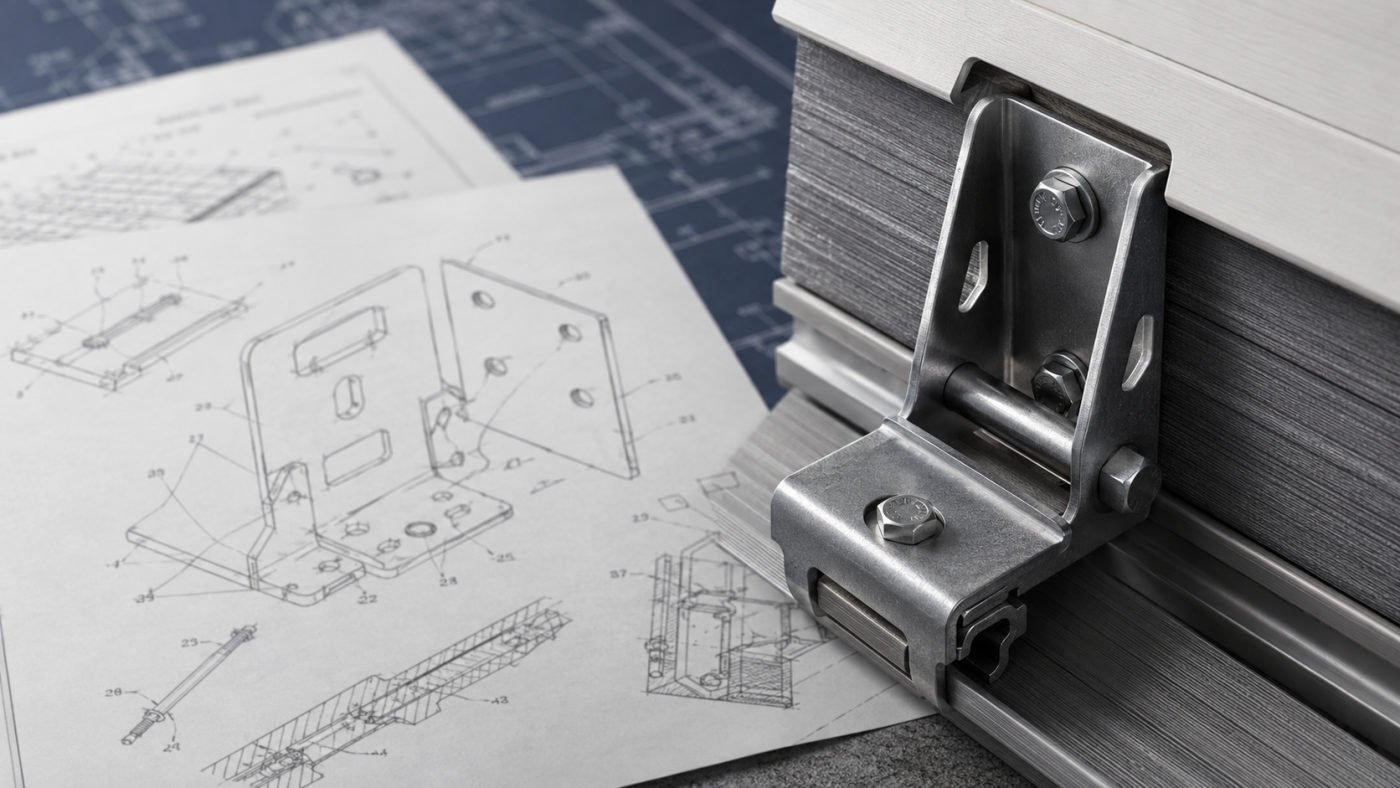
What actually determines whether a system survives a Category 4 hurricane or fails in the first minutes of sustained wind is not the fabric — it is the exact point where that fabric connects to the building structure. And that connection point is far harder to patent than simply selling strong fabric.
The anchoring is where the real engineering happens: how load is distributed across multiple points, how the system behaves under asymmetric pressure, how a single point of failure is prevented from compromising the entire system. Designing and patenting a genuinely distinct solution at that point takes years of development and investment in testing — which is why very few companies in this industry have anything real to patent beyond the fabric.
What the word "patented" says, and what it does not
In an industry where almost any vendor can print the word "patented" in a brochure with no immediate consequence, very few can back it with a specific patent number the buyer can verify in a public registry. That difference — between a word and a verifiable document — is exactly what separates a marketing claim from a fact.
It is also worth distinguishing between "patent pending" and "patent granted." The first means an application was filed — a relatively simple and inexpensive step that guarantees nothing about the patent being granted and legally protects nothing yet. The second means a patent office reviewed the application, compared it against existing prior art, and determined that there is indeed something new and non-obvious to protect. They are entirely different states, and a sales brochure rarely clarifies which of the two applies to the product you are buying.
How to verify a patent number yourself
The process does not require being a lawyer or paying for a specialized search. Anyone can take the patent number a vendor provides and look it up directly in the corresponding public registry — whether the Mexican Institute of Industrial Property for national patents, or the United States patent office if the vendor claims international protection.
That search reveals, in minutes, information no sales brochure will volunteer: whether the patent was actually granted or is still pending, what exactly it protects — the complete anchoring system, or only a generic reference to the fabric — and whether the patent holder is the same company quoting you the system.
That last check matters more than it seems. I have seen cases where the patent number a vendor cites in fact belongs to the original manufacturer of the fabric — not to the company selling and installing the complete system. It is a way of using a real but borrowed patent to suggest proprietary protection that does not actually exist in the product being purchased.
Why asking for a patent number tells you as much about the vendor as about the product
Asking for a specific patent number is not only a way to verify the product — it is almost always an effective way to evaluate the vendor. A company with a real patent, obtained after years of development and investment, normally answers that question with the number at hand, without hesitation, because it is information that directly supports its value proposition.
A company using the word "patented" with nothing specific to show, by contrast, tends to answer vaguely — "we have proprietary technology," "our process is unique" — without ever getting to the concrete number. That difference in response, more than any other signal in a sales meeting, usually reveals how serious the company behind the proposal is.
A patented anchoring design does not stop at one region
A question that comes up frequently is whether an anchoring design patented for the Mexican Caribbean applies equally on other coasts of the country, given that wind conditions, humidity, and construction types vary between the Caribbean and the Pacific. The technical answer is that the engineering principle behind a well-designed anchor — load distribution, fatigue resistance, behavior under asymmetric pressure — applies to any coastline exposed to hurricanes, even though the specific installation may be adjusted to each region's substrate, from hollow block to solid concrete.
This is relevant for owners with properties on more than one Mexican coast: the right question is not whether a different patent exists for each region, but whether the vendor has the field experience needed to adapt that same patented design correctly to the specific conditions of each location.
A patent is more than a legal matter — it changes how the system behaves
It is easy to think of a patent as a purely legal issue, relevant only if there is a commercial dispute between companies. In practice, a well-designed anchoring patent reflects years of technical iteration that translate directly into how the system behaves during a real storm — not just into who has the right to manufacture it.
A patented anchoring design, developed after multiple rounds of testing and adjustment, typically solves specific problems that a generic design does not: how to distribute load across multiple points without concentrating stress on one, how to maintain correct fabric tension without overloading the fastening point, how to allow a degree of controlled movement without compromising the overall strength of the system. That technical difference is, in practice, what separates a system that holds through Category 5 from one that fails at Category 3 despite using fabric of similar quality.
What to ask before signing any contract
- Can your vendor give you a specific patent number, or does it only use the word "patented" with no documentary backing?
- Does the patent protect the complete anchoring system, or does it only make generic reference to the fabric?
- Can you look that number up yourself in a public database before signing any contract?
- Is the patent holder the same company quoting you, or a third party whose patent is simply being cited?
- Is it "patent pending" or "patent granted"? Those are completely different legal states.
Photos of fabric rippling in the wind on social media and generic testimonials are not the same thing as a verifiable legal record. One is marketing content. The other is a public document anyone can confirm independently.
Closing
- In this industry, the genuinely difficult part to protect is usually not the fabric, but the anchoring system and the way that strength is transferred into the building structure. That is where proprietary engineering carries the most value and where a real, specific, verifiable patent can make a tangible difference.
- That is why accepting the word "patented" in a brochure is not enough. You have to ask for a concrete number, distinguish between patent pending and patent granted, and verify it in a public registry. If a vendor cannot produce that basic piece of information, the absence says considerably more than any commercial promise.