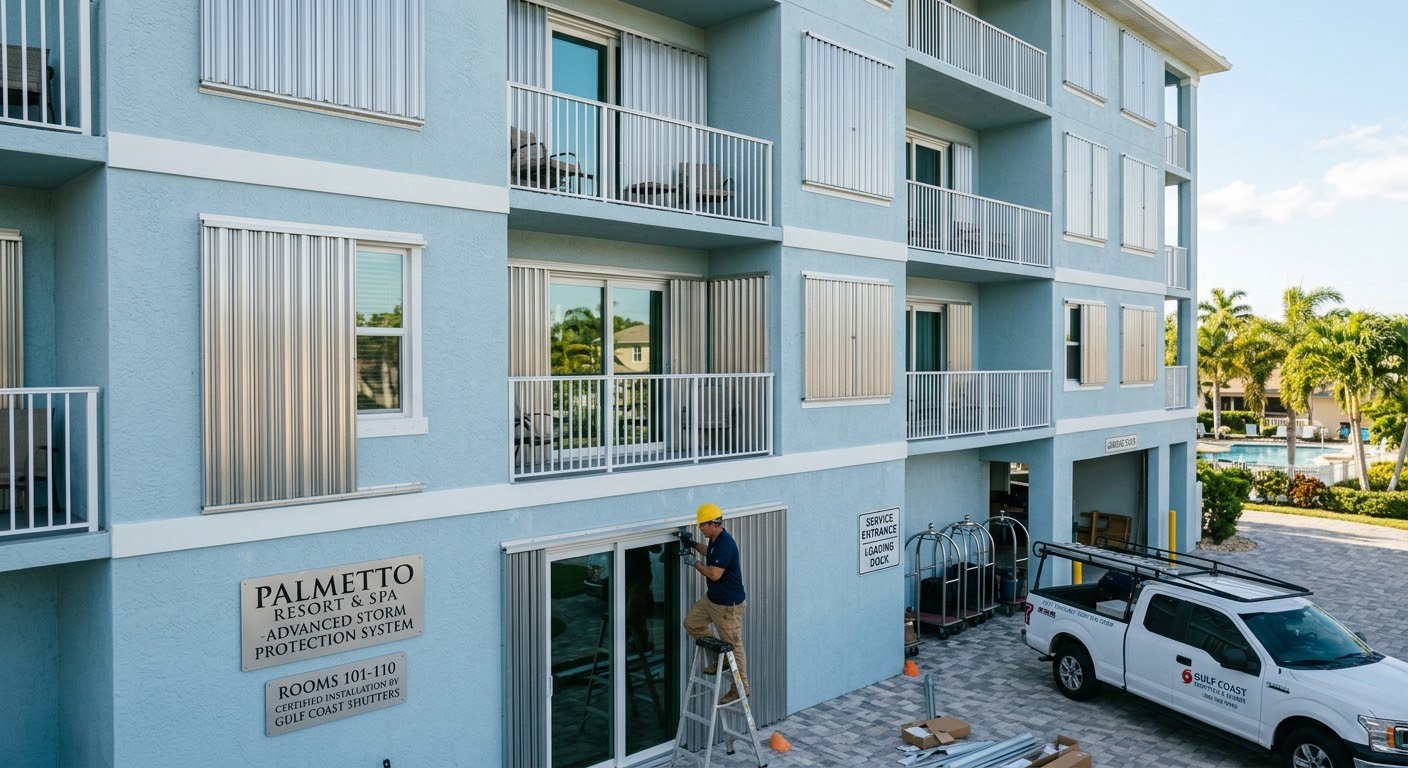
Most hotels that suffer severe hurricane damage didn't fail because the whole property was unprotected. They failed because one opening — often the least visible one, the one nobody argued about in a budget meeting — never got identified or protected in time. That's the core idea behind Before the Storm Finds the Weak Point, the book Fernando Loría, CEO of Hurricane Solution, is currently writing about hurricane protection for the hotel industry in Mexico. This article shares a direct excerpt from Chapter 2.
About the book: a manuscript still in development, not yet published
Before the Storm Finds the Weak Point is, for now, an unpublished draft: roughly 55,000 words across fourteen chapters, with no confirmed publication date. It runs from the physical fundamentals of how hurricanes form to the practical side of procurement, installation, and operational readiness specific to hotels. The excerpt below comes from Chapter 2, titled "The Storm Finds the Weak Point" — the same concept that gives the whole book its title. The passages that follow are direct quotes from the manuscript, shared with the author's permission and translated here for an English-speaking readership.
Why buildings rarely fail everywhere at once
The excerpt opens with the observation that carries the whole argument:
"One of the most important ideas in hurricane protection is also one of the easiest to overlook: buildings rarely fail everywhere at once. From the outside, after a severe storm, the damage can look widespread and chaotic… But once you start studying how the damage began, the story is usually more specific. A major failure often starts with a minor one."
"A hurricane doesn't need every part of a hotel to be weak. It only needs one opening, one poorly protected area, one weak fastening, one unprotected service door, one vulnerable sliding system, or one installation detail that doesn't hold under pressure. Once that first point gives way, the condition of the building can change fast."
Visible isn't always what matters
One of the book's central arguments is that the areas that get the most attention during protection planning — the ocean-facing façade, the lobby, the biggest windows — aren't necessarily the ones that carry the most risk if they fail:
"A large lobby window can come up in every meeting because everyone sees it and understands its value, while a smaller door near a service corridor may get little attention because it doesn't seem important to the guest experience. But if that service door protects an area connected to electrical equipment, laundry, kitchen access, maintenance storage, or interior corridors, its failure can affect the hotel far beyond the size of the door itself."
It's the same distinction we apply in our own technical evaluations at hotel properties: prioritize openings by what's behind them and what happens if they fail, not by size or visibility.
What the maintenance team knows that nobody else thinks to ask
A recurring theme in the excerpt is the value of hands-on knowledge from maintenance staff, often underweighted in protection planning:
"Maintenance managers tend to understand a building differently than ownership or purchasing does. They know where the property has been repaired. They know which doors don't close perfectly. They know where water tends to collect… In many cases, the maintenance team can spot weak points that aren't obvious from blueprints or proposals."
"Almost protected" isn't the same as protected
Perhaps the argument most directly applicable to any property owner — hotel or residential — is the book's distinction between real protection and assumed protection:
"The phrase 'almost protected' can be misleading, because a hurricane doesn't grade a building by percentage. A property can protect eighty or ninety percent of its visible openings, and the remaining ten or twenty percent can still hold the opening that lets in the first serious failure."
It's essentially the same internal-pressurization principle behind why Level E certification tests the complete system under pressure differential rather than just the impact resistance of one isolated component — and why we talk about full envelope protection, not partial coverage. The book reaches that conclusion from hands-on hotel operating experience; the engineering reaches the same conclusion from the lab.
Three dimensions for deciding what to protect first
The book proposes evaluating every opening across three dimensions, not just one. Most informal hurricane-protection assessments only consider exposure: how directly an opening faces wind or rain. That's not enough, because an opening with low exposure but high consequence — a small window in an electrical room, for instance, barely exposed to direct wind but critical to the hotel's recovery — can carry more real risk than a large, exposed opening with low operational impact if it fails:
- Exposure: how likely the opening is to take direct wind, rain, or debris
- Vulnerability: how likely that specific opening is to fail if exposed
- Consequence: what happens to the property if that opening fails
Comparing proposals: why two similar prices can mean very different risk
The book spends real space warning readers how to compare quotes — a level of honesty rarely found in industry marketing material:
"One proposal might include every opening, tested materials, specified anchoring, installation supervision, and deployment training. Another might cover only the most visible areas, use vaguer language, exclude difficult openings, or leave anchoring details unclear. If the comparison comes down to price or square footage alone, the hotel may not understand what risk it's accepting."
Two proposals can look comparable on price while representing radically different levels of protection. That's why it's worth always asking for a verifiable certification number before hiring any installer — something you can confirm by checking the testing and certification documentation behind the proposed system, not just the price per square meter.
Written for the Mexican hotel market, not translated from another one
The excerpt is explicit about why this way of thinking matters specifically for hotels in Mexico: "the region has valuable coastal assets, international guests, high-value buildings, and operational demands that can make post-storm recovery expensive." The book isn't a generic translation of material built for another market — it's written around the specific conditions of the hotel industry in places like the Riviera Maya, Cancún, and Playa del Carmen.
How to apply this to your own property
The book suggests starting with concrete questions, not visual impressions:
- Does your property have a clear inventory of which openings are protected and which aren't?
- Was the decision on what to protect first based on visibility, or on the consequence if that opening fails?
- Has maintenance staff been asked directly about known weak points on the property?
From there, evaluate every opening across the three dimensions above, document explicitly what's covered and what's still exposed if protection is being phased in, and revisit the plan every year as the property changes. For hotels, developments, or large projects, the book recommends involving both maintenance and purchasing in evaluating proposals: one brings hands-on knowledge of the property, the other the ability to compare proposals technically. A technical evaluation that builds that full inventory is the most reliable starting point.
Frequently Asked Questions
When will Fernando Loría's full book be published?
The book is currently still in development, with no confirmed publication date. This article shares an excerpt from the manuscript with the author's permission.
Is the book only for hotels, or does it apply to residential properties too?
It's written specifically for the hotel industry in Mexico, with sections for general management, maintenance, and purchasing. That said, its central principle — that risk concentrates at the weakest point rather than spreading evenly — applies just as much to residential and commercial properties.
What does "weak point," the term in the book's title, actually mean?
It's the opening or structural point with the greatest consequence if it fails during a hurricane — not necessarily the largest, most visible, or most expensive one, but the one that, if it fails, causes the most extensive damage or the most severe operational consequences.
Does the three-dimension framework replace technical certification?
No. They're complementary: the exposure-vulnerability-consequence framework helps decide which openings to prioritize and in what order, while technical certification confirms that the installed system at each opening actually performs as expected under real hurricane conditions.
Why does Hurricane Solution share content from a book that isn't published yet?
Because the book's central argument — evaluating openings by consequence, not just visibility — reflects the same technical evaluation approach we apply on our own installations, and helps explain why that approach matters.