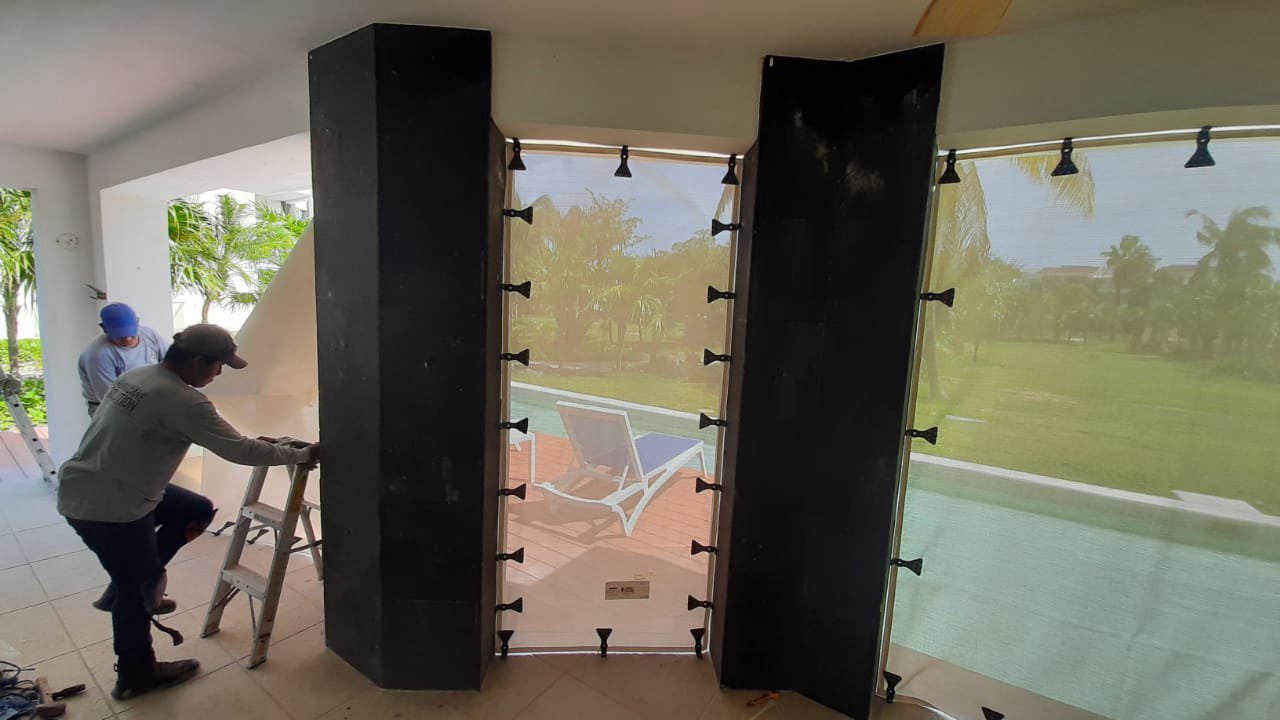
Installation is the part of the business the hotel actually sees
A hotel can read a spec sheet, review certifications, and compare quotes for weeks. But there is only one moment when management, maintenance staff, and often guests directly watch how a provider works: installation day. That's when the whole promise of "hurricane protection" turns into people climbing facades, drills, scaffolding, and decisions made in real time in front of the building.
In Cancun, where hotel occupancy and hurricane season coexist year-round, that installation can't be treated like any other construction job. An operating hotel has guests sleeping, restaurants running, pools in use, and a brand image to protect in every hallway. Professional installation is planned around the hotel's schedule —not the other way around— scheduling work by zone, during lower guest-traffic hours, and coordinating directly with the general manager before touching any facade.
Engineering before tools
Before anyone climbs a ladder, a serious provider has already done the invisible work: exact measurement of every opening, wind-load calculations specific to that facade, and custom fabrication for each opening. No two hotels are identical, so no two installations are identical, even when the base system is the same.
At Hurricane Solution, each panel is custom-fabricated for the project, with in-house engineering reviewed by an engineering team in the United States as a second verification layer. This double review isn't a luxury: it's what separates a calculated installation from an approximate one. An undersized system can look identical to a properly sized one right up until the exact moment it's needed —and that's not the moment to discover an error.
The installation itself follows defined technical parameters, not the improvised judgment of whoever is on site that day:
These numbers aren't decorative. They come from years of failure testing in the hurricane-protection industry, where early fabric systems failed precisely at anchor points. A system with well-distributed, flexible anchoring behaves completely differently under sustained wind and flying debris than one installed "by eye."
When the building doesn't cooperate: the real test of professionalism
Any provider can install protection on a standard four-story facade with rectangular openings. The real test comes when the building presents unusual conditions —and in Riviera Maya and Mexican Caribbean hospitality, that happens more often than it seems.
A real example: a hotel with nine-story towers needed to protect thousands of openings within a single day before a storm's arrival. Physically moving thousands of panels floor by floor in 24 hours would have required an army of workers no hotel has on hand. The professional solution was to treat it as a planning problem: build permanent storage compartments on every balcony, with the panel already anchored and rolled up at the top well before any storm alert existed. When the warning came, each room was protected in 3 to 5 minutes, simply unrolling and securing the bottom. The heavy work had already been done weeks earlier, in calm conditions.
Another frequent case in luxury beachfront properties: glass facades that far exceed the normal engineering limits of any system available on the market, with anchor points spaced 14 meters or more apart. A provider without in-house engineering capability simply says "it can't be done." A professional provider develops, calculates, and tests a new solution —in documented cases, systems engineered for openings up to 22 meters tall.
Most buyers compare hurricane-protection providers by product (the fabric, the system). But in real hotel buildings —irregular balconies, curved facades, unusual heights— the variable that actually determines whether a project can be executed is the provider's in-house engineering capacity to solve what the standard catalog doesn't cover. A hotel should ask less "what system do you sell?" and more "what do you do when my building doesn't fit your standard system?"
Working around guests, not despite them
A hotel can't shut down operations to install hurricane protection, and it shouldn't have to. A professional team understands its work happens inside someone else's space: the guest who paid for an ocean-view room, the wedding scheduled for that afternoon, the restaurant that needs its terrace clear at lunchtime.
The system itself is designed with the hotel's aesthetics in mind, not just its strength: it weighs barely 1 kilogram per 3 square meters. When not deployed, the steel anchor stays installed almost imperceptibly, without ruining the building's facade. A five-star hotel can't afford to have its hurricane protection look like an improvised emergency fix during the other 350 days a year without a storm.
Training: installation doesn't end when the crew leaves
A professional installation doesn't end the day the scaffolding comes down. It ends when the hotel's own staff can operate the system on their own, without depending on an emergency call every time a storm approaches.
That's why the installation process includes direct training for the hotel's maintenance staff on how to deploy, anchor, and store the system correctly. This training comes with a written manual customized for that specific property, so that even if maintenance staff changes in the future —common in hotel staff turnover— the knowledge doesn't leave with the person who does. The manual stays, and the hotel stays protected, regardless of who's working there five years from now.
This training is backed by a written 10-year warranty. It's not a verbal promise from the salesperson at the time of sale: it's a document the hotel can file alongside its insurance policies and use as backup with its own insurer.
What a poorly executed installation actually costs
It's easy to talk about "professionalism" as an abstract value. For a hotel, it's worth translating into numbers. When an installation fails —due to poor engineering, poor coordination with hotel operations, or lack of staff training— the cost isn't just fixing the system. It's the cost of closing rooms or common areas while the problem is corrected, at a moment when, by definition, a storm is approaching and occupancy tends to be more sensitive than on a normal day.
A beach hotel can lose, by estimate, between 15% and 30% of its revenue per available room (RevPAR) in the days before and after a poorly managed storm —due to cancellations, partial closure of areas, or damage requiring room evacuations. That's not a one-time cost. It repeats every season the protection system doesn't perform as it should, and accumulated over several years, it usually far exceeds the price difference between a provider that installs with technical rigor and one that installs "however it takes" to close the sale quickly.
Operational terminology: speaking the hotel's language, not just engineering's
A provider who truly understands hotel operations doesn't speak only in terms of wind resistance or differential pressure. They also understand how those technical concepts translate into the hotel's financial reality: revenue per square meter, operational efficiency, effective occupancy, and RevPAR are the metrics a general manager or operations director actually uses to evaluate the impact of any decision, including hurricane protection.
A professional installation protects these metrics in two simultaneous ways: preventing physical damage that would force room closures (affecting effective occupancy and revenue per square meter), and preventing the installation process itself —if poorly coordinated— from reducing the hotel's operational efficiency while the work is underway. Most hurricane-protection providers speak engineering's language (strength, pressure, certifications). Very few speak the hotel's financial language. A provider who can connect both demonstrates a level of professionalism that goes beyond technical installation.
If you could only demand one thing, make it this
Of all the criteria for evaluating an installation, if a hotel could only verify one thing before signing, it should be this: that the provider has verifiable in-house engineering capability, not just a product catalog. A certified system installed without engineering judgment for the building's specific conditions is, in practice, just as vulnerable as having no protection at all —it simply takes a bit longer to prove it. In-house engineering, with double review, is what separates an installation that holds from one that only looks strong until the first real storm.
The connection to hurricane protection overall
All of this —engineering, operational coordination, training— exists within a larger goal: keeping hurricane protection functioning as an integrated system, not a temporary patch. Professional installation is, at its core, the physical execution of the same philosophy required by a certified hurricane-panel system: every link —design, fabrication, installation, training— must support the next.
A hotel that invests in high-end protection systems but receives a careless installation ends up with the worst possible combination: the cost of a premium system with the performance of a generic one.
Cancun already experienced, in 2005, what happens when hotel infrastructure isn't prepared: Hurricane Wilma sat over the area for more than 24 continuous hours, causing some of the most severe documented hotel damage on the Mexican Caribbean coast, according to records from NOAA's National Hurricane Center. That recent history is a big part of why hotels in the area today demand not just certified hurricane panels, but providers capable of installing them with the same rigor with which they were designed. This discipline applies to hotel properties as much as to commercial developments in the region.
Frequently Asked Questions
Can hurricane protection be installed in a hotel while guests are staying there?
Yes. Professional installation is planned by zone and scheduled in coordination with the general manager, precisely to minimize any disruption to the guest experience.
What if my hotel has an unusual facade design?
A provider with in-house engineering capability can design a custom solution, even for conditions that exceed the limits of standard market systems, such as tall glass facades.
Does hotel maintenance staff need special training?
Yes, and it should be part of the service, not an added cost. It should include a hands-on class and a written manual specific to that property, so the knowledge doesn't depend on a single person.
How long does it take to deploy the system before a storm?
It depends on the installation design, but in well-planned configurations (like pre-anchored balcony systems), deployment can take just 3 to 5 minutes per room.
Does the installation affect the hotel's appearance the rest of the year?
It shouldn't. A well-designed system stays practically invisible when not deployed, without compromising the facade's aesthetics.
What warranty should I demand on the installation, not just the material?
A written warranty of at least 10 years that explicitly covers the installation, not just the material's lab-tested performance.