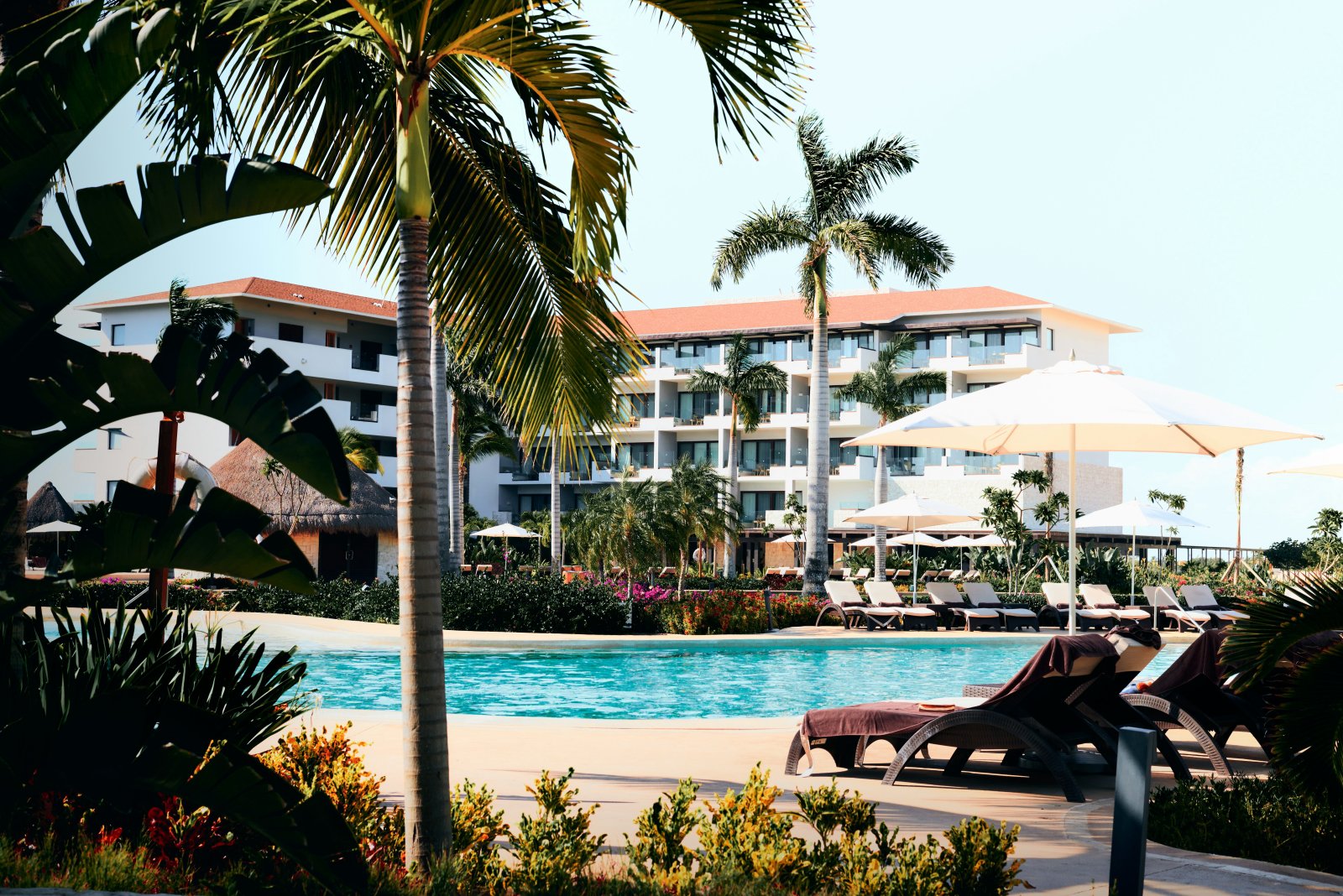
The Real Financial Risk of Hurricanes in Hotels
Hurricanes are not just a climate risk: they are one of the biggest factors of financial loss for hotels in coastal areas like the Riviera Maya. Every year, hotel properties face massive cancellations, severe structural damage, prolonged operational interruptions, and repair costs that can exceed the original construction cost.
However, most of these losses are not inevitable: they are the direct consequence of wrong decisions about property protection. The difference between a hotel that reopens in 2 weeks and one that stays closed for 6 months is not luck, it's the protection system chosen before the event.
Why Hotels Are Especially Vulnerable
Unlike residential homes, hotels have characteristics that dramatically increase risk:
- Large glass surfaces: panoramic windows, full facades, terraces
- Open design: lobbies, exterior hallways, balconies
- Height: upper floors receive significantly more intense winds
- Multiple openings: every room and every balcony is a potential failure point
- Continuous operation: hotels cannot easily "close" or evacuate with enough anticipation
- High cost per night out of service starting from the first day of closure
A 200-room hotel closed for 4 months can lose between $8-15 million in revenue, before counting a single dollar in repairs.
The Real Problem: Failure Begins at the Openings
One of the most common mistakes in hotels is underestimating the role of windows, doors, balconies, and facades during a hurricane. The typical destruction sequence in an unprotected hotel is: a window or door fails under debris impact or extreme pressure; wind violently enters the interior; internal pressure rises dramatically (internal pressurization); the roof receives lifting force from inside plus suction from outside simultaneously; and partial or total collapse occurs, multiplying the damage exponentially.
This phenomenon —internal pressurization— is responsible for most catastrophic damage in hotels during intense hurricanes. A single compromised opening can trigger the collapse of an entire floor. That's why hurricane protection is not an accessory: it's a critical structural component.
Hurricane Systems: What Actually Works in Hospitality
Hotels that effectively minimize risk use systems certified under ASTM E1996 and E1886 standards, tested for debris impact at 250+ km/h and extreme differential pressure, with comprehensive coverage of every opening.
High-Resistance Hurricane Tarps
These are the most versatile solution for existing hotels. They can be installed on windows, doors, balconies, and facades without modifying the architecture, deploy in 1-2 hours, and allow normal hotel operation between seasons. Certified under ASTM E1996 for projectile impact and resistance to category 4 and 5 pressures.
Hurricane Mesh Systems
Designed to dissipate wind energy rather than absorb it directly. Ideal for terraces, common areas, and facades where visual and air permeability —such as ocean views— needs to be maintained. Excellent cost/protection ratio for premium hotels, though they require pre-event activation.
Certified Fixed or Retractable Systems
The ideal solution for new hotels or major renovations. They integrate into the architecture from the design stage, remain permanently active, and require no manual activation. Higher initial cost, but they eliminate the operational risk of late or incomplete activation.
The Costly Mistake: Choosing Cheap Solutions
Many hotels opt for cheaper solutions to reduce initial costs. The typical result: failures during category 3+ storms, partial protection that leaves openings uncovered, frequent replacements, and uncertified systems that insurers don't recognize in claims. In real terms, "cheap" tends to be the most expensive option.
The Trap of Traditional Shutters
Conventional shutters are popular for their low initial cost, but they are designed for category 2-3 maximum —insufficient for the Riviera Maya—, require intensive labor to install, are generally not ASTM certified, and typically protect windows but not balconies or terraces. A hotel with shutters on windows but unprotected balconies has a worse outcome than one with an integral certified system, because internal pressurization doesn't need every opening to fail: it only needs one.
The Real Economic Calculation
The most frequent mistake in hospitality is comparing installation cost with the cost of "average damage." In a category 4 or 5 hurricane without certified protection, that average scenario doesn't exist.
Estimated direct impact on a 200-room hotel without protection: structural damage to facades and windows ($2-5M), interior repairs ($1-3M), operational closure of 4-8 months ($8-15M in lost revenue), future cancellations due to damaged reputation ($2-5M), insurance premium increase over 3 years ($0.5-1.5M), and legal and public relations costs ($0.3-0.8M). Estimated total loss per event: between $13.8 and $30.3 million.
Hurricane fabric protection systems are custom-engineered based on high-velocity wind-load calculations, opening spans, mounting substrates, and motorization requirements. Contact our engineering team directly for a precise project calculation.
Protection as Business Continuity
Beyond physical damage, the real impact of a hurricane on an unprotected hotel lies in operations. The typical cycle for an unprotected hotel is: structural damage, forced closure, reservation cancellations, lost revenue, costly repairs, delayed reopening, and damaged reputation, a cycle that's difficult to reverse.
In contrast, a hotel with certified protection experiences minimal or no damage, rapid inspection, reopening within days, retained reservations, and a permanent competitive advantage as a safe hotel. In the Riviera Maya, a hotel that can guarantee tour operators and agencies it will remain open after a hurricane has a negotiating advantage no discount can match.
Category 5 Protection: The Standard That Really Matters
Designing for lesser storms is a strategic mistake in the Riviera Maya. Over the past 20 years, the Mexican Caribbean has experienced multiple category 4 and 5 hurricanes, and according to NOAA and CENAPRED the trend is toward more intense events.
Category 5 protection means resistance to sustained winds above 250 km/h, the ability to withstand projectile impact at that speed, resistance to differential pressure of 2.5+ kPa on an exposed facade, and certification under ASTM E1996 and E1886 —the Florida standard, the most demanding in the world— with documented laboratory testing. When a system is certified under Miami-Dade County NOA (Notice of Acceptance), it means it has been physically tested, not just theoretically calculated. A system "designed for category 5" without laboratory certification is a marketing claim, not an engineering guarantee.
Decision Framework for Hotel Operators
Step 1: Assess Your Real Exposure
Document every opening in your hotel —windows, sliding doors, balconies, terraces, skylights, vents, and service access— and verify what percentage of your facade is glass, whether you have protection on all openings or only some, and whether your current system is ASTM E1996 certified with documentation your insurer recognizes.
Step 2: Assess Your Current System
If you already have a system, verify it has ASTM E1996 or E1886 certification (request the physical certificate), that it covers 100% of openings, that your staff can activate it in under 2 hours, and that the installer has specific experience in hotel projects. If you don't have a system, request a technical vulnerability assessment and quotes for certified systems, comparing certificates and not just price.
Step 3: Implement Before Season
The Atlantic hurricane season runs from June 1 to November 30. A recommended timeline is: technical assessment and quotes in January-February, system selection and contract in March-April, installation and testing in April-May, operational system and trained staff by May 15, and monitoring/activation during June-November. The activation protocol should begin with forecast monitoring 96 hours before the event and full activation at 48 hours, never waiting until the 24 hours before.
Conclusion
Hurricane protection in hotels is not optional: it's a critical decision that defines the business's ability to survive extreme events. Investing in certified hurricane systems protects the structure, operations, reputation, and long-term profitability. In an environment where hurricanes are inevitable, million-dollar losses are not.
Hotels that understand this difference choose systems certified under ASTM E1996/E1886 instead of the lowest price, protect 100% of openings and not just the most visible ones, and implement before the season instead of waiting for the first storm warning. Learn more about available hurricane protection solutions and options specific to hospitality.
Frequently Asked Questions
What type of protection is best for hotels?
Certified systems designed for impact and pressure, such as hurricane tarps and mesh, offer the best combination of resistance, efficiency, and operational adaptability. For new hotels or renovations, integrated fixed systems are the ideal option.
Are traditional shutters enough?
In most cases, no. They are designed for category 2-3 maximum, typically don't cover all openings —especially balconies and terraces— and generally lack ASTM certification recognized by insurers. Hotels in the Riviera Maya need certified category 5 protection.
What does category 5 protection mean?
It's the system's ability to withstand sustained winds above 250 km/h, high-speed projectile impact, and differential pressure of 2.5+ kPa, validated through independent laboratory ASTM E1996 certification.
How much can a hotel lose without adequate protection?
In a category 4-5 event, a 200-room hotel can lose between $13-30 million considering physical damage, lost revenue, reputational damage, and insurance impact.
Hurricane fabric protection systems are custom-engineered based on high-velocity wind-load calculations, opening spans, mounting substrates, and motorization requirements. Contact our engineering team directly for a precise project calculation.
Do insurers recognize these systems?
Systems certified under ASTM E1996/E1886 are recognized by most international insurers; several clients have obtained lower premiums and broader coverage, though results depend on each insurer. Uncertified systems can be rejected in claims.
How long does it take to install protection in an existing hotel?
Between 4 and 12 weeks for a full hotel, depending on size and system chosen. Contracting in January-February is recommended to be ready by May; installation can be done without interrupting operations in most cases.