The most common mistake: thinking that more rigid means safer
Choosing between hurricane mesh and metal panels is one of the most important -and most misunderstood- decisions in hurricane protection in Mexico. At first glance, metal panels seem stronger: they're rigid, heavy, and give an immediate sense of security.
But in hurricane engineering, visual strength doesn't equal structural performance. The real test happens under negative pressure, debris impact, sustained gusts, and sudden internal pressure changes -conditions that can't be evaluated "by sight."
How metal panels actually fail
Metal panels work as a rigid barrier and don't dissipate wind energy. The failure sequence is predictable: a gust hits the rigid surface, pressure concentrates because it has nowhere "to go," the load transfers completely to bolts and anchors, and structural fatigue points form at each fixation.
In high-category events this causes partial or total detachment, permanent deformation of the material, vibration and accumulated fatigue in fixations -even if they don't fail on the first impact- and internal pressure entry when a single point collapses.
Once a panel fails, the system stops protecting completely. In hurricanes, a small failure can trigger progressive damage across the entire building envelope: the same rigid point that seemed "stronger" becomes the origin of total failure.
The critical problem: internal pressurization
One of the most destructive factors in a hurricane isn't just external wind, but what happens when air enters the interior. When rigid protection fails, wind enters under pressure, the building's interior pressurizes, and the roof and other structures receive force from within. This phenomenon explains many structural collapses in hotels and coastal developments. That's why advanced protection systems don't just block wind -they control it.
How hurricane mesh works
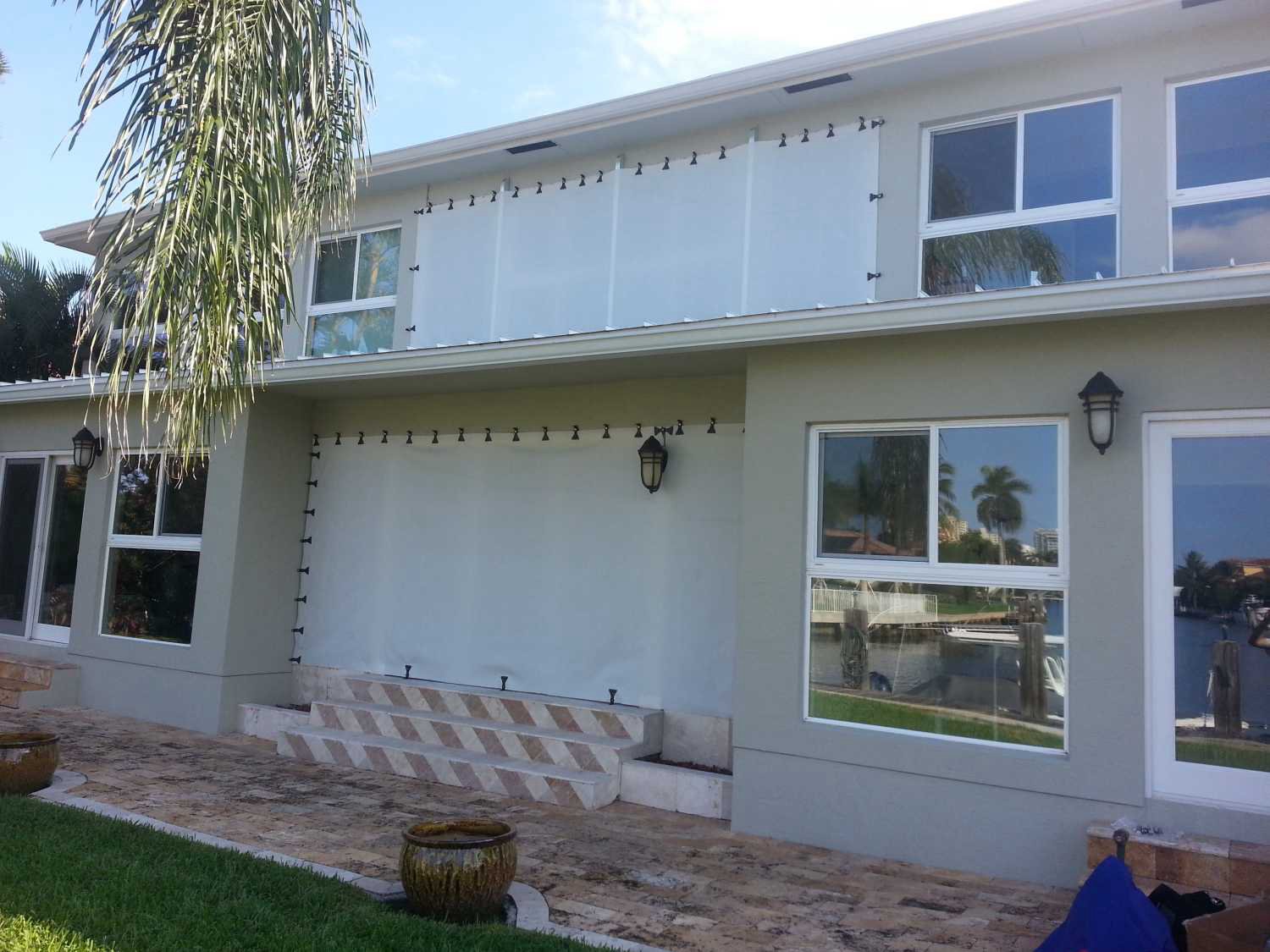
Hurricane mesh is based on a different principle: energy dissipation. Instead of acting as a solid barrier, it allows controlled airflow, reduces direct pressure on the structure, and absorbs and distributes impact load across the entire mesh surface.
This completely changes hurricane behavior: lower load transfer to anchors because energy dissipates before reaching them, reduced structural vibration, greater resistance to repeated impacts without accumulating fatigue like a rigid surface, and avoidance of the critical pressure buildup that triggers internal pressurization. Certified systems are designed to withstand high-speed projectile impacts, simulating category 4 and 5 hurricane conditions.
Impact resistance: the difference you can't see
A common mistake is assuming that harder is better. In reality, panels can dent or puncture with repeated impact, while flexible mesh absorbs and redistributes energy. This is especially relevant in areas like Riviera Maya, where hurricane debris can include concrete fragments from nearby structures, structural wood from damaged buildings, and objects carried at high speed such as outdoor furniture or large branches.
Hurricane mesh maintains integrity even after multiple impacts, something rigid solutions don't consistently achieve: a panel may "withstand" the first impact and be weakened, without visible signs, for the second or third impact that occurs minutes later during the same event.
Durability in coastal environments
In Mexico's coastal areas, durability doesn't depend only on the hurricane itself, but also on salinity, constant humidity, UV radiation, and accelerated corrosion.
Metal panels oxidize over time -a process that accelerates significantly with salt exposure-, progressively lose structural integrity often without early visible signs, and require constant maintenance: painting, anti-corrosion treatment, and replacement of rusted fixations.
High-quality hurricane mesh is treated against UV, resistant to corrosion in marine environments, and maintains long-term performance without the intensive maintenance cycle of metals. This makes it a more reliable solution for long life-cycle projects, such as hotels and developments, where the recurring maintenance cost of a metal system can accumulate significantly over the property's useful life.
Table: direct comparison
| Factor | Metal Panels | Hurricane Mesh |
|---|---|---|
| Operating principle | Rigid barrier, fully blocks | Energy dissipation, allows controlled airflow |
| Load transfer to anchors | High, all load concentrates there | Low, energy distributed across surface |
| Behavior under repeated impact | Cumulative denting/puncturing | Absorbs and redistributes, maintains integrity |
| Risk of total detachment | High if one anchor point fails | Lower, no single critical point |
| Relationship with internal pressurization | Rigid failure = sudden pressure entry | Designed to prevent critical pressure buildup |
| Corrosion in coastal environments | High, requires constant maintenance | Low with proper UV/anti-corrosion treatment |
| Long-term maintenance | High (paint, anti-corrosion, fixations) | Low (with certified product) |
| Architectural integration on large surfaces | Limited, visually heavy | High, efficient installation, lower visual impact |
| Category 4-5 certification available | Depends on specific product | Yes, in certified systems |
| Ideal for | Specific small openings | Hotels, developments, large surfaces |
Application in hotels and developments
For hotels, resorts, and developers, the criterion isn't just withstanding a hurricane: it's protecting high-value assets, reducing operational risks, avoiding prolonged closures, and meeting international standards.
Hurricane mesh allows efficient installation on large surfaces, architectural integration, and continuous protection without compromising aesthetics -three factors where metal panels traditionally have a disadvantage in projects of this scale. Learn more at hotel protection and certified hurricane systems.
Decision framework: which one should you choose?
Step 1: evaluate the size and type of opening
For extensive facades, terraces, and common areas, certified hurricane mesh is generally the more efficient option, covering large surfaces without multiple individual anchor points. For small, specific openings, certified metal panels may be appropriate, always with properly calculated anchoring and documented corrosion resistance.
Step 2: consider the property's life cycle
For hotels and developments with a long life cycle (20+ years), the recurring maintenance cost of metal systems in coastal environments should be included in the comparison, not just the initial installation cost. Mesh with certified UV/anti-corrosion treatment tends to have lower total cost of ownership over this horizon.
Step 3: verify specific certification, not the material in general
Regardless of which you choose, demand impact certification (large missile test) for the specific product and configuration, verify anchor design calculated for your substrate and location, and confirm documentation of behavior under cyclic pressure (ASTM E1886). "Metal panel" and "hurricane mesh" are product categories, not performance guarantees; certified and non-certified versions exist within each category.
Step 4: for large projects, consider a mixed approach
In large-scale hotels and developments, it's common to combine systems: certified hurricane mesh for extensive facades, terraces, and common areas, and certified specific systems (which may include panels) for point openings where mesh isn't the most practical solution. What matters isn't system uniformity, but that each component meets verifiable certification.
Conclusion
Hurricane mesh doesn't just represent a technological evolution over metal panels -it's a complete shift in how hurricane protection is understood. While rigid solutions try to resist wind force, advanced systems are designed to control it, dissipate it, and reduce its structural impact. In real scenarios, that difference separates partial damage from effective protection.
Frequently Asked Questions
Does hurricane mesh withstand category 5 hurricanes?
Yes, certified hurricane mesh systems are designed to withstand extreme conditions, including high-speed impacts and category 5 wind pressure, as long as they have specific certification (ASTM E1996/E1886, Miami-Dade NOA, or equivalent).
Are metal panels safer because they're harder?
Not necessarily. Rigidity can increase load transfer and cause structural failures if anchors give way. An extremely hard but poorly anchored panel can fail before a well-designed, certified flexible mesh.
Which system requires less maintenance?
High-quality hurricane mesh typically requires less maintenance in coastal environments due to its corrosion resistance. Metal panels, even treated ones, generally need periodic inspection and anti-corrosion maintenance in high-salinity areas.
Are they suitable for hotels and large developments?
Yes, hurricane mesh is one of the most widely used solutions in high-level projects due to its efficiency on large surfaces, durability, and structural performance, especially for protecting extensive facades or open common areas.
Can I combine mesh and metal panels on the same property?
Yes, this is common practice in large-scale projects: mesh for extensive facades and common areas, specific systems for point openings. What matters is that each component meets verifiable certification for its specific application.