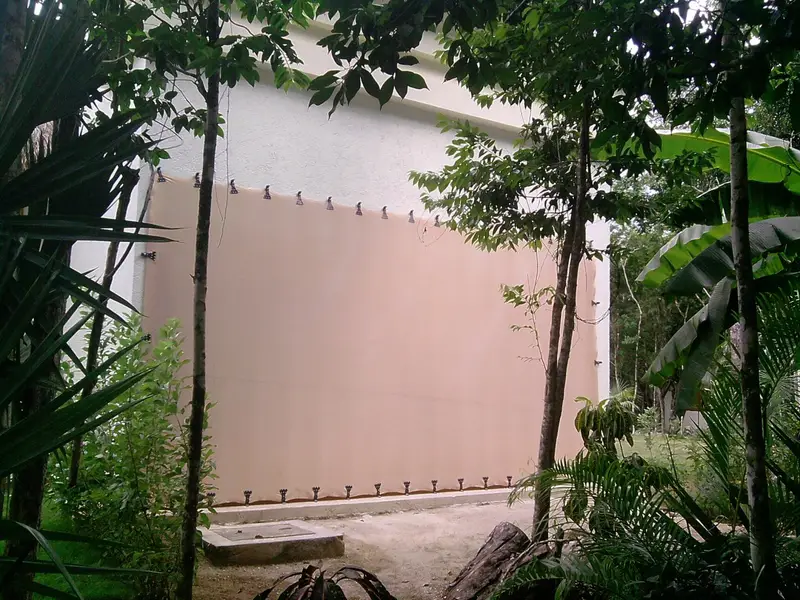
The HS-875 is the entry-level system in the Hurricane Solution line, and it is often misread: because it carries the most accessible price, many assume it is a “reduced” or less safe version of the HS-1250 or HS-1500. The official documentation says otherwise. The HS-875 is a polypropylene fabric system with an 875 psi design strength, certified for Category 3 hurricanes and intended for properties located beyond the zone of direct open-sea exposure. “Accessible” here means a different design exposure level, not a cut in certification rigor.
The official approval: what the document says
The system behind the HS-875 is registered with the Florida Building Code under number FL15186, documented as “Astroflex — Fabric Hurricane Protection System” (Shutters category, Fabric Storm Panel subcategory), manufactured by Hurricane Fabric, LLC. The evaluation report was prepared by John H. Kampmann Jr., PE (Florida license PE-47516), under Method 1(d) of the Chapter N-3005 Rule, and independently validated by Frank L. Bennardo, PE.
- Certified design pressure: +80/-80 psf.
- Test protocols: TAS 201, 202 and 203 (large missile impact, cyclic loading and uniform static pressure).
- Rating: impact resistant.
- Use: approved outside the High Velocity Hurricane Zone (HVHZ).
These are the same TAS protocols used to evaluate the higher-specification systems in the same line. The certification process does not change between the HS-875 and the HS-1250 or HS-1500.
Why “accessible” does not mean “no engineering”
There is a common, mistaken assumption: that an entry-level system sacrifices engineering rigor for price. With the HS-875, the public record contradicts that. The report was sealed by a licensed professional engineer, validated by a second engineer, and subjected to the same TAS protocols as the higher systems. The only thing that changes is the design pressure each system was calculated for, calibrated to the wind exposure expected at different distances from the coast.
So the real difference is not one of degree but of kind: an uncertified “budget” system is a bet with no verifiable technical backing; the HS-875 is a documented, evaluated and sealed engineering decision, simply calibrated for a different risk.
The decisive component is still the anchoring
As with any system in the line, the fabric’s certified strength depends in practice on the anchoring being correctly specified for the property’s exact substrate. The ±80 psf pressure documented in approval FL15186 corresponds to the complete system —fabric plus anchoring— under the test conditions, not the fabric in isolation. That is why, even in the entry-level system, professional installation and substrate evaluation remain as decisive as in the HS-1250 or HS-1500.
What kind of property it is designed for
The HS-875 is intended for properties beyond the beachfront line —homes and businesses farther from the coast— where real risk exists, especially against Category 3 or higher hurricanes on the Saffir-Simpson scale, but differs from that of an oceanfront property. For that profile it offers real certified protection at a more accessible investment point, without giving up official certification or professional engineering evaluation.
The frequent error is to assume that if a property is not on the beachfront, any uncertified solution —wood, generic panels— is “enough.” The correct answer to lower risk is not to abandon certification, but to choose the certification level calibrated for that risk.
The value of a public record
Many sales materials claim strength without a single verifiable document behind them. The FL15186 record breaks that pattern: any architect, structural engineer or insurer can look up the approval status, the reviewing engineer, the date and the exact test protocols directly on the Florida Building Code Online portal. That verifiable technical evidence can be decisive both in a real event and in risk-mitigation talks with an insurer —several owners use it to document their upgrades, though recognition depends on each company—. No improvised solution offers this, regardless of cost.
A common pattern in commercial chains
Among operators with multiple locations at varying distances from the coast, a useful pattern appears: an inland branch with a properly specified HS-875 obtains the same kind of verifiable documentation —certified design pressure, TAS protocols, engineer evaluation— as an oceanfront property with a higher-specification system. Forcing the top system on every branch means an investment that does not match each location’s real risk; under-specifying leaves a genuinely exposed property vulnerable. That is why, across a commercial portfolio, an individual assessment per location is advisable.
Frequently Asked Questions
What certification does the HS-875 have?
It is registered with the Florida Building Code under number FL15186, as the Astroflex system, evaluated by a Florida professional engineer (PE-47516) and independently validated.
Is the HS-875 less safe than the HS-1250 or HS-1500?
It is not less rigorous in its certification. It is calibrated for a different exposure level —Category 3, properties beyond the beachfront line— with the same professional engineering evaluation process.
What design pressure does it withstand?
±80 psf, according to the official FL15186 approval documentation, evaluated under TAS 201, 202 and 203 protocols.
Is it suitable for oceanfront properties?
It is designed for properties beyond the zone of direct exposure. Beachfront properties should be evaluated for higher-specification systems such as the HS-1250 or HS-1500.
Does anchoring matter as much as in the higher systems?
Yes. The certified pressure corresponds to the complete system —fabric and anchoring— so professional installation on the correct substrate remains decisive. You can review more questions in our FAQ.