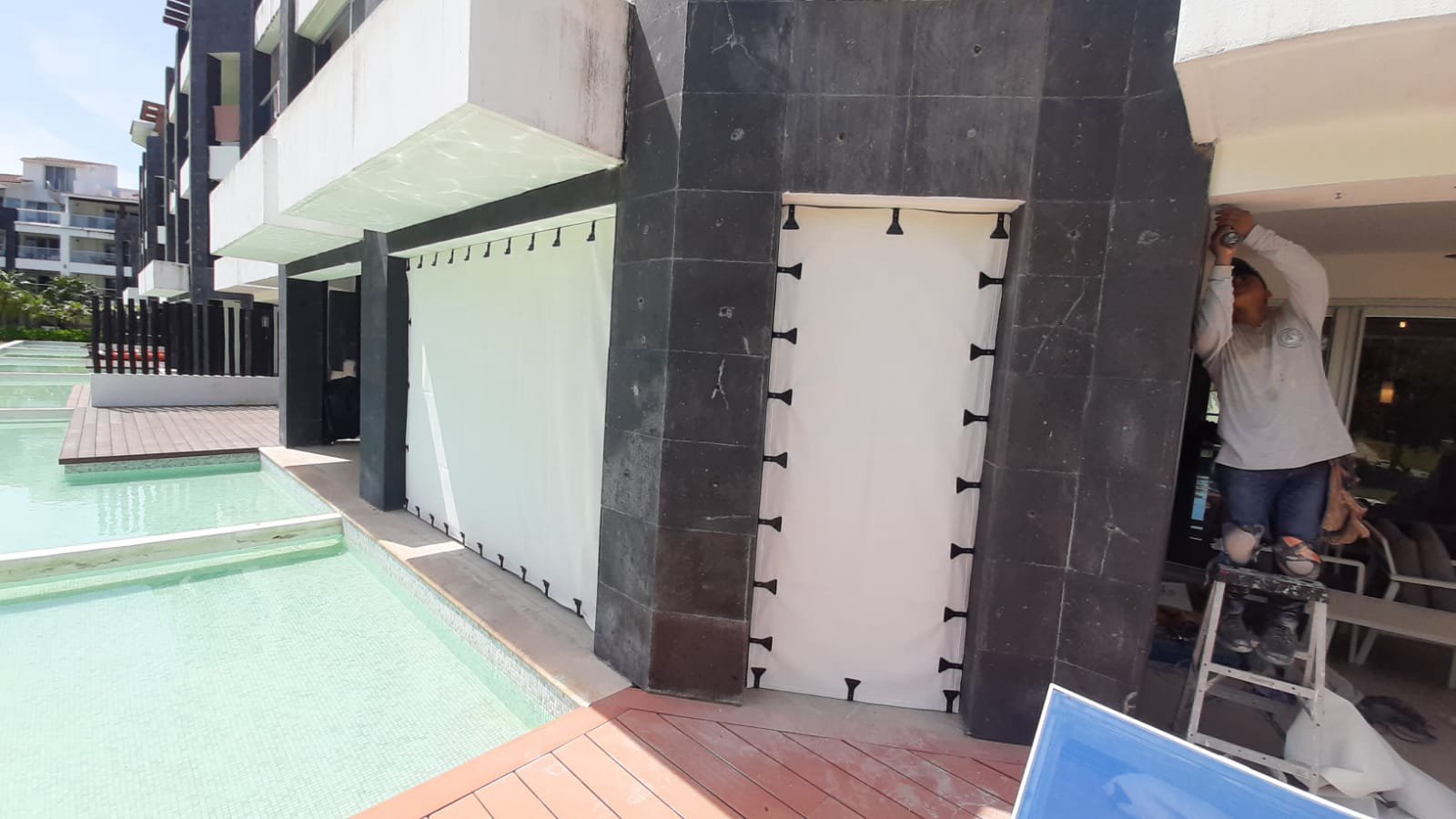
Choosing a hurricane protection installer in Mexico isn't a matter of comparing quotes: it requires verifying three things independently, not just taking the vendor's word for it—a certification with a verifiable file number, demonstrable years of continuous operation, and references with a specific name and date, not generic testimonials. The price gap between a certified installer and one without real certification often looks significant at quote time, but it reverses completely the first time the system faces a serious wind event and fails.
The Question Most Owners Never Ask: "What's the Number?"
When an installer claims a product is "hurricane certified," the word alone verifies nothing. A real certification—like a Miami-Dade County Notice of Acceptance (NOA) or a test report under ASTM E1996—always comes with a specific file number that can be checked independently in public records, without relying on the vendor to confirm it.
It's far easier for a vendor to say "we're certified" than for a homeowner to verify it, especially if the owner doesn't know to ask for that file number rather than accepting a vague answer. Asking for the number—and insisting on it—is the single most powerful question a buyer can ask before signing.
Warning Signs of a Provider Without Real Certification
- Can't produce a specific file number when asked directly, and answers with vague phrases like "it's certified"
- The price is noticeably lower than other providers for apparently similar specs. Real certification under Level E or a Miami-Dade NOA requires substantial investment in testing and documentation, and that shows up in the final cost
- No verifiable multi-year operating history in the region, or contradictory answers about how long the company has been in business
- Can't provide verifiable references with a specific name and date—only generic, unattributed testimonials
- Warranty paperwork is vague about what's covered and for how long, instead of spelling out clear terms
Why the Upfront Price Gap Is Misleading
A pattern seen often in the industry: owners pick a noticeably cheaper installer without verifying certification, drawn in by the upfront savings. When that system fails during the first serious wind event—often because the material was never actually tested under the combined wind, water, impact, and pressure-differential conditions a hurricane generates—the total cost ends up higher than if a certified installer had been hired from the start: property damage, repairs, and installing a certified system anyway after the fact.
Comparing quotes on total price alone, without normalizing for real certification, isn't comparing the same thing. A Level E–certified system, with a Miami-Dade NOA covering both the anchoring and the fabric, represents an investment in lab testing, engineering documentation, and code compliance that an uncertified product simply doesn't have.
Hurricane fabric protection systems are custom-engineered based on high-velocity wind-load calculations, opening spans, mounting substrates, and motorization requirements. Contact our engineering team directly for a precise project calculation.
What to Ask During the Evaluation
Beyond asking for the certification number, a full technical evaluation should cover:
- What's the NOA or ASTM test report number, and which components does it cover—anchoring, fabric, or both?
- Does the certification evaluate the complete installed system, or just the material on its own?
- How many years has the company operated continuously in the region, with verifiable evidence?
- Can they provide at least one reference with a company or homeowner name and a specific installation date?
- What exactly does the warranty cover, for how long, and what written documentation backs those terms?
It's also worth asking directly about the crew doing the physical installation: how many similar jobs has this specific team completed, did they receive formal training from the system's manufacturer or learn informally, and who signs off on quality once the work is done.
Certification Has to Match Your Specific Zone
Not every certification that's relevant in one region applies equally in another. A system evaluated under one zone's wind conditions won't necessarily perform the same way in a zone with different wind patterns. Asking exactly what conditions the certification tested—wind speed, pressure differential, water exposure—is more useful than simply confirming that "a certification exists" without knowing its parameters. See the Level E parameters and the testing and certification process behind a certified system.
Why Installation Matters as Much as the Material
Of every decision involved in hurricane protection, choosing the installer determines most whether the rest of those decisions matter at all. The best material in the world, poorly installed by a provider without real experience or genuine certification, doesn't deliver the protection its spec sheet promises. Correct anchoring, proper sealing, and integration with the existing structure matter as much to final performance as the material itself—see how certified anchor integrity is verified.
Even when a material carries real, verifiable certification, final performance depends critically on installation quality. A poorly placed anchor, an incomplete seal, or the wrong spacing between fastening points can undermine a certified material's performance almost as much as using an uncertified one from the start. Verifying product certification is necessary but not sufficient—the installer also needs demonstrable experience installing that specific system.
The right approach isn't picking the first available provider or the cheapest one, but following a comparative evaluation process—similar to the one documented in commercial cases like Sears Playa del Carmen, which ran an intensive review of every system on the market before deciding. For hotels, developments, or large-scale projects, that process needs to be even more rigorous: ask for references from other commercial clients of similar scale, not just residential ones, and confirm the certification specifically covers the planned installation's conditions.
Certified Installer vs. Installer Without Verifiable Certification
| Factor | Certified, verifiable installer | Installer without verifiable certification |
|---|---|---|
| Certification file number | Provided without hesitation | Missing or vague |
| Operating continuity | Verifiable, multiple years | Hard to confirm, or recent |
| References | Attributable, with name and date | Generic or anonymous |
| Price | Generally higher, reflects certification investment | Generally lower, but higher risk |
| Warranty | Clear terms in writing | Vague or undocumented |
Frequently Asked Questions
How do I verify a Miami-Dade Notice of Acceptance is real?
A real NOA has a specific file number that can be checked in Miami-Dade County's public records. If a provider can't give you that number, or it doesn't match the products they're actually selling, that's a warning sign.
Is it normal for a certified system to cost more than an uncertified one?
Yes, generally. Obtaining and maintaining real certification like Level E or a Miami-Dade NOA requires substantial investment in lab testing and engineering documentation, which shows up in the final product cost.
What if I already installed a system without verifying certification?
Ask the installer who did the work for the specific certification documentation. If they can't provide it, consider an independent technical evaluation to determine whether the installed system actually delivers the protection you'd expect.
Is a neighbor's reference enough to evaluate a provider?
It's a good starting point, but it should be paired with verification of specific certification—one satisfied customer doesn't confirm that the installed system carries real, verifiable certification.
How many years in business should a reliable installer have?
There's no universal minimum, but the longer and more verifiable a company's operating history, the more evidence there is that it has maintained consistent quality standards over time, rather than being a quick in-and-out operator.
Should I vet the installation crew, not just the company?
Yes. Installation quality can affect a system's performance almost as much as the material's own certification. Asking about the crew's specific experience, and whether there's a post-installation quality check, matters as much as verifying the product's certification.