Case Study: Camana Bay Hurricane Refuge — flexible protection in Grand Cayman
Leer este caso de estudio en español →
International technology & architectural reference | Grand Cayman | AstroFlex / HS-875 Architecture
Executive summary
The Camana Bay Hurricane Refuge project in Grand Cayman utilized load-disbursing deployable AstroFlex hurricane screen technology—the same proven structural screen architecture engineered and standardized in Mexico today under Hurricane Solution's HS-875 system—to protect large-span open bays in a four-level parking structure designed for rapid emergency refuge conversion. Shared as an international architectural and engineering reference.
Key project facts
| Item | Documented detail |
|---|---|
| Reference Project | Camana Bay Hurricane Refuge |
| Location | Camana Bay, Grand Cayman, Cayman Islands |
| Developer | Dart Realty (Cayman) Ltd. |
| Architect | Spillis Candela DMJM Architects (Coral Gables) |
| Design Objective | Convert a four-level open parking structure into an emergency refuge within 24 hours |
| Historical System Name | AstroFlex load-disbursing deployable hurricane screens |
| Equivalent HS System in Mexico | Hurricane Solution HS-875 (international technology & architectural reference) |
| Corporate Documentation | Camana Bay Sustainability Report (p. 7) confirming hurricane refuge use within the development |
Development profile
Camana Bay was conceived by Dart as a master-planned town in Grand Cayman connecting Seven Mile Beach and the North Sound, integrating residences, commercial offices, retail, public spaces, and entertainment (https://www.camanabay.com/about/building-camana-bay/). Designing a coastal community in the central Caribbean required engineering beyond everyday building functions, including infrastructure capable of withstanding severe hurricanes.
The challenge
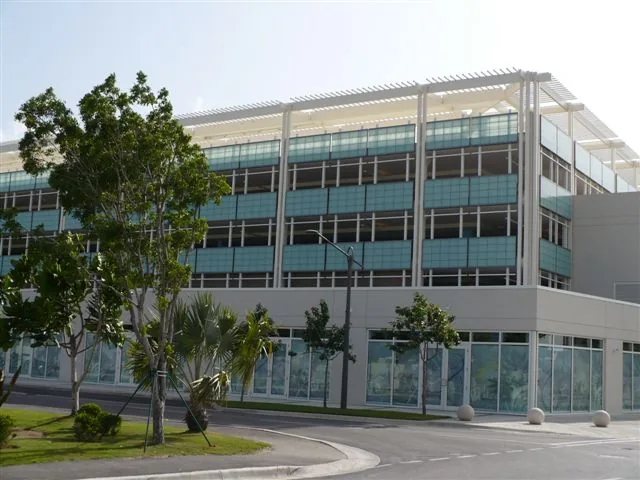
According to the project's architectural brief, Spillis Candela DMJM Architects designed a four-level parking structure capable of converting within 24 hours into a hurricane refuge equipped with restrooms, backup power, and controlled access for emergency personnel.
A parking structure engineered for daily vehicle circulation and natural cross-ventilation faces radically different wind-pressure and envelope-enclosure demands during a major storm. Permanently enclosing large multi-bay openings with heavy louver walls or impact glazing would sacrifice year-round airflow and daylight, while conventional grommet-punched tarps fail under prolonged oscillating hurricane gusts.
The solution
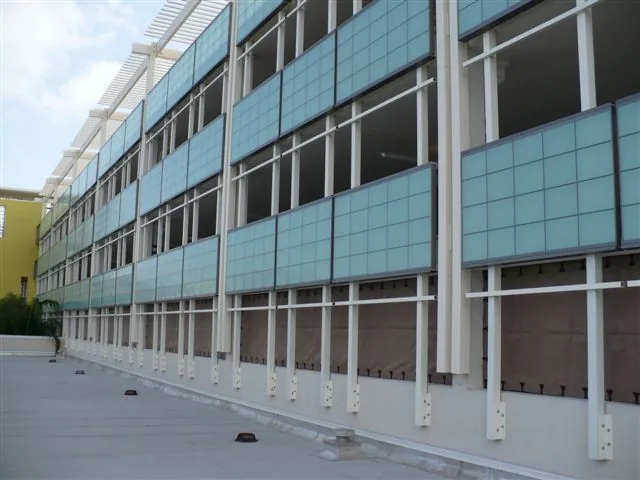
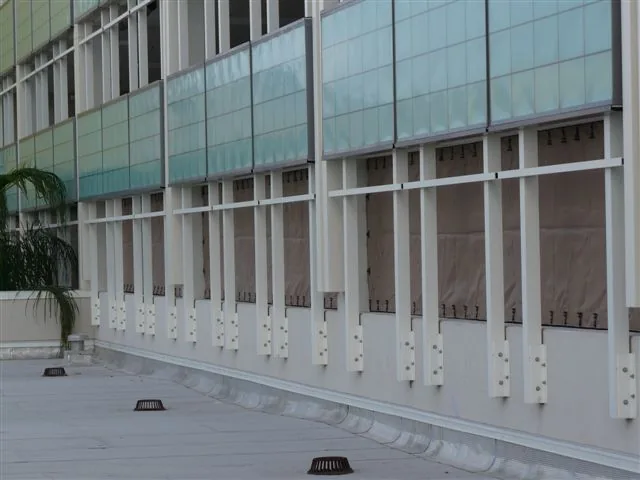
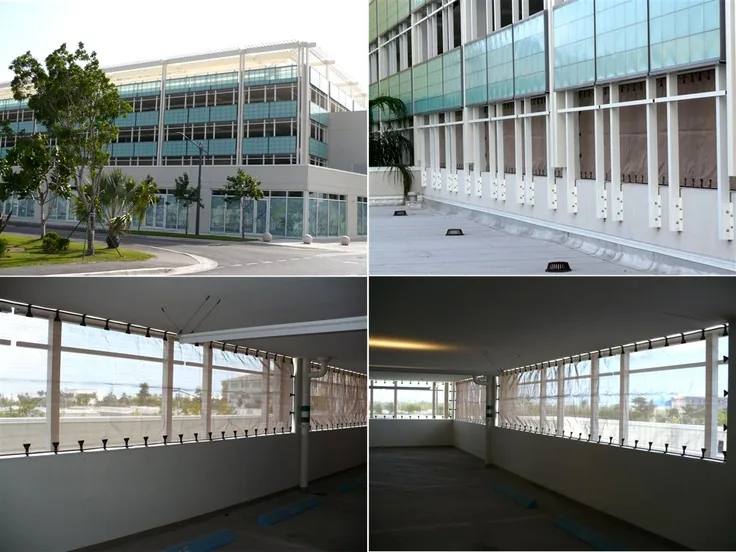
To enclose the multi-bay structural openings without sacrificing year-round natural ventilation, the project utilized AstroFlex tensioned, load-disbursing deployable hurricane screens. Project photographs show removable panels spanning multiple structural bays, anchored directly into the concrete columns and slabs with two-piece load-disbursing perimeter clips.
In Mexico, Hurricane Solution engineers, fabricates, and installs this exact load-disbursing screen architecture under our HS-875 system. By presenting the historical AstroFlex installation transparently alongside HS-875, architects and developers can trace the direct engineering lineage of the system used today across Mexican coastal resorts, commercial complexes, and institutional facilities—such as DIF Solidaridad and the U.S. Navy Hospital in Guam.
Documented results
The deployable screen system allowed the four-level structure to operate as an open, naturally ventilated parking facility throughout the year while providing a rapid-deployment storm barrier across its perimeter bays.
On page 7 of its official corporate sustainability report, Where Sustainability Blossoms (https://www.camanabay.com/media/el4cjrrt/where-sustainability-blossoms-2025.pdf), Camana Bay officially confirms that its hurricane-resilient infrastructure serves emergency refuge functions to reduce pressure on public services: “Some of our buildings can be used as a hurricane refuge in the case of emergencies.”
Photographic and written evidence
- Official Camana Bay Sustainability Report (Page 7): https://www.camanabay.com/media/el4cjrrt/where-sustainability-blossoms-2025.pdf — confirms that designated buildings within Camana Bay can be used as hurricane refuges during emergencies.
- Dart Hurricane Preparedness Parking Programme: https://www.dart.ky/news-and-media/parking-programme-ready-to-go-as-hurricane-season-begins/ — documents ongoing hurricane readiness procedures for Camana Bay's parking structures.
- Historical Planning & Archival Records: Cayman Islands Central Planning Authority records (minutes dated October 28, 2009, p. 70, referencing Block 12D, Parcel 95, original approval CPA/29/04, Item 2.7 of December 15, 2004, and application P09-1072) and original architectural installation photography document the multi-bay AstroFlex screen panels and concrete perimeter anchors.
What the project demonstrates
- Dual-purpose coastal infrastructure: Open parking garages, institutional shelters, and commercial podiums can be engineered at the design stage for rapid storm conversion using deployable fabric screens.
- Load-disbursing clip superiority over grommets: Two-piece perimeter load-disbursing clips grip and flex with the fabric without perforating it, preventing point-stress tearing under cyclic hurricane gusts.
- Preservation of natural ventilation and daylight: Removable screens avoid the cost and airflow penalties of permanent shutters on large-bay structures.
- Proven international engineering pedigree: The AstroFlex technology demonstrated in Grand Cayman forms the exact structural basis for Hurricane Solution's HS-875 system in Mexico.
Frequent questions
How does the historical AstroFlex system at Camana Bay relate to Hurricane Solution's HS-875?
Camana Bay was built with AstroFlex load-disbursing deployable hurricane screens—the exact same structural screen and two-piece clip architecture that Hurricane Solution engineers, fabricates, and installs across Mexico today under our HS-875 system.
Why use load-disbursing clips instead of standard grommets on large openings?
Standard metal grommets punch holes in the fabric and concentrate wind loads at single points, which can tear during prolonged hurricane gusts. Load-disbursing clips grip the fabric edge without perforating it and flex under dynamic wind pressure.
Can HS-875 protect large open spans in institutional shelters, commercial buildings, and parking structures in Mexico?
Yes. Hurricane Solution custom-engineers HS-875 and HS-1500 screen assemblies for wide-span commercial bays, public shelters, and multi-level structures. See also our DIF Solidaridad case study and U.S. Navy Hospital Guam case study.
What should architects and developers consider when specifying deployable screens?
Identify exposed openings early, confirm concrete or steel substrate capacity for perimeter anchors, designate dry storage, and establish staff deployment procedures.
Planning a commercial building, refuge, or large-span structure in coastal Mexico?
Request a technical assessment from Hurricane Solution · info@hurricanesolution.com · WhatsApp +52 984 404 5980.