Concrete Did Not Fail in Otis. The Openings Did.
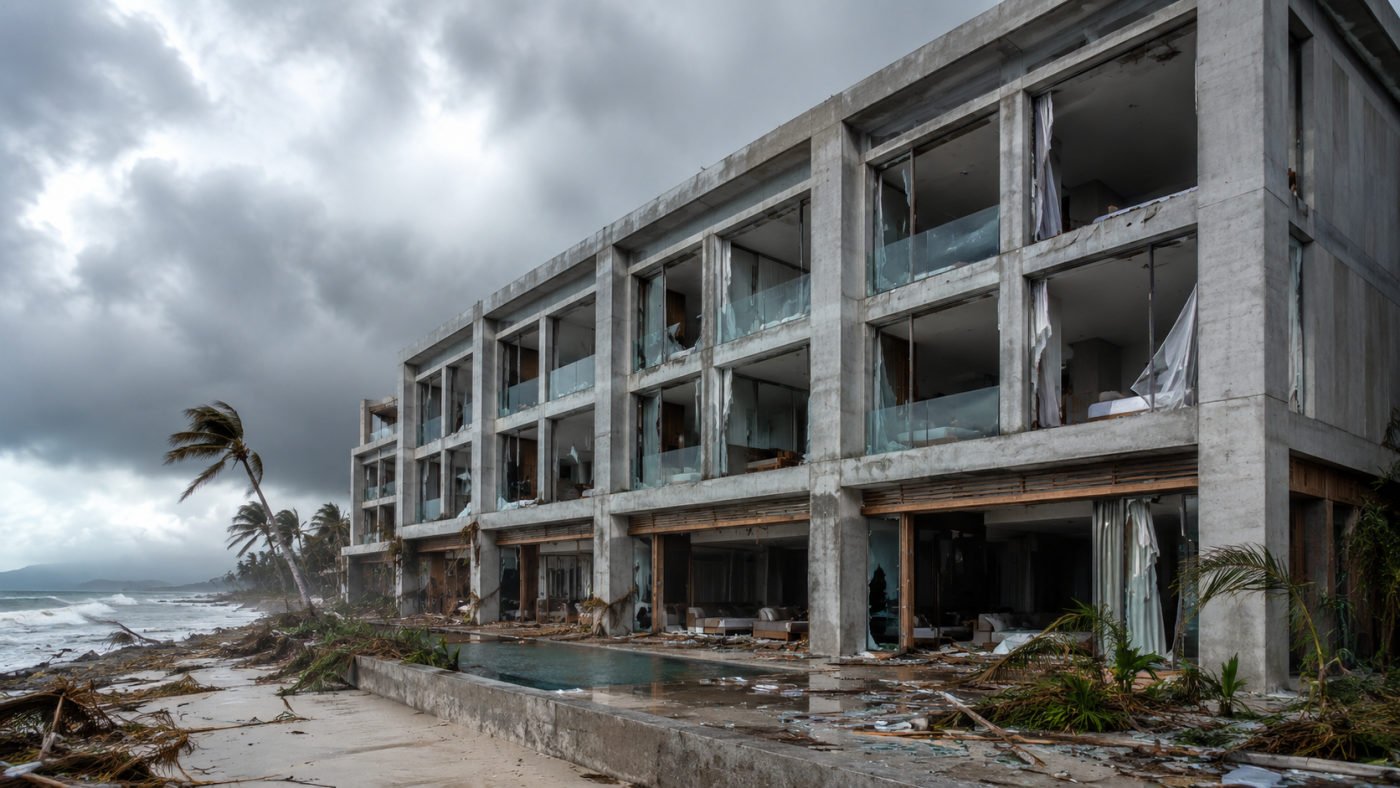
In October 2023, Hurricane Otis made landfall in Acapulco as a Category 5 storm, intensifying at a rate no model predicted in time. Weeks later I walked the city alongside insurance and construction teams assessing the damage, and I saw one thing repeat itself with a frequency I had not expected: concrete buildings with their facades perfectly intact, and their interiors completely destroyed.
It was not coincidence. Every one of those properties shared the same flaw, even though at first glance no two of them looked anything alike: an unprotected opening, almost always one of the kind nobody considers important.
Working from what Otis left behind, four questions deserve a careful answer: why a concrete building can fail even when its structure stays standing, how internal pressurization takes over once an opening gives way, what an owner or property manager should verify before assuming the building is protected, and what to ask when evaluating a protection system. What happened in Acapulco offers hard evidence for understanding that mechanism.
For years, the conversation about hurricane protection in Mexico has centered almost exclusively on structure: how thick the wall is, how heavily reinforced the slab is, how solid the building looks from the street. That is the logic much of the Mexican coast was built on, and for decades it seemed sufficient, in part because most of the hurricanes that arrived never pushed that logic to its limit.
Otis did push it, and the result is clear enough once you walk the properties afterward: concrete handles lateral wind pressure without much trouble. What it does not do, because that is not its job, is protect the openings.
A window. A sliding door. A skylight. A service entrance nobody included in the protection quote because, in the judgment of whoever priced it, it was not an important window. Any one of those points, left without certified protection, can become the entry through which a Category 5 hurricane destroys a building that, from the outside, looks untouched.
What the Post-Storm Assessments Showed
In the weeks after Otis I walked Acapulco with insurance and construction teams evaluating damage to process claims and plan reconstruction. The pattern repeated across the great majority of the properties we reviewed, not in a couple of isolated cases.
An apartment tower on the Costera, for example, came out of the storm with its main facade intact. Seen from the street it looked like one of the few properties that had survived well. Inside, a single service skylight on the roof had given way in the first hours of the event. Nobody had counted it as part of the building's protection, because it is not a window a resident uses or ever sees, but it was enough to pressurize the entire stairwell: interior doors torn out of their frames up to the 12th floor, ceilings down in half the units, and weeks of interior reconstruction in a building that, to anyone driving past on the Costera, looked perfect.
At another property, a boutique hotel with a reinforced concrete facade, the failure point was a staff entrance at the rear, the one the maintenance team uses and guests never see. That door had been left off the list of protected openings years earlier. When it gave way, the service corridor became a pressure tunnel that ended up damaging the kitchen, the laundry, and part of the guest room block connected to that hallway.
In both cases the construction was sound and the problem was not workmanship. In both cases there was an opening that, at the moment the protection was quoted, someone decided was not worth covering — and in both buildings, that was the only one that ended up mattering.
The Vulnerability Sits in the Openings
During a Category 5 hurricane, the weak point is almost never the concrete wall. The problem begins the moment an opening gives way: instead of staying outside, pushing against the facade, the wind gets in.
When that happens, the interior pressurizes from within, while outside the wind passing over the roof generates suction. Those two forces acting at the same time — pressure pushing outward from inside, suction pulling upward from outside — are what lift roofs, blow out interior walls, flood rooms, and turn what could have been localized damage into a near-total loss.
Concrete resists lateral pressure. It does not protect openings. And the openings are, almost always, where it gets decided whether a property survives a Category 5 hurricane or not.
Understanding the mechanism in a little more detail helps explain why the damage multiplies so quickly once it starts. In terms of air pressure, a closed building behaves like a sealed system: as long as every opening holds, the air the wind drives against the facade has no way in, and that pressure stays outside, against a wall designed to resist exactly that kind of load.
The moment a single opening gives way, that system stops being closed. Air enters at high velocity and pressurizes the interior, while on the outside the wind moving over the roof generates suction — the same effect that keeps an aircraft in the air, applied now to a building's roof deck. A roof calculated to carry its own weight plus a normal wind load suddenly has to resist that exterior suction added to internal pressure pushing upward from within. It is a combination of forces almost no residential or commercial structure was designed for, because standard building code does not treat it as a routine scenario.
What Separates Two Buildings Exposed to the Same Hurricane
The most useful comparison is not between a concrete building and a lightweight one. It is between two concrete buildings, of comparable construction quality, that faced the same storm: one with certified protection on every opening, and one with partial protection.
The first, a residential development in the Diamante zone with full-envelope protection that included service entrances and skylights, was back to normal operation in under a week. Damage was limited to landscaping and a few non-structural exterior elements.
The second, less than two kilometers away, had certified protection only on windows and main doors, with two service entrances left uncovered. It took more than three months to return to normal occupancy. Protecting those two additional openings, before the storm, would have cost a small fraction of what it ended up paying in reconstruction.
This pattern repeats, with different property names and in different cities, after practically every Category 4 or 5 hurricane that reaches the Mexican coast.
What Every Owner Should Verify Before the Next Season
This is the list I work through, property by property, when someone asks me for a serious assessment:
- Does the property have every opening protected, not only the walls that look most vulnerable?
- Do the sliding doors and terraces carry certified protection, or only the front-facing windows?
- Were skylights, ventilation ducts, and service entrances included in the protection inventory, or left out because nobody brought them up?
- Was the installed protection designed to account for internal pressure, or only for rain and everyday wind?
When any of these questions gets answered with "I'm not sure," that is almost always the place worth looking at first.
What to Do Now, in Practical Terms
The first thing that changes the outcome is not a different technique, but the question the assessment starts from. Instead of asking whether the building is strong, ask where the wind could get in.
In practice that means walking the entire property, not just the oceanfront facade, with that question in mind. A serious opening-inventory walkthrough covers:
- Every window and door in the occupied areas, without exception, including those facing interior courtyards or a secondary view
- Doors and windows in service rooms, laundry, mechanical rooms, and storage areas
- Skylights, roof lights, and any opening in the roof or on the rooftop, including hatches serving water tanks or air conditioning equipment
- Staff entrances, vendor delivery doors, and emergency exits the maintenance team uses every day
- Large ventilation grilles and ducts that open directly to the exterior
A Category 5 hurricane does not distinguish between the most visible opening and the most discreet one; it enters through whichever is weakest. That is why the inventory has to be done with the same seriousness in a service corridor as at the main window of the presidential suite.
Once the inventory is finished, what is needed is documentation, not appearance: every protected opening should have verifiable backup showing it was designed to resist sustained pressure, and not only the initial impact of a flying object. The installer's word is not that backup.
In Acapulco, after Otis, this stopped being a theoretical recommendation and became documented evidence, property by property. It remains, for me, the clearest lesson that storm left behind for any coastal city in the country.
Closing
- Otis left a very precise technical lesson. A concrete building can remain standing and still suffer severe interior damage if a single opening lets the wind in. At that point internal pressurization takes hold, works together with the exterior suction on the roof, and multiplies the damage fast.
- That is why an assessment should not focus only on how solid the building is, but on the continuity of its envelope. Protection has to cover every opening — including the skylights, service entrances, and points routinely left out of quotes — because the decisive question is not how strong the concrete looks, but where the wind can get in.