The Physics That Decides Whether a Property Survives a Category 5 Hurricane
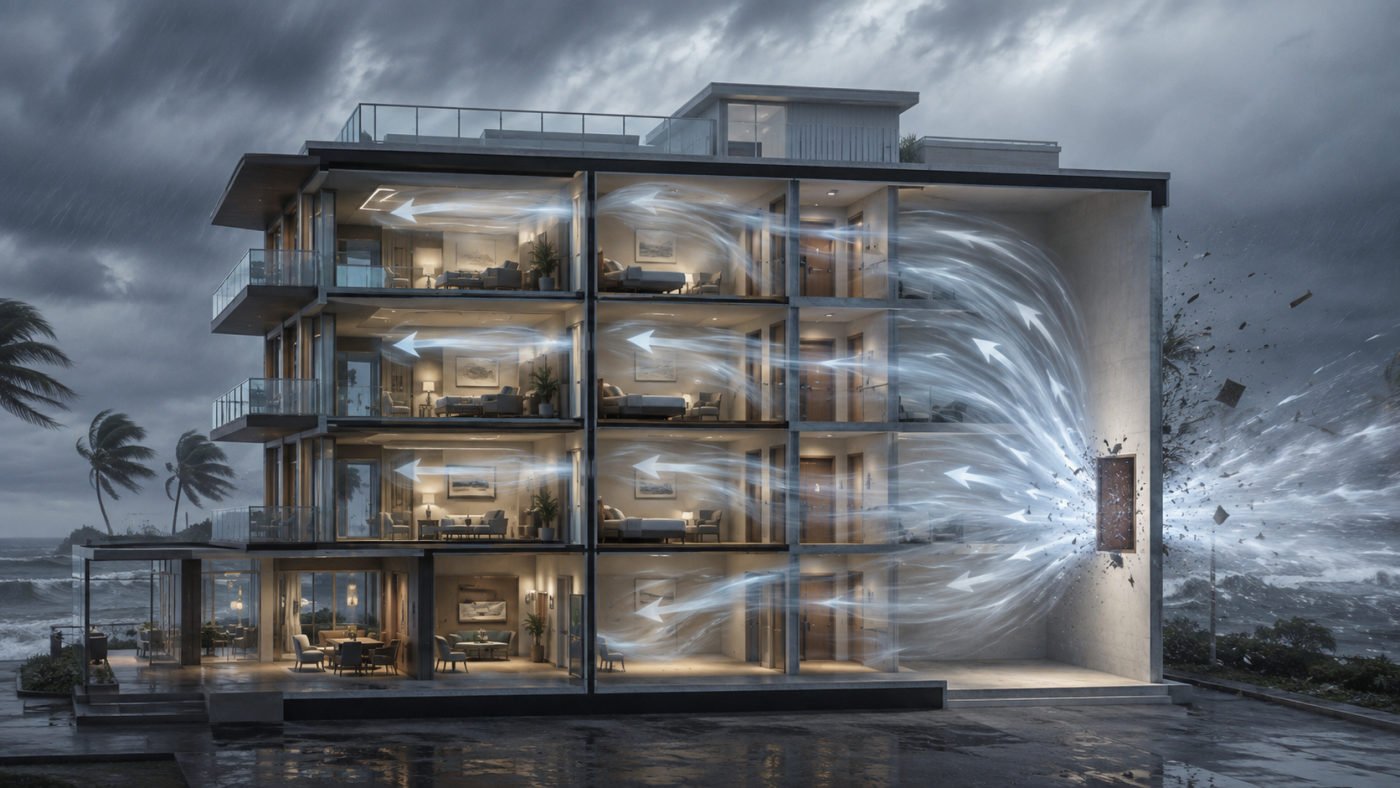
A couple of seasons ago I visited a hotel in the Riviera Maya that felt completely protected. Tempered glass across the main facade, certified sliding doors in the lobby, guest room windows with documented hurricane protection. Everything a guest sees was covered.
One door was missing. The loading and unloading entrance at the rear, next to the kitchen area. Nobody had counted it as part of the "hotel's protection system" because, technically, it was not one — it was a service door. That detail is exactly why understanding internal pressurization is not an academic exercise. It is the difference between a hotel that reopens in days and one that closes for months.
This analysis focuses on the mechanism that most often decides the outcome of a severe storm: internal pressurization. From there, it is worth understanding clearly how a single unprotected opening can compromise an entire building, why the gap between almost protected and genuinely protected is far wider than it appears, and what a property has to review in order not to repeat that mistake.
It is intuitive to assume a hurricane destroys a property from the outside in — wind hits the roof, hits the walls, and eventually something gives. The reality, documented again and again in Category 4 and 5 hurricanes, is different: destruction almost always begins when a single opening lets the wind inside.
The concrete can stay entirely upright, facade intact, and the property can still sustain enormous damage. The reason lies in the building envelope — the combined system of walls, roof, windows, and doors that, as long as it stays closed, behaves as a single resistant unit.
The moment a window, door, skylight, or closure fails, that unit ceases to exist. Wind enters the interior violently, and that is where the real sequence of destruction begins.
The Failure Sequence, Step by Step
In practical terms, this is what happens after a single opening gives way during a high-intensity hurricane:
- Step 1 — Wind enters at high velocity through the compromised opening and begins to pressurize the interior, as if the space were being inflated from within like a balloon.
- Step 2 — At the same time, on the exterior, wind passing over the roof generates suction — the same aerodynamic principle that keeps an aircraft in the air, applied now to the building's roof deck.
- Step 3 — Internal pressure pushing outward and external suction pulling upward act on the same roof, at the same time, adding their forces together instead of canceling each other out.
- Step 4 — The roof, designed to resist normal wind plus its own weight, was never calculated for that combination of loads. When it gives way, the damage stops being confined to one room and starts affecting ceilings, interior walls, electrical systems, and frequently several floors of the building.
That is why so many properties that look solid from outside end up with a total loss of interiors, roofs lifted off, and severe internal structural damage, after a single opening — often small, often ignored in the original quote — stopped holding.
Why standard code does not account for this combination
It is worth pausing on a point rarely explained clearly outside engineering circles: most residential and commercial building codes in Mexico calculate roof resistance assuming an enclosed building. In other words, the structural design starts from the premise that wind acts only from the exterior, pushing against and generating suction on sealed surfaces.
That assumption is reasonable as long as the envelope stays closed. It stops being reasonable at the exact moment a single opening fails, because from then on the roof faces a combined load — external suction plus internal pressure — it was never designed for. The roof is not badly built. It is solving a different problem from the one it faces once the building stops being sealed.
This explains a pattern that confuses many owners after a storm: why a roof that came through earlier hurricanes of similar intensity without a scratch fails in an event where "only" one additional window broke. The difference is not wind speed. It is whether that additional window turned the building, for the first time, into an open system.
"Almost Protected" Is Not a Real Category
One of the most common errors I see in property assessments is treating protection as a percentage. "We have 90% of the openings protected" sounds, in a budget conversation, like a reasonable result. In terms of internal pressurization, it is not.
A building's system does not fail in proportion to the share of unprotected openings. It fails the moment the first unprotected opening gives way — whether it is one out of a hundred or the only one left uncovered. A property protected at 90% can fail exactly the way one with no protection at all does, if that remaining opening turns out to be the one the wind finds first.
That is why hurricane protection should not be analyzed as "protecting windows." It should be analyzed as keeping the entire envelope closed for the full duration of the event — no exceptions, no second-priority openings.
Two Properties, the Same Lesson
At the Riviera Maya hotel I mentioned at the start, the unprotected loading door turned out to be precisely the entry point during a seasonal storm. The kitchen area and part of the storeroom pressurized, with damage to ceilings and equipment, while the guest zones — fully protected — recorded no incidents at all.
Repairing that service area ended up costing several times what it would have cost to include that one door in the original protection system. It was not a problem of insufficient budget. It was a problem of an incomplete inventory — nobody had asked the right question at the time of quoting.
At a different residential property, designed from the start around a full-envelope approach — service entrances, mechanical room, and skylights included — the same class of storm produced no internal pressurization incident whatsoever. The difference was not the size of the protection budget. It was the criterion used to define what counts as an "opening."
The Case of a Hospital, and Why the Margin for Error There Is Zero
In facilities where operations cannot stop — a hospital, for instance — full-envelope protection stops being a recommended best practice and becomes a non-negotiable requirement. A hospital that loses internal pressurization during a hurricane faces more than material damage: it faces the real possibility of evacuating patients mid-storm, with operating rooms and critical areas compromised by water and wind infiltration.
In assessments we have carried out for hospital facilities in Cancún and Puerto Vallarta, the pattern repeats with remarkable consistency: window protection is well resolved, but ambulance bays, medical supply loading entrances, and emergency exits — larger openings, with less standard geometry — fall outside the scope of the conventional systems available on the market. A hospital is not protected because some of its windows have a barrier. The storm does not calculate coverage percentages; it looks for the opening nobody resolved.
It is exactly the same principle that applies to any property, hotel or residential, but with consequences that in a hospital setting allow no margin for error.
What Every Property Should Review
- Does your property's opening inventory include service entrances, mechanical rooms, and skylights — or only the windows and doors guests and residents see?
- Was any opening left out of the protection quote because it seemed "secondary"?
- Did your supplier assess the entire property, or only the main facade?
- Is there documentation showing each protected opening was designed to resist sustained pressure, not just initial impact?
If the answer to any of these questions is "I don't know," that uncertainty is itself the signal that an unresolved entry point exists.
Closing
- In a Category 5 hurricane, the major damage almost never begins when wind strikes the wall, but when an opening gives way and lets air into the interior. That internal pressure, combined with the suction the wind generates over the roof, creates a load far more severe than standard design normally contemplates.
- Which is why partial protection is misleading. A single unresolved opening can compromise the entire assembly, so the inventory has to include service entrances, skylights, mechanical rooms, and any other point connected to the outside. The real function of a certified system is not simply to protect windows, but to keep the building envelope closed for the whole storm.