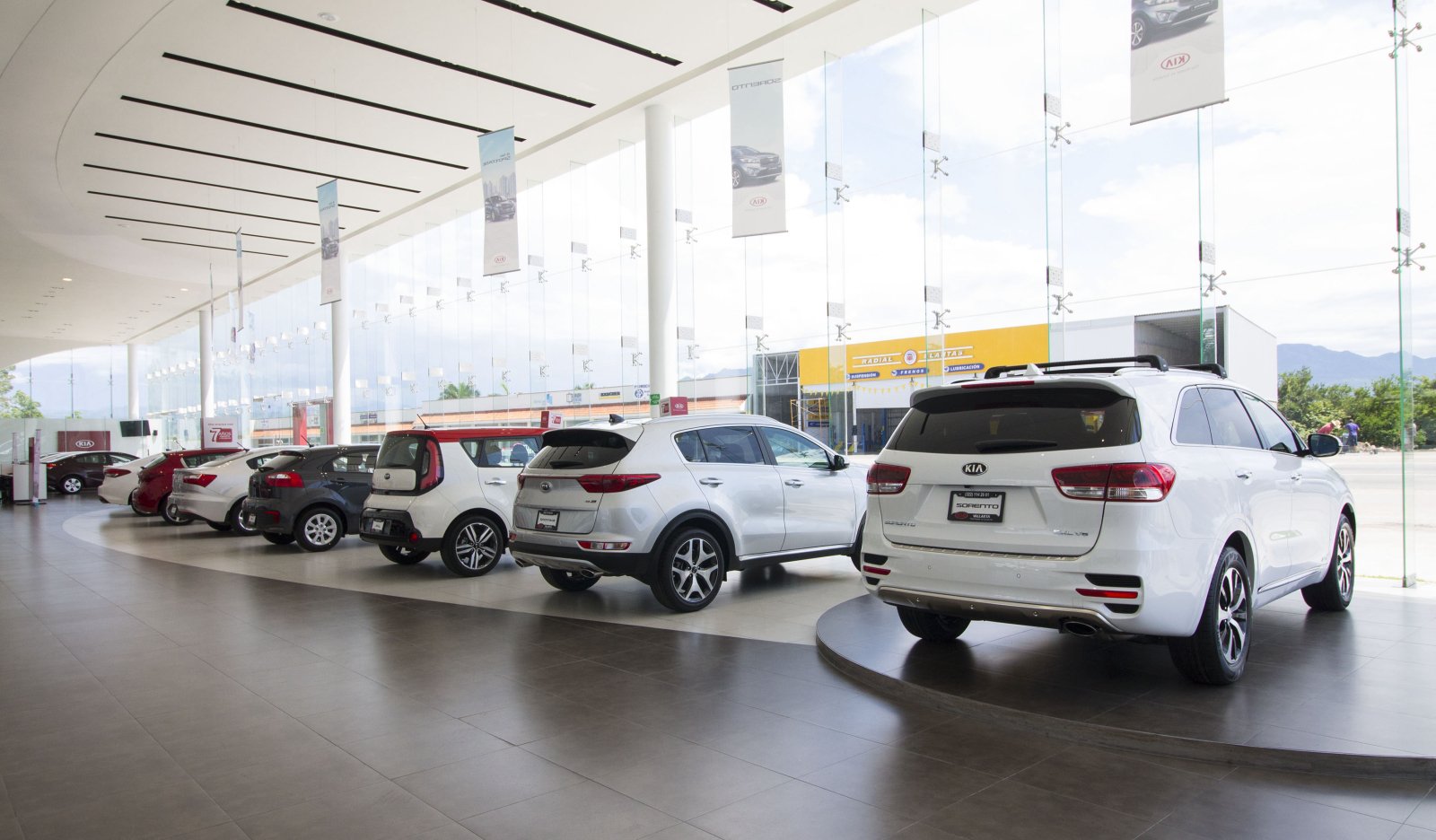
The real cost of a hurricane for a car dealership does not begin with the showroom’s broken glass. It begins with everything that stops working when wind and water breach the envelope: sales, deliveries, service, parts, systems, equipment and building availability. The useful question is not "how much does a tarp cost?" but how much does it cost to lose the use of this opening and the space behind it for 3, 7 or 30 days?
The mistake of measuring the loss by the price of the glass
Behind the facade lies a full operation: sales advisors, cashier, F&I, servers, delivery areas, vehicles, chargers and documentation. According to FEMA’s guidance on openings, wind and water enter through doors, windows and joints; a single entry path turns an exterior problem into a large-area interior one. If water gets in, cleanup and drying can force the closure of zones that don’t even look damaged.
Inventory and service: the value at risk behind the glass
A showroom can hold dozens or hundreds of vehicles. It is not responsible to publish a universal figure, but it is responsible to build scenarios: 80 units at a hypothetical value of 550,000 pesos represent 44 million exposed. That is not a market average; it illustrates scale. The decision tool is always the same: exposed inventory × probability of damage + cost of interruption.
But a dealership does not live on new-vehicle sales alone. Service, parts, warranties and bodywork sustain income even when no car is sold. The showroom produces image; the service bay produces continuity. It is easy to relocate a sales meeting; it is very hard to improvise lifts, tools, parts and diagnostic equipment. That is why a serious plan reviews service-bay doors, service entrances and storage, not just the facade.
3, 7 and 30 days: interruption grows over time
A useful model splits the impact into four buckets —deferred revenue, lost revenue, added cost and physical damage— so you neither exaggerate nor underestimate:
- 3 days: rescheduled deliveries, missed service appointments, prospects buying at another branch, overtime and logistics.
- 7 days: the problem shifts from emergency to continuity. Customer trust is at stake; reopening fast becomes a competitive advantage.
- 30 days: the invisible cost accumulates — temporary rent, penalties, rescheduled campaigns, customers who migrate and reputational damage.
Cancún and Puerto Vallarta: exposure on two coasts
The National Hurricane Center report on Wilma (Cancún, 2005) teaches that the lesson is duration, not just category: a structure can be exposed for hours while wind-driven water exploits any compromised opening, and windborne debris strikes wide facades. On the Pacific, the official Patricia report documents the extreme intensification possible near Puerto Vallarta and Bahía de Banderas. Design is based on plausible risk and exposure, not on repeating the last cyclone’s track.
Large-format facades change the cost equation
Hurricane fabric protection systems are custom-engineered based on high-velocity wind-load calculations, opening spans, mounting substrates, and motorization requirements. Contact our engineering team directly for a precise project calculation.
A risk-based ROI, without promising invented savings
Mitigation ROI can be modeled without fabricating statistics: use three scenarios —minor event, severe event, and severe event with a critical opening failing— and estimate direct damage, days of interruption and lost revenue. Protection does not generate income like an ad campaign; it resembles a fire-suppression system: it exists to reduce a high-consequence loss. Measuring it only by "annual savings" leads to an absurd conclusion in every storm-free year. The right question is how much catastrophic risk you buy down per year of service life.
Protecting only the most visible glass can be a bad investment
A showroom can spend well on the facade and still be exposed through a service-bay door or a parts entrance. The Full Envelope philosophy forces you to ask which areas create the greatest consequence if they fail. On a phased budget, prioritize by exposure, vulnerability and consequence: it is not always about "protecting more meters" first, but about eliminating the risk that can most stop the business. And because every screen is manufactured and shipped to Mexico, the alert should trigger deployment, not start the purchase.
| Cost | Before protecting | After a failure | How to reduce it |
|---|---|---|---|
| Glass / facade | Known | Repair + wait | Adequate protection |
| Inventory | High value exposed | Damage / transfer / appraisal | Envelope + protocol |
| Sales | Normal flow | Delays / loss | Fast reopening |
| Service | Recurring operation | Halted work orders | Protect critical access |
| Staff | Routine | Overtime / relocation | Deployment plan |
| Reputation | Stable | Frustrated customers | Continuity and communication |
In Cancún and Puerto Vallarta, the discussion should start before the storm and with real numbers from your own business. Once you know your inventory, your service orders, your daily margin and which opening would halt the most functions if it fails, the price of protection stops being an isolated figure: it becomes a continuity decision.
Frequently Asked Questions
How much does a dealership lose per day when closed?
There is no universal figure. Use the branch’s real sales, margin, service, parts and added costs, and model 3, 7 and 30-day scenarios instead of a single number.
Does insurance cover the interruption?
It depends on the policy, deductibles, exclusions and business-interruption coverage. Physical protection does not replace insurance, and insurance does not replace continuity; they work best together.
What should be protected first on a limited budget?
The opening with the greatest combination of exposure, vulnerability and consequence — not necessarily the largest or most visible. An electrical room or a service-bay access can matter more than the main glass.
Is AquaGrid always more expensive?
It cannot be answered without a project. Its cost depends on the span, the structure and logistics. On conventional openings it may not be needed; on large spans it is often the only technically adequate solution.
When should I request the assessment?
Before the season, with enough lead time to manufacture, ship and install. Large facades are not an emergency solution: the forecast should trigger deployment, not the quote.