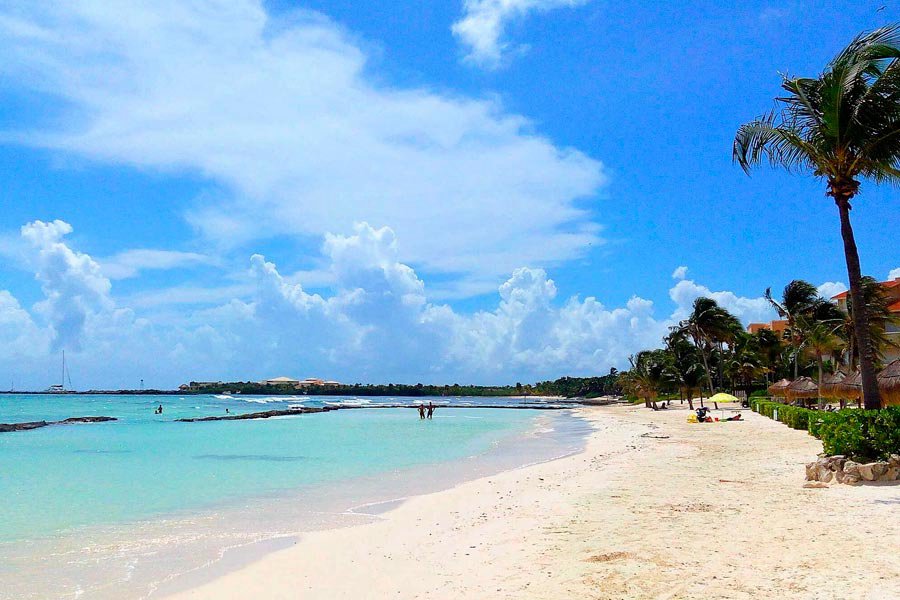
Puerto Aventuras holds a particular place within the Riviera Maya. It is not a high-density hotel zone or an open commercial corridor: it is a gated residential community, built since 1988 around three marinas and a system of navigable canals, with phases ranging from mid-sized condominiums to large-format villas with a private dock. That is why hurricane protection here cannot be solved with the generic recommendations that would apply in Playa del Carmen or Cancun.
The right answer combines systems certified under the ASTM E1996 standard, with low visual impact, together with documented deployment protocols and specific attention to the water-facing openings, which are the most vulnerable in this kind of community.
The risk profile within Quintana Roo
Puerto Aventuras sits between Playa del Carmen and Tulum, a coastal strip that NOAA's National Hurricane Center records as being hit by significant tropical cyclones roughly once every 3 to 4 years, with severe-damage events every 4 to 7 years. Hurricane Wilma, a category 4-5 storm in 2005, remains the reference event for gauging the scale of damage possible on this coast.
What sets the community apart is its internal geography: during a sustained-wind event, the canal system that connects the phases to the open sea can act as a corridor that channels and concentrates wind force toward canal-facing properties, an effect that does not exist inland.
Property types and their vulnerability
Condominiums (Chac Hal Al, Marina Coral and similar)
They hold most of the community's residential units and have the most manageable profile: 4 to 8 openings per unit, modern construction and, in many cases, a building HOA that already manages common maintenance. The main challenge is coordinating HOA approval to install protection.
Villas without canal frontage
Villas in the interior phases have an intermediate profile: good construction, 8 to 14 openings and wind exposure similar to any standard Riviera Maya residence, without the added factor of water-facing openings.
Villas with canal frontage and a private dock
This is the most complex type to protect. They combine large-format openings facing the canal's prevailing wind, a private dock that adds risk for the boat, and accelerated salt exposure due to constant proximity to the water.
Commercial properties by the marina
Restaurants and shops around the marinas face large open storefronts, designed to draw foot traffic from the waterfront promenade, that must stay visually appealing most of the year. Our commercial section addresses this case.
What actually damages a property during a hurricane
Wind-driven rain penetrates any opening without adequate protection, even with frames in good condition, under the pressure differential created by sustained winds of 150 km/h or more. That pressure difference between inside and outside generates suction that can pull 40 to 80 liters of water per hour through a single unprotected opening.
In a canal villa the effect is worse: the water-facing picture windows are the ones receiving the greatest direct pressure. If just one of these large openings fails, the resulting internal pressurization can cause additional structural damage, including partial roof lift, even in areas not directly exposed to the wind.
The technical reference standard for evaluating resistance is ASTM E1996, which verifies wind loads of up to 250-300 km/h with projectile impact testing. Systems certified under this standard, such as the HS-875, HS-1250 and HS-1500 from Hurricane Solution, are designed to keep the property envelope intact under these extreme conditions.
Cost by property type
Hurricane fabric protection systems are custom-engineered based on high-velocity wind-load calculations, opening spans, mounting substrates, and motorization requirements. Contact our engineering team directly for a precise project calculation.
The regulation hurdle and how to navigate it
Puerto Aventuras is organized in phases with individual HOA regulations, several of which restrict visible facade modifications. The right strategy is not to avoid protection out of fear of the rules, but to choose low-visual-impact systems, present complete technical documentation, and frame the request as a safety and property-value benefit for the whole phase.
The operating protocol when an alert arrives
Having the system installed is only half the equation; the other half is a clear protocol on when and how to activate it, which matters especially where many owners manage remotely. A good protocol defines the activation threshold (recommendation: at the first Tropical Storm Watch mentioning Quintana Roo, not the Red Alert), who executes the deployment if the owner is not present and, for properties with a dock, what is decided about the boat: relocation to a designated refuge or reinforced mooring in place.
The difference between reactive and proactive management is concrete: whoever waits for the storm to approach faces urgency surcharges of 30% to 60% and limited availability, competing with the whole community for the same resources. Whoever installs off-season (November to March) and keeps a documented protocol operates with certainty, no matter how fast the next system intensifies.
Why documentation matters as much as the protection itself
For those who rent their property or rely on a Mexican insurance policy, documenting the installed system —ASTM E1996 certification, installation photos and a written deployment protocol— has value beyond the physical. It strengthens the owner's position in a claim after an event, because it demonstrates reasonable preventive measures. Several Mexican insurers explicitly consider this factor under the prevention and mitigation clause of coastal property policies, though the outcome depends on each insurer and should not be taken as guaranteed.
A real case: the remote owner who activated the protocol in time
Consider a villa owner living in Canada who manages remotely through a local manager. At the first Tropical Storm Watch mentioning Quintana Roo, they activated the agreed protocol: the system, already installed since the previous season, was fully deployed in 3 hours with two people. The manager also coordinated with the marina operator to temporarily relocate the boat to a refuge area within the canal system, and both tasks were ready 30 hours before the projected impact, a system that ultimately weakened but left sustained winds of 95 km/h. Result: zero damage to the property, zero damage to the boat and less than a full day of remote coordination.
The full financial argument
Hurricane fabric protection systems are custom-engineered based on high-velocity wind-load calculations, opening spans, mounting substrates, and motorization requirements. Contact our engineering team directly for a precise project calculation.
For those who rent as part of the area's vacation-rental offering there is an additional argument: operational continuity. A property that stays protected and available throughout the season keeps its rating on rental platforms, avoids forced cancellations and preserves the organic positioning that determines how many bookings it receives in the months following any weather event. You can expand on all of this in our residential section.
Conclusion
Puerto Aventuras brings together features that do not coincide anywhere else in the Riviera Maya: a gated community in phases, an extensive system of navigable canals, a high proportion of water-facing properties and owners who tend to manage from a distance. Protecting it well requires understanding these particularities rather than applying a generic recipe. With the right system, the proper documentation and a clear operating protocol, an owner can protect their investment as effectively as anywhere else in the region, while respecting the character and the rules that make this community so valued.
Frequently Asked Questions
What makes Puerto Aventuras different when it comes to hurricane protection?
Its phase structure with individual HOA regulations, its navigable canal system that can channel wind toward water-facing properties, and the high proportion of owners who manage their investment remotely.
How much does it cost to protect a typical property?
Hurricane fabric protection systems are custom-engineered based on high-velocity wind-load calculations, opening spans, mounting substrates, and motorization requirements. Contact our engineering team directly for a precise project calculation.
Can my phase's regulations stop me from installing protection?
Most regulations do not ban protection itself, but they may restrict the type of system visible from the outside. Retractable-fabric systems with recessed anchoring usually gain approval without difficulty.
Do I need a different protocol if my property has a private dock?
Yes. Beyond protecting the home, you must coordinate dock preparation and the decision about the moored boat with the marina operator, within the same preparation timeline for an alert.
Does documenting my system affect my insurance?
It can strengthen your position. ASTM E1996 certification, installation photos and a documented protocol reinforce the owner's position in a claim after an event, though the concrete effect depends on each insurer.