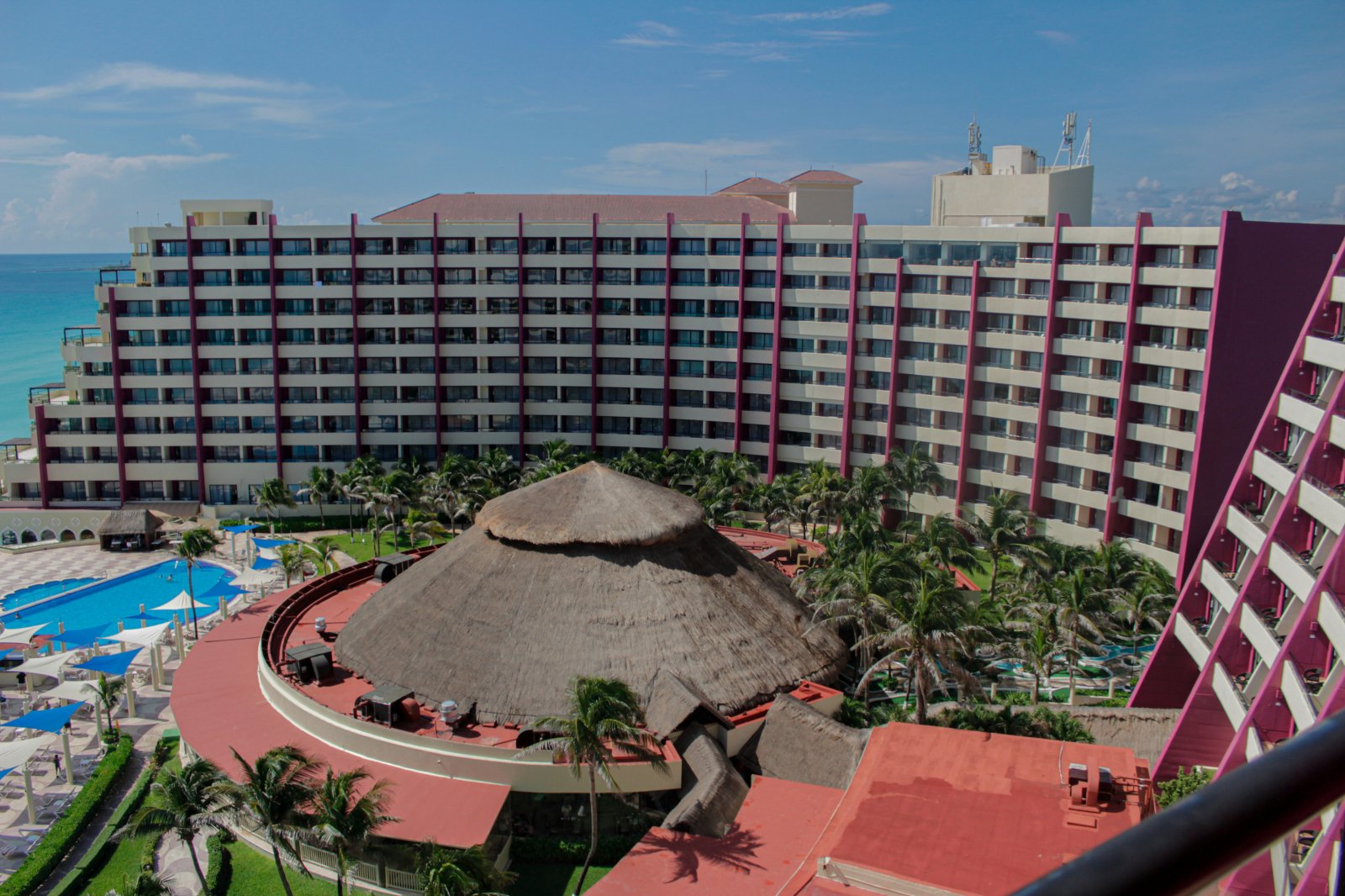
Almost all hurricane-protection content is written for homes. The physics are the same, but applying it directly to a hotel ignores differences that change the right decision. A hotel does not have 1.5-meter windows: it has 20-meter lobbies with no front facade. It does not calculate the return as "avoiding damage to my house," but in RevPAR, effective occupancy and commercial premium. And no single person decides: maintenance, general management, procurement and often a corporate structure that demands the financial case before approving are all involved. This guide condenses what matters to make that decision well.
The problem that defines everything: large-format openings
Almost every system on the market was designed around a residential window of 1.5 to 3 meters. Riviera Maya hotels —Cancun, Playa del Carmen and Tulum— are built on the opposite philosophy: double-height lobbies with no front facade, restaurants that open completely toward the pool, and common areas designed to maximize the visual connection with their surroundings, not to minimize it.
The case that led to AquaGrid was a hotel client who needed to cover a 20-meter opening —an entire lobby front— for which no available system offered a viable solution. A solid panel at that scale, under sustained category 3 or higher wind, behaves like a sail: it concentrates load and differential pressure that no conventional anchor can hold without failing. On top of that, every joint between panels is a potential failure point. The answer was an open-mesh weave that lets part of the wind pass through instead of creating a concentrated pressure zone, reducing the total load on structure and anchors. It is a system proven in the real world; ASTM E1996 is the reference standard for impact resistance, not a certification owned by the product.
The three hotel spaces that demand a specific solution
Open lobbies
Designed without a full front facade so the guest sees the ocean the moment they walk in. Protecting them means covering 15 to 25 meters, often across several ceiling heights that complicate the system design.
Open-facade restaurants
They open completely toward the terrace or the pool, sometimes with palapa structures that add complexity. Here deployment speed matters as much as structural resistance: a system that is slow to operate ends up closing the restaurant for minor alerts that were never a real threat.
Pool areas and bar palapas
This is where the tension between protection and aesthetics is most evident. No guest wants to see protection structures on a clear high-season day, so a compact profile when retracted is practically non-negotiable. Our catalog of hotel solutions is organized around exactly this space-by-space logic.
ROI: this is not an expense, it is risk management
Hurricane Wilma (2005) damaged 98% of the hotels in Quintana Roo, with 110 properties damaged or destroyed in Cancun alone. More than half of Cancun hotel inventory stayed closed for months —some properties up to six— with indirect tourism revenue losses estimated at 1.3 billion dollars for the region. The storm track and intensity are on record at the NOAA National Hurricane Center.
Your own number is more persuasive than the anecdote. A 200-room hotel with a 180 USD ADR and 75% effective occupancy can lose more than 1.6 million dollars in RevPAR alone from a 60-day closure.
Hurricane fabric protection systems are custom-engineered based on high-velocity wind-load calculations, opening spans, mounting substrates, and motorization requirements. Contact our engineering team directly for a precise project calculation.
For a group with several properties, exposure should be assessed as a portfolio, not property by property. With the historical probability of a significant event every 4 to 7 years that NOAA documents for the region, a simultaneous or consecutive closure across several properties is not unlikely: it is statistically expected over a 10 to 15 year horizon, and it multiplies the financial and reputational impact for the entire brand.
On insurance it pays to be precise: documenting mitigation against recognized criteria such as ASTM E1996 can strengthen the conversation with the insurer, but no premium reduction is guaranteed. Terms are negotiated case by case depending on the policy and the property risk profile.
The operating protocol: who does what
- Maintenance: assesses which spaces need protection, coordinates installation, deploys the system when an alert arrives, and runs the periodic inspections that keep it at its design capacity.
- General management: decides when to activate the full protocol, balancing the forecast against operational impact, and communicates with guests when the closure affects the lobby or the main restaurant.
- Procurement: evaluates suppliers, compares specifications and builds the financial case. Its key technical decision is telling a system engineered for the real scale of each opening apart from a generic solution adapted to fit.
- Owner or corporate: approves the capital, and expects the case framed as risk —RevPAR exposed, mitigation cost as a percentage of that risk, effect on insurance terms— not as an isolated maintenance expense.
Getting all four roles to share the same vocabulary —RevPAR, effective occupancy, revenue per protected square meter, deployment efficiency— is what keeps each department from evaluating the same investment through completely different frameworks.
Certification must match the real scale
Certified is not a binary attribute. It is specific to the conditions under which the system was tested, including the scale of the surface: a validation for a 2-meter opening does not transfer to a 20-meter installation just because the same material is repeated several times. When comparing suppliers, verify that the documentation presented corresponds to the real scale of your project and not to a generic manufacturer reference.
How to start: the first three steps
- Inventory: maintenance lists every large-format space without certified protection —lobbies, restaurants, pool areas and any opening larger than 5 or 6 meters.
- Technical assessment: turn that inventory into a request to a supplier with specific experience in large-format hotel systems, not only in general residential protection.
- Internal case: present the quote as RevPAR at risk and what percentage of that risk the investment represents, both at property level and to the corporate structure.
The pattern we see is that hotels take this decision seriously after a closure, not before, and that inverts the correct order: the greatest financial leverage exists before the event, when you can still avoid the full cost instead of reducing the cost of the next one. Executed during low season, without the pressure of an active alert, these three steps are the difference between entering the season with a rehearsed protocol and improvising again with temporary panels and luck. If specific questions remain, review our frequently asked questions.
Frequently Asked Questions
Why does a hotel need a different system than a house?
Because its common areas —lobbies, restaurants, pool areas— have large-format openings of 15 to 25 meters that no residential system was designed to cover safely and in an aesthetically acceptable way.
What is AquaGrid and why was it developed?
It is a protection system built on an open-mesh weave, developed after a hotel client needed to cover a 20-meter opening with no viable solution on the market. The open mesh lets part of the wind pass through to reduce the concentrated load on the surface.
How much does it cost to protect a full hotel?
Hurricane fabric protection systems are custom-engineered based on high-velocity wind-load calculations, opening spans, mounting substrates, and motorization requirements. Contact our engineering team directly for a precise project calculation.
Who should lead the decision inside the hotel?
It is a coordinated effort: maintenance assesses and deploys, general management decides when to activate the protocol, procurement evaluates suppliers and presents the financial case, and the owner or corporate structure approves the capital investment.
Does this reduce my hotel insurance premium?
It can help in the negotiation: documenting mitigation against recognized criteria such as ASTM E1996 is a verifiable argument for the insurer. No reduction is guaranteed, and terms depend on the policy, the insured value and the property risk profile.