How to Tell Hurricane Protection Certifications Apart
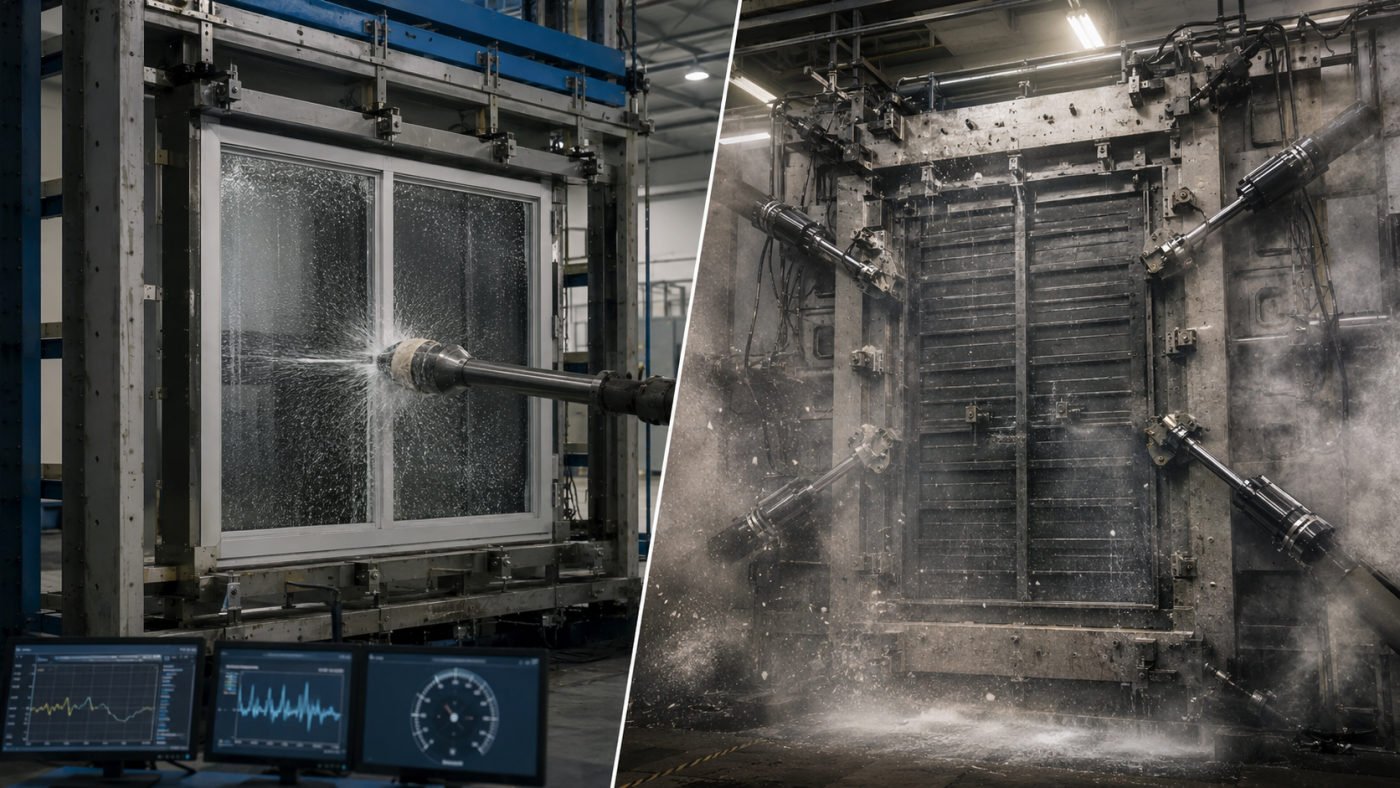
The word "certified" appears in practically every hurricane protection quote issued in Mexico. Almost none of them specify under which standard, which forces were tested, or how. That is not a minor detail — it is the difference between two levels of rigor that are light years apart.
I have reviewed dozens of quotes for hotels and luxury residences along the Mexican coast where the only technical reference is the word "certified," with no file number, no standard, no laboratory. That is not information. It is a word that reads well in a sales proposal.
When a quote describes a product as "certified," what matters is not the word itself but the standard it refers to. So it is worth clarifying what Miami-Dade actually evaluates, how that differs from Level E, why testing forces separately is not the same as testing them simultaneously, and what questions a buyer should ask to know precisely which certification the system under review actually holds.
Miami-Dade County, in Florida, has the most demanding civil building code for hurricane zones in the United States. A system with a Miami-Dade Notice of Acceptance (NOA) has passed serious testing for wind, water, projectile impact, and barometric pressure. It is unquestionably a respectable standard — and most protection systems sold in Mexico do not even reach that level.
Level E is something else. It is the ASTM E1996-09 standard used by the United States military, developed originally not for luxury residential construction but for facilities that cannot fail under any circumstance: naval hospitals, air bases, command installations. The difference in purpose explains the difference in rigor.
Miami-Dade tests wind, water, projectiles, and barometric pressure separately. Level E requires all four forces to be tested simultaneously — replicating with far greater fidelity what actually happens during a real hurricane.
Why simultaneity is not a technicality
A hurricane does not attack a building one force at a time. Wind, horizontal rain, projectiles, and barometric pressure all occur at once, for hours. A system can pass four successful individual tests — resisting wind in one, impact in another, water in a third — and still behave in a completely different way when those four forces act together, which is exactly how a real hurricane behaves.
It is comparable to testing a car's brakes, steering, and suspension separately under controlled conditions, versus testing the complete vehicle through a tight curve at high speed, in the rain, with the engine under full load. Both tests tell you something. Only one tells you whether the complete system works in real conditions.
Level E also requires projectile impact at 80 feet per second, against Miami-Dade's 51 feet per second — 57% more demanding. In practical terms, the difference is a metal object striking the system at a considerably higher speed, far more representative of the real debris a Category 5 hurricane sets in motion.
What Happens When the System Is Not Tested as a Whole
During a technical review we carried out for a development in the Riviera Maya, we found a system installed by another supplier with separate Miami-Dade documentation for the fabric and, independently, for the anchoring system. Each component, reviewed in isolation, passed its test. What did not exist was documentation that both components, working together under the four simultaneous forces, had ever been evaluated as a complete system.
That distinction — components certified separately versus a system certified as a unit — is exactly the gap Level E is designed to close. An anchor that resists static pressure can behave very differently when that same pressure arrives accompanied by vibration from projectile impact, something only simultaneous testing reveals.
To date, we are the only company in Mexico holding this military Level E certification. Not because it is impossible to obtain, but because the testing process is significantly longer, more expensive, and more demanding than certifying components separately under civil standards.
Why Level E was created for naval hospitals, not residences
The origin of a standard says a great deal about its real level of rigor. Level E was not developed by a manufacturers' association looking for a commercial differentiator. It was developed by the United States military for installations where failure is not an acceptable possibility under any circumstance — naval hospitals, air bases, command centers that must keep operating even through the most severe weather event conceivable.
That origin explains why Level E is not simply "somewhat stricter" than Miami-Dade — it is a different category of standard, built on the premise that failure is not an option, rather than the premise that failure is unlikely. When a luxury property, hotel, or commercial development in Mexico adopts that same standard, it is applying a failure-tolerance criterion originally designed for critical military infrastructure.
What an NOA Number Actually Tells You That Marketing Language Does Not
A Miami-Dade Notice of Acceptance carries a specific file number, verifiable on the county's website. That number tells you exactly which product was evaluated, under what configuration, and what limits of application it carries — for example, the maximum opening size for which it is valid, or the type of substrate it can be anchored to.
That is information a sales brochure rarely includes at that level of detail, because a specific NOA almost always comes with restrictions that do not read as well in a proposal as the word "certified" with no further context. Asking for that number, and reading the specific conditions under which it was issued, is the most direct way to know whether the system you are evaluating genuinely applies to your property, or whether the NOA being cited corresponds to a configuration different from the one being installed.
Why this matters even more in investment due diligence
This distinction between certification levels becomes especially critical in the purchase and sale of high-value properties. During investment due diligence, it is common that no buyer — not their legal team, not their technical team — can actually verify who installed a property's protection, or under what standard, if the seller can only offer the word "certified" with no supporting documentation.
That lack of traceability is not a minor administrative detail in a multimillion-dollar transaction. It is a risk that, correctly identified, should be reflected in the property's valuation or in the terms of the transaction — the same way any other critical building system gets verified before a purchase closes.
What to Verify Before Accepting the Word "Certified"
- Was the system you are evaluating tested with the four forces separately, or simultaneously?
- At what impact speed was it certified — 51 feet per second or 80 feet per second?
- Does the certification cover the complete installed system — fabric, anchoring, and configuration — or only individual components?
- Is there a verifiable file number, or only the word "certified" with no documentary backing?
- Can your supplier show you the certification document, or only a commercial description of the product?
"Meets Miami-Dade" and "Level E certified" describe radically different levels of rigor. Both use the word "certified." Only one has been tested under the closest conditions to a real hurricane that exist outside a real hurricane.
Closing
- Miami-Dade is a serious and well-respected civil standard, but it should not be confused with Level E. The first verifies important capabilities separately; the second demands a level of simultaneity and severity far closer to the extreme conditions of a real hurricane, along with a considerably more demanding projectile impact.
- The practical consequence is simple: hearing the word "certified" is not enough. You have to ask for the exact standard, the document that backs it, and the real scope of the test on the complete system. In a major investment, that technical precision is not a minor detail; it is part of basic due diligence.