Quick Answer
Hurricane fabric protection systems are custom-engineered based on high-velocity wind-load calculations, opening spans, mounting substrates, and motorization requirements. Contact our engineering team directly for a precise project calculation.
Why the Price per m² Varies So Much in Cancún (and Why That's Not Necessarily a Bad Sign)
If you request quotes from three or four hurricane protection companies in Cancún, you will very likely receive three or four significantly different prices per m² — sometimes with differences of several times between the most affordable and the most expensive option.
This raises a logical question: is someone overcharging, or is someone offering less than it appears? The honest answer is: it depends — but that is almost never information the quote itself gives you.
Hurricane fabric protection systems are custom-engineered based on high-velocity wind-load calculations, opening spans, mounting substrates, and motorization requirements. Contact our engineering team directly for a precise project calculation.
In other words: the price per m² is the starting point of a comparison, not the end. What determines whether a price is "expensive" or "cheap" is what that price includes.
This guide complements Hurricane Solution's general coverage of hurricane protection in Mexico, focusing specifically here on how pricing is formed in the Cancún market.
The Five Factors That Really Determine the Price (and That Quotes Rarely Explain)
1. Type of System
The most common systems in Cancún include high-density hurricane fabric and mesh, rigid panels (accordion shutters, rolling shutters, removable aluminum or polycarbonate panels), and high-end certified systems with specialized anchoring. Fabric and mesh tend to be the lowest initial-cost option; rigid panels and high-end certified systems represent a greater investment, but with corresponding differences in durability, service life, and documented protection level.
2. Certification
A system with an ASTM E1996/E1886 test report or Miami-Dade NOA involves materials, manufacturing processes, and anchors that have been evaluated — which generally results in a higher cost than a locally manufactured system without that documentation. To understand exactly what to ask for and how to verify it, refer to the article on certified vs. non-certified hurricane shutters in Cancún.
3. Type of Anchor
The anchor — the component that connects the system to the building structure — rarely appears itemized in a quote, but it can represent a significant cost difference. Stainless steel or salt-corrosion-resistant alloy anchors (relevant in the Hotel Zone due to direct exposure to the Caribbean Sea) cost more than standard anchors, but they also last longer in a high-salinity environment.
4. Complexity of Openings
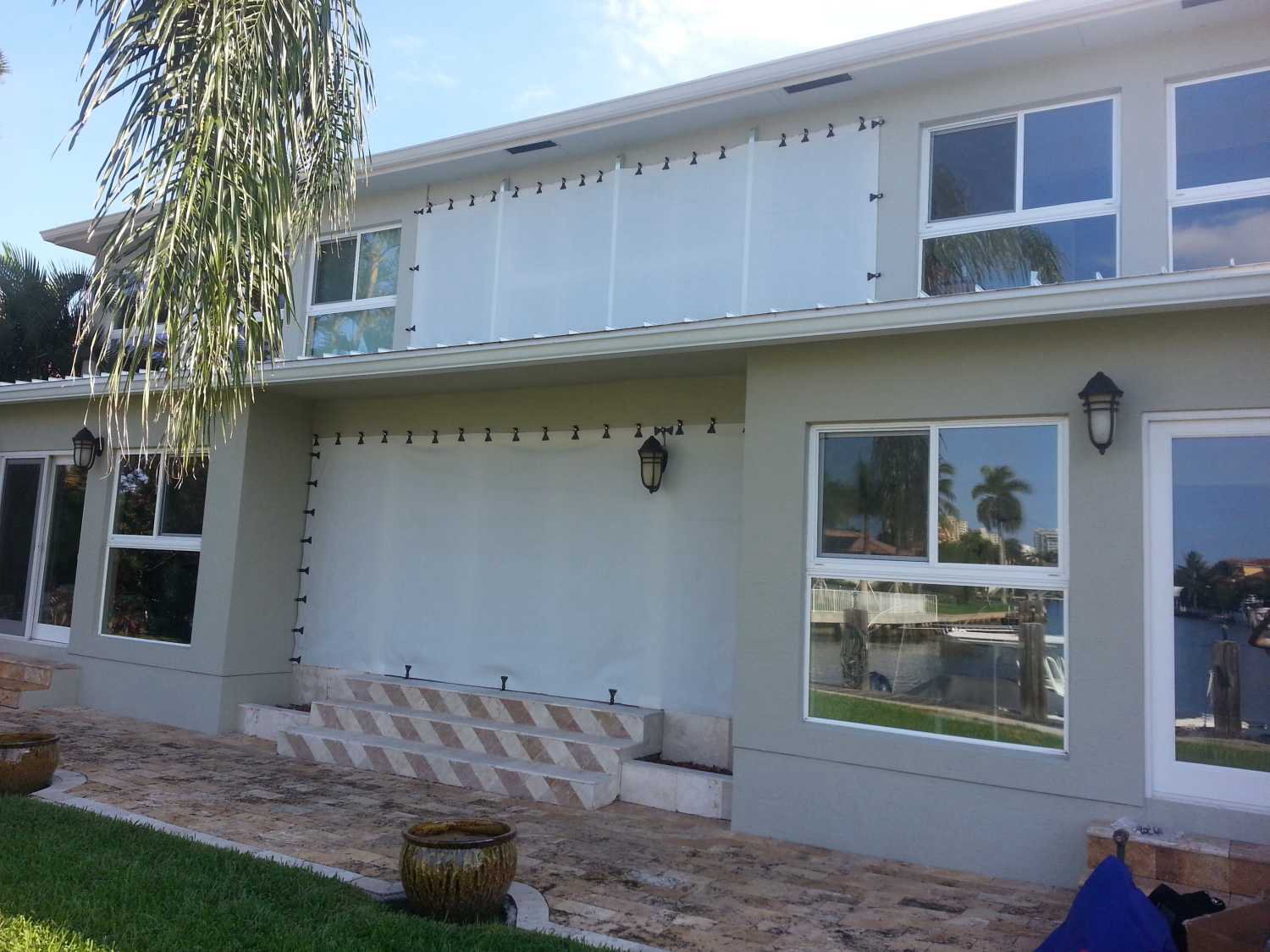
A standard 1.2 x 1.2 meter window is a relatively simple installation. A floor-to-ceiling window measuring 3 x 2.5 meters, a large sliding door, or an open terrace/balcony — common in luxury Hotel Zone apartments — require more complex solutions. Systems like AquaGrid are designed for large openings that no standard system covers well, and they carry a higher cost per m² than standard windows, even when using the same base system type.
5. Access and Installation Logistics
An apartment on a high floor of a tower in Puerto Cancún or Isla Dorada may require specialized access equipment (scaffolding, aerial platforms) that a single-story house does not — which is reflected in the installation cost, not in the material itself.
A Real Example: Why Two Quotes for the "Same" Apartment Can Look So Different
Imagine a 120 m² apartment on the 8th floor of a tower in Puerto Cancún, with six standard windows, a floor-to-ceiling living room window (3.5 x 2.4 m) with an ocean view, and an open terrace of 15 m².
Quote A covers only the six standard windows with mid-range hurricane mesh, without specifying certification or anchor type, and does not include the living room window or the terrace — because "they are more complex" and would be quoted separately if the client requests it. The total price seems reasonable compared to the apartment's construction cost per m².
Quote B includes the six windows, the floor-to-ceiling window (using a system designed for large openings), and a protection system for the terrace, all with stainless steel anchors and certification documentation. The total price is significantly higher.
At first glance, Quote A seems like the more affordable option. But when compared by what it actually covers, Quote A leaves the two largest and most exposed openings of the apartment unprotected — the living room window and the terrace — which are precisely the ones that, if they fail during a hurricane, generate the internal pressurization that can damage the rest of the unit even if the smaller windows are well protected.
The price per m² of Quote A may appear lower because it is literally covering fewer m² of actual exposure — not because it is more efficient.
Is the Lowest Price Always a Red Flag?
Not necessarily — but the lowest price without explanation should prompt questions, not be automatically dismissed or accepted.
There are legitimate reasons why a system may cost less: thinner materials that are still adequate for small, less-exposed openings; uncertified systems that nonetheless offer reasonable protection for tropical storms (though not for Cat 4-5); or simply a company with lower operating costs that passes those savings on to the client.
The way to distinguish a legitimately low price from one that conceals important limitations is the same in both cases: ask the quote to specify exactly which openings it covers, what system and certification it includes, and what type of anchor will be used. A low price with that complete information is a valid option the client can consciously evaluate. A low price without that information is simply incomplete information — regardless of whether the final result is good or bad.
What Makes the Hotel Zone Particularly Relevant for Cost Calculations
Two factors specific to the Hotel Zone affect protection costs in a particular way:
This means that, for a typical Hotel Zone property, the "right" price per m² is not necessarily the lowest available in the general Cancún market — it is the one that corresponds to the specific conditions of that area.
Key Insight #1: "Protected m²" vs. "Construction m²" — Two Numbers That Are Constantly Confused
When someone asks "how much does it cost to protect a 120 m² apartment?", they are thinking about the size of the apartment — but hurricane protection pricing is calculated on the area of the openings (windows, doors, terraces), not on the total area of the apartment.
This means that a small apartment with large windows may cost more to protect than a larger apartment with standard windows — something that seems counterintuitive if you think in terms of "property m²." Requesting the calculation in "m² of opening to be protected," not in "construction m²," is the correct way to compare quotes across properties of different sizes.
Key Insight #2: Why Quoting "in Parts" Can Cost More Than Quoting the Whole
Some quotes deliberately leave out the most complex openings (large windows, terraces) and offer them "separately, if needed" — which makes the initial price appear lower.
The problem is that the largest openings are also typically the most critical for preventing internal pressurization — so protecting them "later, if necessary" is not truly optional from a protection standpoint, even if it is presented that way from a commercial standpoint. Requesting a quote that covers the complete building envelope from the start generally results in a lower total cost and a more coordinated installation than contracting protection in parts at different times.
Key Insight #3: Salinity as a "Hidden Cost" That Doesn't Appear in the Initial Price
Two systems with the same initial price per m² can have very different total costs over 5 years, depending on whether the anchor was specified to withstand the salinity of the Hotel Zone.
An anchor that corrodes within 2-3 years implies a replacement or repair cost that does not appear in any initial quote, but that is completely predictable if the anchor material is known from the start. This turns the question "what material is the anchor made of?" into a financial question, not just a technical one — it directly affects the real cost of protection over time, not just the installation price.
Comparative Table: What to Expect by System Type (Indicative)
Note: these ranges are indicative and describe relative positioning between system types, not exact figures — the actual price depends on the five factors described above for each specific property.
Decision Framework: Steps to Take Action
Step 4: For Properties with Large or Luxury Openings in the Hotel Zone
If your property has floor-to-ceiling windows, panoramic sliding doors, or open terraces, you will likely need a solution specifically designed for those dimensions, not just an extension of a standard system.
Conclusion
The question "how much does it cost?" has an honestly uncomfortable answer: it depends — but not arbitrarily. The price of hurricane protection in Cancún's Hotel Zone depends on specific, verifiable factors: which openings will be protected, what type of system will be used, whether it is certified, and what material the anchor is made of.
The wide price variation in the market does not mean that some companies are "ripping you off" and others are "honest" — it means that different quotes may be describing genuinely different solutions, even if they are presented with a single price per m². The only way to compare fairly is to ask each quote to specify which openings it covers, what system and certification it includes, and what anchor it will use.
For properties in the Hotel Zone — where salinity and large openings are real long-term cost factors, not just initial price factors — this clarity is especially important.
Hurricane Solution quotes considering the complete envelope of each property from the start, with certification documentation, salt-corrosion-resistant anchor specification, and solutions for large openings when necessary — so that the price you receive reflects exactly what you will get. Learn more about our solutions at hurricane protection and our residential section.
Frequently Asked Questions
Can I ask that only some windows be protected to save cost?
It is possible, but protecting only some openings may leave the rest of the property vulnerable to internal pressurization if an unprotected opening fails during the hurricane. If budget is a real constraint, it is worth prioritizing the largest and most exposed openings first, not necessarily the easiest or most economical ones to protect.
Does the price include installation, or just the material?
This varies by provider and must be clearly specified in the quote. The price per m² may refer only to the material, or to the fully installed system — confusing the two is one of the most common ways two quotes "seem" very different when they are actually describing different things.
Is it worth paying more for a certified system if my budget is limited?
It depends on your exposure and which openings you are protecting. For large openings, on the first line of the beach, or in buildings where your protection affects other units, certification has a direct impact on the actual level of protection. For small, less-exposed openings, mid-range uncertified systems may be a reasonable option within a limited budget — as long as that difference is understood.
Do prices go up during hurricane season?
It is a common pattern in hurricane protection markets: installation demand concentrates in the months before the season or when a storm warning is already active, which can affect both price and installer availability. Quoting and planning ahead — before June — generally offers more options and better conditions.
How do I know if a "cheap" quote is leaving something out?
Ask the quote to explicitly list each opening in your property (windows, doors, large windows, terraces) and confirm which ones are included. If any large opening or terrace does not appear on the list, it is probably not included in the price — and it is worth asking specifically why.