It all starts almost imperceptibly
A darker cloud on the horizon. The wind shifting slightly. Within minutes, the terrace full of guests enjoying the ocean starts turning into something very different: waiters scrambling for solutions, staff moving without a clear protocol, guests grabbing their plates and glasses. The restaurant that was open and breezy seconds ago becomes closed, damp, and uncomfortable.
Rain doesn't send a warning, and the guest experience doesn't pause while the team figures out what to do. Rain protection at coastal hotels in Mexico shouldn't be understood as a cosmetic upgrade for terraces, but as part of the hotel's operating system: it determines whether an outdoor space keeps generating revenue during rainy season or becomes lost capacity every time the weather changes. That's why it can no longer be an improvised reaction—it has to be built into how the hotel operates.
The difference between covering and protecting
Many hotels believe they already have rain protection because they have awnings or tarps they set up when the weather turns. But covering is not the same as protecting.
Covering is reacting once the problem has already started. Protecting means being ready before the first drop falls, keeping the space functioning without disrupting the experience—no unnecessary scrambling, no trapped humidity, no sense of emergency. A well-designed system lets the restaurant keep being a restaurant, even while it rains.
When it starts raining, everyone is watching you
Guests don't analyze internal logistics—they perceive how the team responds. Order and speed read as professionalism. Confusion reads as exactly that. Rain itself doesn't damage the terrace; what it can damage is the perception of control.
A wet terrace dries over time. A bad experience can linger much longer, especially in the era of online reviews, where every moment has the potential to become a story.
A typical case: two terraces, the same rain
Same 20-minute storm, two neighboring properties. At the first, staff run between tables and someone tries to manually unroll a tarp while the wind fights back; the experience is disrupted for 15-20 minutes and several guests film it on their phones. At the second, a sensor detects the change in pressure and humidity, the system deploys in under a minute, and service continues—some guests don't even notice it activated. The difference isn't the weather: it's whether the property had a system or just a reaction plan.
Designed for hotels that can't close
In destinations like Cancún, Riviera Maya, Tulum, and Los Cabos, outdoor areas aren't a decorative extra—they're central to the business. Closing those spaces every time it rains hard isn't realistic. Rainy season along the Mexican Caribbean runs from May to October, and downpours arrive suddenly, precisely during the months when outdoor spaces represent a significant share of food and beverage revenue.
What repeated closures really cost
Consider a terrace with 15 tables operating during rainy season. If a 20-30 minute downpour interrupts service once a day, and each interruption means an average of 2-3 tables that don't get reoccupied that session, the impact compounds day after day for 6 months. The cost isn't just the direct revenue lost in the moment—it's the effective occupancy of the space over the whole season, plus the operational efficiency of a team spending time "handling" the rain instead of serving guests. An outdoor terrace or restaurant that repeatedly closes for rain loses revenue that never comes back: everyday rain protection is a profitability decision, not a comfort one.
HS Rain Protection: Hurricane Solution's system
HS Rain Protection is Hurricane Solution's system for protecting terraces, restaurants, pool areas, and outdoor hotel spaces against rain, wind, and sun. It requires no permanent structure, deploys in minutes, and keeps spaces operational throughout rainy season in Cancún, Riviera Maya, Playa del Carmen, and the entire Mexican coast—from Los Cabos to Huatulco. It's designed specifically for high-intensity hotel environments, not occasional residential use.
Three advantages that matter
More operating days: outdoor areas keep functioning during heavy rain. More tables, more customers, more revenue, regardless of weather.
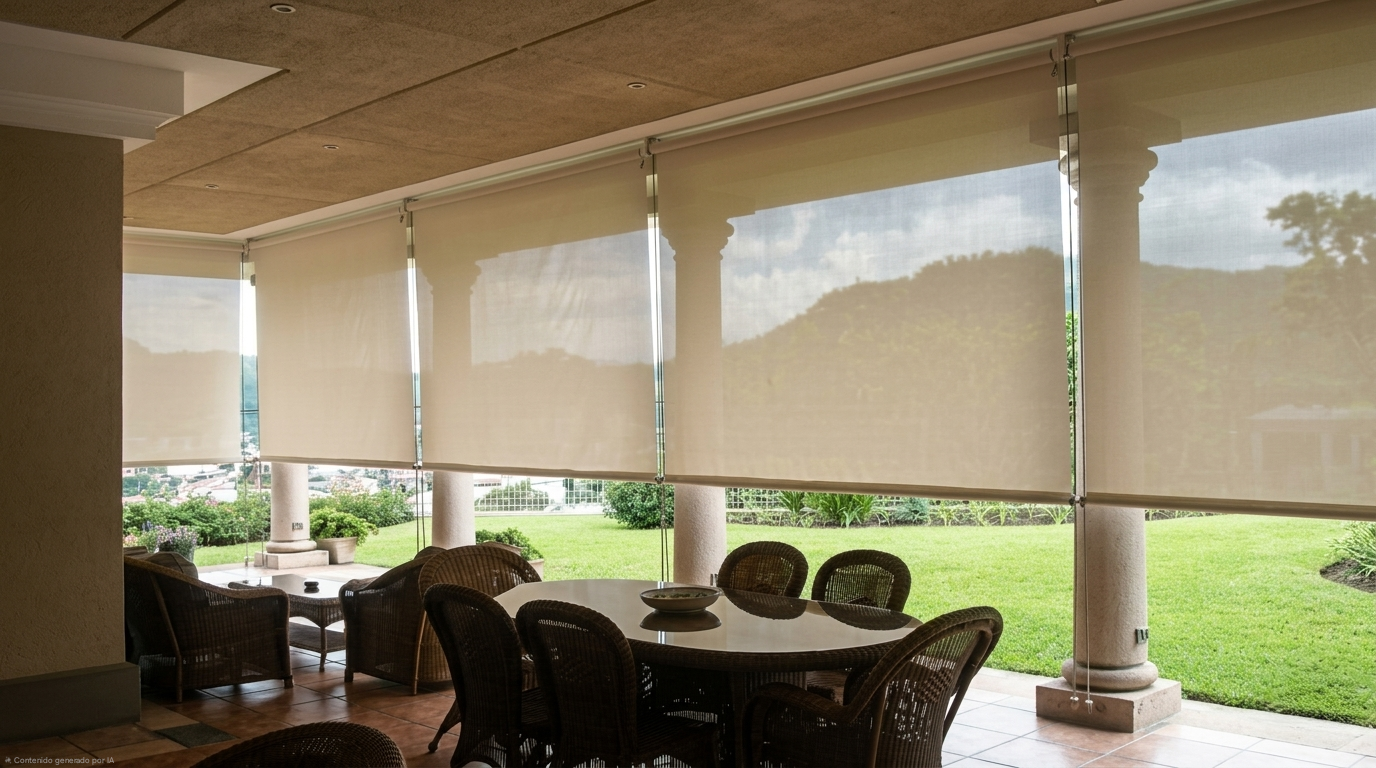
Without compromising the space: designed to integrate with the architecture. When not needed, it stays neatly retracted; when needed, it deploys in minutes with no special tools.
Low maintenance: technical fabric resistant to UV, humidity, and salinity, requiring only occasional washing with soap and water. It doesn't rust or fade, built for Mexico's coastal climate, where high salinity and intense UV radiation quickly degrade lower-quality systems.
Two operating systems
HS Rain Protection operates in two configurations, each designed for different types of spaces.
Mechanical system: more convenience for medium-sized areas, with efficient deployment requiring no physical effort. It's the most common solution for beach restaurants and hotel terraces with daily operation, balancing installation cost, ease of use, and durability.
Electric system: automatic deployment with remote control, especially suited for large-format spaces such as main restaurants, event areas, and outdoor lobbies. With integrated rain sensors, the system can activate without staff intervention, protecting the space before guests even notice the weather has changed.
Where is it applied?
HS Rain Protection is designed for three types of spaces on coastal properties: hotels (terraces, restaurants, bars, and pool areas), restaurants (more tables available year-round, regardless of weather), and high-value residential properties by the ocean (patios, balconies, pergolas, penthouses), applying the same technology that protects hotel operations to private use. Learn more about hotel protection and commercial protection.
From improvisation to protocol
Most hotels have formal hurricane plans, but when heavy rain hits mid-service, the procedure isn't always as clear. A real rain protection system simplifies the protocol: rain is detected, the mechanism activates, the space is protected, and service continues, without unnecessary tension. The best system is the one guests barely notice—that's quiet professionalism.
The connection with hurricane protection
Everyday rain and hurricanes aren't two separate problems—they're different manifestations of the same climate risk system along the Mexican coast. Leaks during a rainstorm with 60 km/h winds aren't "working partially"; they reveal a vulnerability that amplifies exponentially when a stronger cyclonic system arrives.
A hotel that has protection for everyday rain but not for its main openings against a hurricane only has half the system. Hurricane Solution offers the complete system: from HS Rain Protection to certified category 5 hurricane protection with the HS-1500, HS-1250, and HS-875 systems for openings, and AquaGrid for facades and large-format openings.
If you could only do one thing: the gold standard
If a coastal property could only make one decision about its outdoor spaces, it would be this: an electric system with rain sensors for the spaces with the greatest revenue impact (main restaurant, event area), combined with a mechanical system for secondary terraces, integrated into the same certified protection strategy that covers the property's openings against hurricanes. This isn't "buy the most expensive option"—it's recognizing that climate protection works best as a system layered by impact, where everyday protection and hurricane protection form a single system.
Decision framework: what system does your property need
Step 1: identify your current situation (no system, basic coverage, worn manual system, or a functional system you want to review).
Step 2: assess each space's impact on your operation: what percentage of your food and beverage revenue depends on it during rainy season, whether it's high-traffic or secondary, and whether it's used for events where an interruption would be especially visible. Higher-impact spaces are natural candidates for an electric system with sensors; secondary ones can be covered efficiently with a mechanical system.
Step 3: consider your location's specific coastal environment: exposure to salinity and wind, and whether the material is treated for the Mexican Caribbean or Pacific climate.
Step 4: connect this decision with your hurricane protection. If your main openings don't yet have certified hurricane protection, evaluate both systems as a single conversation with Hurricane Solution, not as two separate projects.
Conclusion
Rain will keep being part of the environment along the Mexican Caribbean and Pacific. The difference lies in how you choose to respond. Repeatedly closing due to rain affects revenue, experience, and brand perception; rain protection shouldn't be seen as an added expense—it's a tool that protects operational flow and long-term reputation.
HS Rain Protection keeps hotel terraces, restaurants, and outdoor areas operational throughout rainy season in Cancún, Riviera Maya, and the entire Mexican coast, with no permanent structures and without turning every downpour into an emergency. Request a free quote for your terrace, restaurant, or outdoor area through our FAQ page or contact us directly.
Frequently Asked Questions
What is HS Rain Protection and what properties is it designed for?
It's Hurricane Solution's system for protecting terraces, restaurants, pool areas, and outdoor spaces against rain, wind, and sun, designed for hotels, restaurants, and high-value residential properties on the Mexican coast. It requires no permanent structure and deploys in minutes.
How long does the system take to deploy?
It deploys in minutes. The mechanical system operates with no physical effort; the electric system can be programmed with rain sensors to activate automatically, with no staff intervention.
Does the system alter the space's aesthetics when not in use?
No. It's designed to integrate with the architecture and stays neatly retracted when not needed.
What maintenance does it require in a marine environment?
The technical fabric resists UV, humidity, and salinity. Maintenance is limited to occasional washing with soap and water; it doesn't rust or fade.
How does it relate to hurricane protection?
Leaks in openings during windy rain are vulnerability signals that amplify during a hurricane. Hurricane Solution offers both HS Rain Protection for daily use and certified hurricane protection systems for openings and facades.
Where does Hurricane Solution operate?
From Los Cabos to Huatulco, with the same team and standards across the Mexican coast, including Cancún, Riviera Maya, Puerto Vallarta, and Acapulco.