A continuity decision, not a maintenance expense
For a hotel in Puerto Vallarta, hurricane protection should not be evaluated as a maintenance expense, but as an operational continuity and financial risk management decision. A partial or full closure due to structural damage during high season can mean weeks of lost revenue, high repair costs, cancellations, and a reputational impact that extends well beyond hurricane season.
Hurricane Solution currently protects thousands of rooms across some of the most prestigious hotel properties in Puerto Vallarta and Punta Mita, with a full-time local team that makes this bay the company's second most important market in Mexico. Learn more about our hotel solutions.
Why the conversation changes when it's a hotel
When a residential owner evaluates hurricane protection, the main question is usually "how much does it cost?" When a hotel operator makes the same evaluation, the right question is different: "how much does it cost me NOT to have it?"
An operational closure, even partial, has cascading effects: direct room revenue loss, future cancellations due to negative reviews, relocation costs for already-lodged guests, and in some cases, contractual penalties with booking platforms or international tour operators. The real cost of not having certified protection isn't measured only in structural damage — it's measured in lost revenue, future cancellations, and the cost of rebuilding trust with guests and travel agencies.
How much an operational closure represents
For a mid-sized hotel in the Romantic Zone or Marina Vallarta, with high-season occupancy near 80-90%, closing a full wing due to window or terrace damage can mean an effective occupancy drop of 25% to 50% during the repair period, which can extend from two to eight weeks depending on material and contractor availability.
A 120-room hotel operating at 85% occupancy before the event, dropping to 40% effective occupancy during six weeks of repairs, can lose the equivalent of several months of normal low-season revenue — not counting direct reconstruction costs, damaged furniture, and management time spent managing the crisis instead of normal operations.
Most hotel risk analyses focus on the physical repair cost. However, the biggest hidden cost is usually the lost RevPAR during the repair window: the revenue per available room the hotel stops generating while damaged rooms remain out of service, even if the rest of the property keeps operating normally.
The pattern between protected and unprotected properties
A consistent pattern in the coastal hotel industry: properties with certified systems and full opening coverage typically continue operating during and after tropical storm or lower-category hurricane events, with disruptions limited to hours, not weeks. Properties with partial protection — plywood panels on only some windows, uncovered terraces — more frequently face outdoor furniture damage, water infiltration into common areas, and in severe cases, closure of entire wings.
This pattern doesn't depend solely on the intensity of the weather event — it depends decisively on whether the property had certified full-envelope protection or improvised partial protection. An illustrative example: two comparable hotel properties in the same area, exposed to the same tropical storm. The one with a certified full-envelope system — including its terrace restaurant with rain protection — keeps food service running without interruption. The neighboring property, without terrace protection, closes its restaurant for two full days and faces negative comments in reviews published that same week. The difference wasn't the storm — it was preparation.
What a hotel really needs: beyond the window panel
- Guest areas: windows, balconies, and sliding doors in all rooms, with special attention to upper floors in tower-type properties, where wind pressure is greater.
- Common and reception areas: lobbies with large-format glass facades — exactly the type of opening that most raises the risk of internal pressurization if it fails.
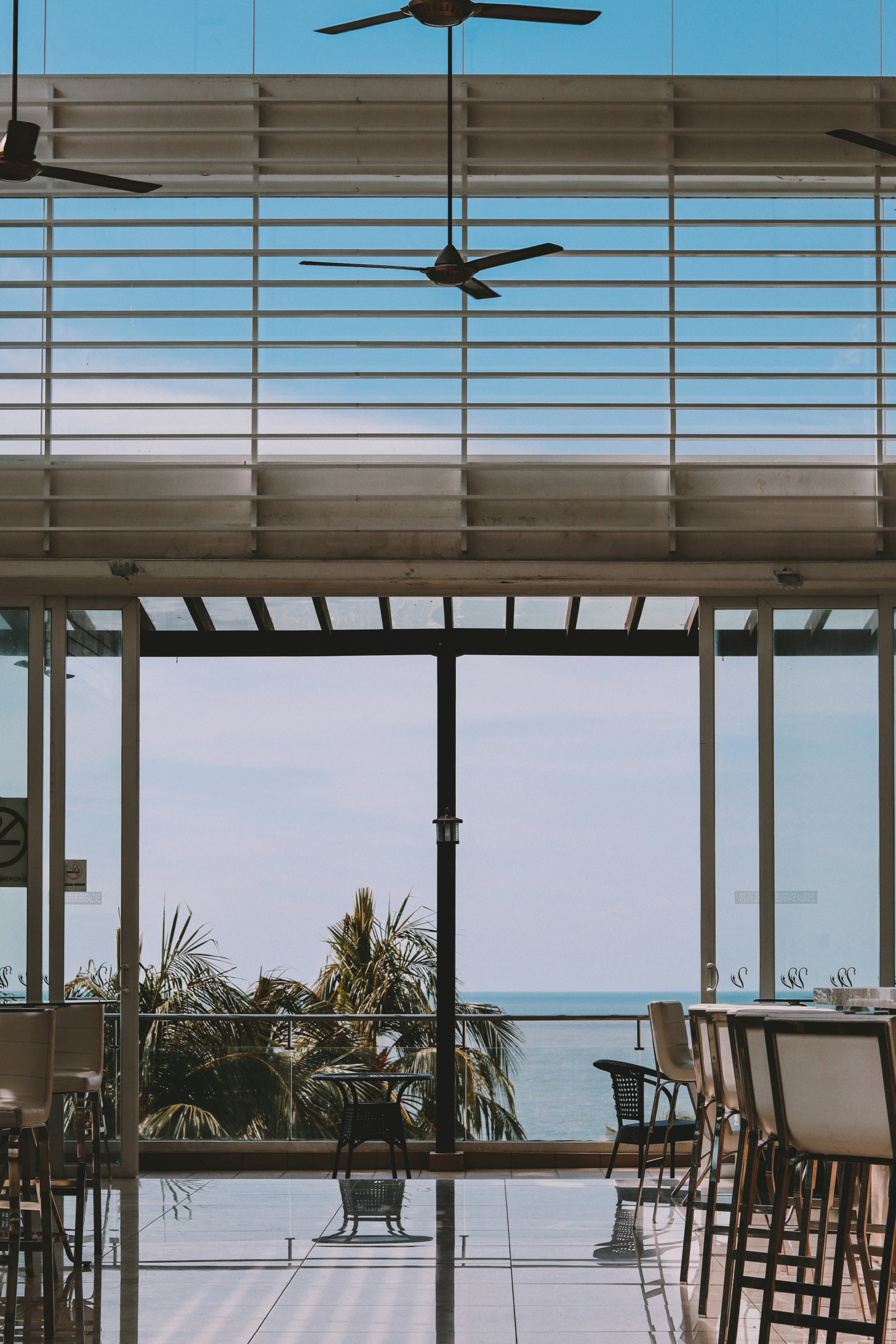
- Restaurants and terraces: here the challenge isn't just wind — it's horizontal rain and daily operation. The right solution is usually a rain protection system designed specifically for terraces and restaurants, which also allows normal operation during regular summer rains.
- Technical facilities: generators, HVAC equipment, and exposed electrical systems, whose protection prevents prolonged operational interruptions.
Reactive vs. proactive operation
A reactive hotel improvises protection every time a storm warning is issued: mobilizing staff to install temporary panels, closing areas without real protection, and waiting. A proactive hotel already has certified protection systems installed permanently or ready for rapid deployment, clear closure and reopening protocols, and technical documentation ready to present to guests, corporate offices, and insurers. This difference — operational control versus reactive improvisation — is especially critical for hotel chains and large-scale developments, where consistency across properties is as important as individual protection.
Key terminology for hotel operators
- Effective occupancy: the real capacity to safely receive guests, which can drop significantly even without major structural damage, simply from preventive area closures.
- RevPAR (revenue per available room): a key metric directly affected by the time damaged rooms remain out of service.
- Operational continuity: a hotel's ability to keep functioning — or reopen as quickly as possible — after a severe weather event.
- Documented risk mitigation: formal technical evidence of installed protection measures, relevant for insurers and international hotel brand corporate standards.
If you could only do one thing
If a hotel in Puerto Vallarta could only invest in one protection measure, it should be certified full-envelope coverage: protecting 100% of exposed openings — not just ocean-facing rooms, but also common areas, restaurants, and service entrances — with a system tested under the ASTM E1996 reference standard. Partial protection, no matter how robust it seems in covered areas, leaves intact the internal pressurization mechanism that causes most severe structural damage.
Daily rain is already a version of the same problem
Many hotel operators mentally separate "hurricane protection" (a rare, extreme event) from "terrace rain problems" (a recurring operational nuisance). In practice, both are manifestations of the same physical phenomenon — wind and water interacting with a building's openings — at different intensities. A hotel that only solves the extreme scenario but not the everyday one keeps losing operational revenue recurrently, at a smaller scale than a hurricane, but continuously.
Cumulative financial impact: beyond the single event
The most common analysis focuses on the cost of a single severe event. However, the real financial impact of climate vulnerability in Puerto Vallarta accumulates differently: recurring partial closures from intense summer rains, cancellations of outdoor events at unprotected restaurants, and repair costs for outdoor furniture damaged by repeated humidity exposure, all adding up season after season. For a hotel with significant outdoor spaces — terraces, pool lounge areas, outdoor restaurants — this accumulated cost of "minor events" can, over time, exceed the cost of a single, infrequent catastrophic event. This is one reason why rain protection for daily operational spaces deserves the same budget attention as category-5 wind protection.
Decision framework: steps to take
Step 1: identify your property type
Boutique hotel, mid-sized hotel or resort, large-scale development with multiple properties, or restaurant/commercial property facing the public.
Step 2: evaluate your operational priority
Minimize closure during high season, meet international corporate brand standards, reduce insurance premiums through risk mitigation documentation, or protect reputation and guest experience.
Step 3: choose your solution
For hotel operations, the standard recommendation is full-envelope coverage — rooms, common areas, restaurants, and service entrances — with certified rapid-deployment or permanently installed systems, depending on each property's architectural design.
Step 4: for chains or multi-property developments
A standardized technical audit applied across the entire portfolio is recommended, with uniform documentation that can be presented to both corporate offices and international insurers, avoiding significant variation in protection levels from one property to another within the same brand.
Explore our solutions for the commercial sector and for residential properties owned by remote owners.
Conclusion
For a hotel in Puerto Vallarta or Punta Mita, hurricane protection isn't a maintenance line item — it's a business continuity decision with direct impact on revenue, reputation, and insurer relationships. The difference between an hours-long closure and a weeks-long one, between a positive review and a negative one, between a manageable premium and a high one, often comes down to a single variable: whether the property had certified full-envelope protection before the season began. Learn more in our hurricane protection section.
Frequently Asked Questions
What type of system does a hotel in Puerto Vallarta need?
It depends on the architectural design, but generally certified full-envelope coverage is recommended: rooms, common areas, restaurants, and service entrances.
Does hurricane protection reduce a hotel's insurance premium?
Technical documentation of a certified system can facilitate risk mitigation negotiations with insurers; several clients have reported favorable outcomes, though the exact effect depends on each policy and insurer.
What's the difference between protecting rooms and common areas?
Common areas, such as lobbies with large-format glass facades, usually represent the highest risk of internal pressurization if they fail, so they require the same priority as guest rooms.
Do restaurants and terraces need a different system?
Yes. In addition to hurricane wind protection, these spaces benefit from specific rain protection systems to maintain daily operation during the regular rainy season.
Does Hurricane Solution have experience with large hotels in the bay?
Yes. We currently protect thousands of rooms across some of the most prestigious properties in Puerto Vallarta and Punta Mita, with a full-time local team in the area. Learn more in our FAQ section.