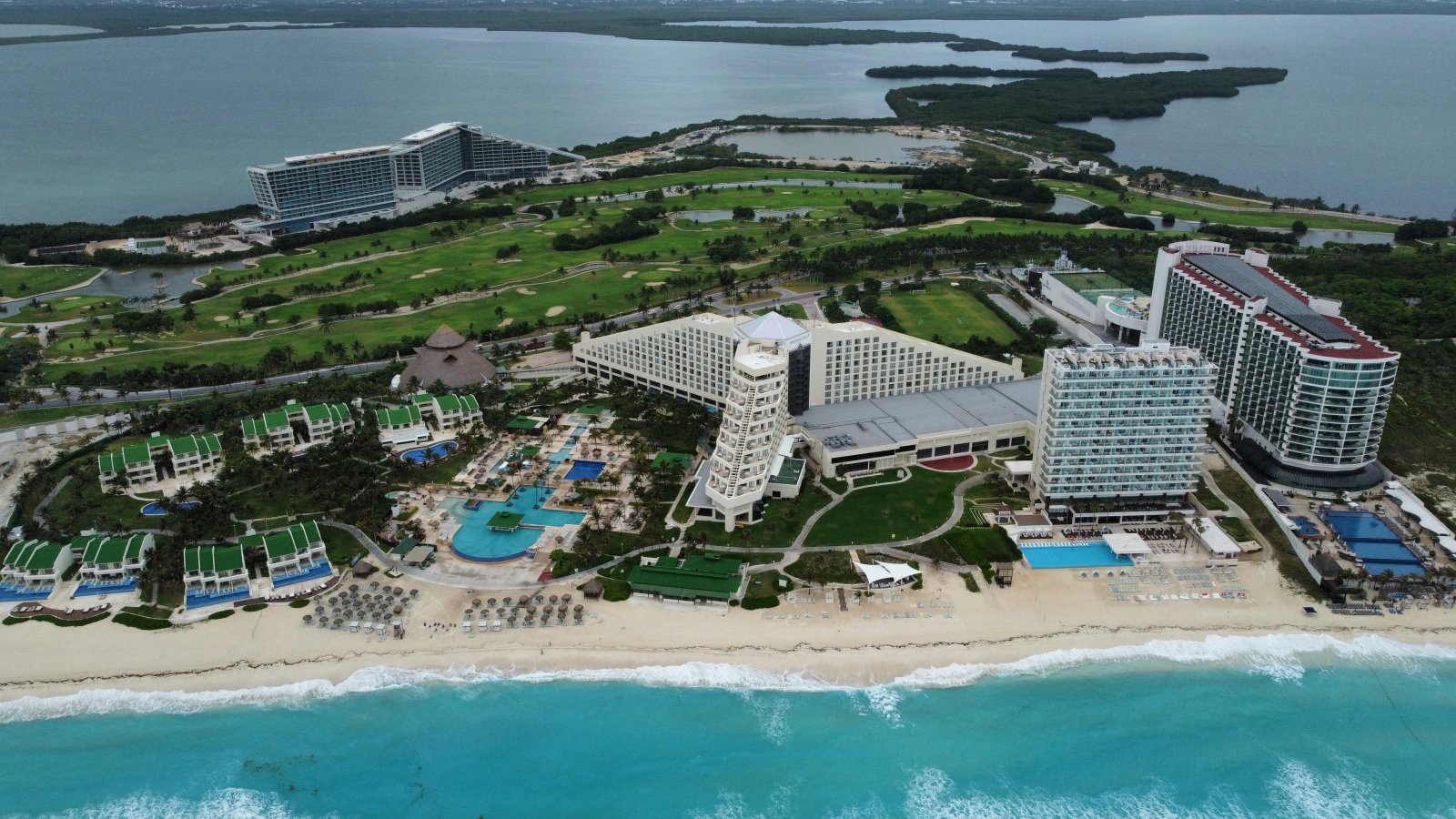
From "safety measure" to "amenity": a real shift in how Cancún is sold
For years, hurricane protection in Cancún was discussed almost exclusively in one context: what to do before a storm arrives. It was preparation information, not sales information.
That is changing. Today, listings for apartments at Bay View Grand, La Vela in Puerto Cancún, Isla Dorada, and similar developments in the Hotel Zone include phrases like "newly remodeled unit with hurricane shutters, new windows" or "high-efficiency windows with Category 3 hurricane resistance" alongside descriptions of finishes, views, and concierge services.
In Cancún's Hotel Zone, hurricane protection has shifted from a seasonal preparation measure to a real estate selling point: luxury condo listings such as Bay View Grand and Isla Dorada now mention hurricane shutters and hurricane-resistant windows in the same section as amenities like the pool, gym, and 24/7 security.
This is no coincidence. It reflects a more sophisticated buyer: foreign purchasers — many of them already aware of the Caribbean hurricane season before searching for property — now actively ask about protection as part of their decision-making process, just as they would ask about the building's air conditioning system or backup power.
This guide is part of Hurricane Solution's coverage of certified hurricane protection in Mexico, focused here on what it means for buyers and investors in Cancún's Hotel Zone.
"Category 3 resistance" in windows vs. certified protection for the entire building: the difference listings don't explain
This is where most buyers — and many real estate agents — lose the thread. A listing that mentions "high-efficiency windows with Category 3 hurricane resistance" is describing a feature of the glass or frame of that specific unit. That is real and has value — but it is only part of the full picture.
What window resistance DOES cover
Windows rated for Category 3 are generally designed to withstand impact from projectiles and wind pressure up to the thresholds associated with a Category 3 hurricane (sustained winds of approximately 178–208 km/h, according to the Saffir-Simpson scale). This significantly reduces the risk of glass breakage during events of that magnitude or lower.
What window resistance does NOT necessarily cover
Windows rated as Category 3 hurricane-resistant offer real protection against impact and wind pressure up to that level — but they are not equivalent to certified Cat 5 protection for the entire building, and they do not automatically cover common areas or the internal pressurization that can occur if other building openings fail during the hurricane.
In other words: the protection of your individual unit and the protection of the building as a system are two separate questions — and a real estate listing almost never answers the second one.
Why this matters more in Puerto Cancún, Isla Dorada, and the Hotel Zone than in other areas
Cancún's Hotel Zone — including developments such as Puerto Cancún, Isla Dorada, and the strip of oceanfront towers along Blvd. Kukulcán — is built on a narrow sandbar between Laguna Nichupté and the Caribbean Sea. This means direct exposure to marine winds with no natural barriers to reduce them before they reach building facades.
For properties in this zone, the question is not just "how resistant is my window?" but "how resistant is the building's complete system, including the areas I share with other owners?" — because in a condominium building, internal pressurization and damage to common areas affect all owners, not just the one whose window failed.
This makes certified hurricane protection for the entire building — not just individual windows — a shared risk factor, similar to how roof or facade maintenance in a building affects all owners equally, regardless of how well-maintained their individual unit may be.
Two towers in Puerto Cancún, two stories after hurricane season
Consider two neighboring condominium towers in Puerto Cancún, both marketed with "high-efficiency hurricane-resistant windows" as an amenity, both with similar sale and vacation rental prices.
Tower A has Cat 3 windows in every unit, but the common areas — the lobby with floor-to-ceiling windows, the pool palapa, the ground-floor restaurant — have no additional certified protection. Tower B has the same level of windows in the units, but also features a certified Cat 5 protection system for common areas and a pre-season deployment protocol.
During a strong tropical storm (not necessarily a major hurricane), both towers may perform similarly — the unit windows hold without issue. The difference appears in the scenario that amenities alone do not communicate: if a higher-category hurricane passes nearby, Tower A faces the risk of the lobby or palapa sustaining significant damage, generating internal pressurization that can affect units on upper floors — even those with perfectly intact windows — while also disrupting building operations (access, common-area electricity, vacation rental income) for weeks during repairs.
For an owner renting their unit as vacation income, that operational disruption — not the damage to their own window — is frequently the real financial cost of a hurricane.
What this means for buyers and investors
If you are evaluating a property in the Hotel Zone, Puerto Cancún, or Isla Dorada for investment purposes — whether as a second residence or a vacation rental property — hurricane protection as an amenity should be assessed at two distinct levels:
This distinction is especially relevant for pre-sale developments, where amenities — including hurricane protection — are described as part of the finished project, but certification documentation for the building's complete system may not be available until later stages of construction.
Connect this to your investment strategy: if your purchase's financial model includes vacation rental income during peak season — which in Cancún partially overlaps with hurricane season (June–November) — the building's ability to remain operational during and after a weather event is directly relevant to the projected return, not just to safety.
If you are evaluating protection options for commercial and investment properties in the Riviera Maya, incorporating this building-level protection assessment — not just unit-level — into your due diligence process can reveal risk differences between developments that otherwise appear equivalent.
Three insights that real estate listings don't mention
Insight 1: The amenity no one asks to see documented
Buyers who thoroughly question amenities like the A/C system, backup power, or water system of a building almost never ask to see the certification documentation for hurricane protection — even though both directly affect the habitability and operation of the building during extreme events.
This creates an asymmetry: hurricane protection is promoted using the same language as other verifiable amenities, but is rarely verified with the same rigor. For an informed buyer, requesting common-area certification documentation during the purchase process is as reasonable a question as requesting the maintenance history of the elevator or water treatment plant.
Insight 2: "Unit level vs. building level" as an invisible search filter
Real estate portals allow filtering by number of bedrooms, view, pool — but there is no standard filter for "certified building-level hurricane protection," because it is not data that developments report in a structured way.
This means two properties can appear equivalent in a search — same price, same view, same Cat 3 windows — while having completely different operational risk profiles at the building level. Until that data becomes a standard filter, the only way to obtain it is by asking the developer, manager, or agent directly — and documenting the response.
Insight 3: Why peak rental season and hurricane season overlap — and why that changes the risk calculation
In Cancún, part of the hurricane season (June–November) coincides with months of high vacation rental demand, especially for properties that attract visitors from regions where summer is vacation season.
This means that for investment properties, the risk of a weather event is not just a physical damage risk — it is a direct risk to projected income during specific months of the year. Evaluating the building's hurricane protection as part of the return-on-investment analysis — not just as a safety measure — is an angle that almost no listing or investment analysis mentions explicitly.
Decision framework: steps to take action
Step 4: For condominium and development managers
If you manage a building in the Hotel Zone or similarly exposed areas, hurricane protection for common areas is a building asset that benefits all owners equally — and can become a documentable differentiator compared to neighboring buildings.
To learn about certified protection options for hotel buildings and developments in Cancún's Hotel Zone, Hurricane Solution works with managers and developers to document Cat 5 systems at the complete building level.
Frequently asked questions
Does hurricane protection really increase the resale value of an apartment in Cancún?
While no formal study yet quantifies this effect in the Cancún market, the fact that luxury developments actively include it as an amenity suggests that developers perceive it as a relevant factor for buyers. For vacation rental properties, the ability to operate without interruptions during hurricane season has a more direct and measurable financial impact.
If my unit has Cat 3 windows, do I need additional protection?
It depends on your specific exposure and the building's overall protection. Cat 3 windows offer real protection for events of that magnitude or lower. For Categories 4–5, or if the building's common areas lack additional certified protection, it is worth evaluating complementary protection options for your unit. You can explore Hurricane Solution's residential solutions for individual units.
How do I know if my building has certified protection for common areas?
Ask the management or HOA directly whether certification documentation (ASTM, Miami-Dade NOA, Level E) exists for any system installed in common areas, and whether an operational deployment protocol exists before each hurricane season.
Does this apply only to the Hotel Zone, or to other areas of Cancún as well?
The logic of evaluating unit-level vs. building-level protection applies to any condominium property in a coastal zone. The Hotel Zone, Puerto Cancún, and Isla Dorada are highlighted in this article for their direct exposure to marine winds without natural barriers, which makes the difference between both levels of protection especially relevant.
As an investor, should I avoid developments that don't document this clearly?
Not necessarily avoid them, but treat it as a due diligence question as valid as any other regarding the financial or legal structure of the development. The lack of documentation does not mean the absence of protection — but it does mean that information has not been verified, which is relevant to your risk analysis.
Conclusion
The fact that hurricane protection now appears on the same list as the pool and concierge is, in many ways, a positive sign: it means the Cancún market is beginning to treat hurricane resilience as part of a property's value, not just as a maintenance expense.
But an announced amenity and a verified system are different things — and the difference between "Category 3 resistant windows" in a unit and certified Cat 5 protection for the entire building can determine whether a property remains habitable and operational after a major hurricane, or sits out of service for weeks during repairs.
For buyers, investors, and managers in the Hotel Zone, Puerto Cancún, and Isla Dorada, making this distinction — and requesting the documentation to support it — is as reasonable as verifying any other amenity that directly affects the value and operation of the property.
Hurricane Solution works with developments, managers, and individual owners in Cancún's Hotel Zone to document and certify Cat 5 protection at both the unit and complete building level, with Level E systems designed specifically for the coastal exposure of this zone. If you have questions about your building or development, visit our frequently asked questions section.