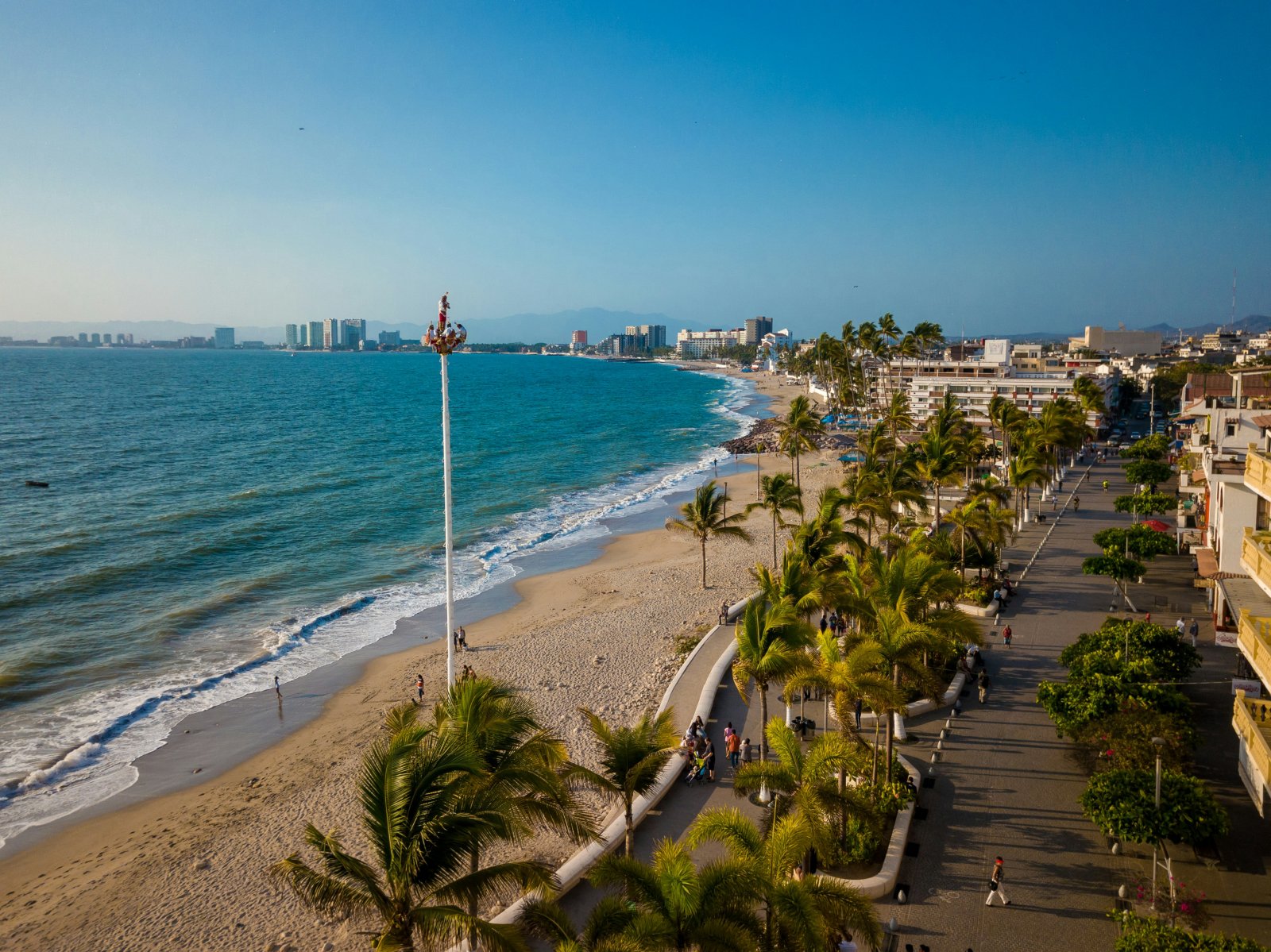
There is no single requirement for the whole bay
There is no single "requirement" for hurricane protection in Puerto Vallarta, because the Bahía de Banderas is not a uniform zone. Wind exposure, flood risk, and building height change drastically between Zona Romántica, Marina Vallarta, Conchas Chinas, Nuevo Vallarta, Bucerías, and Punta Mita. As a general rule, any beachfront property or high-floor tower unit should be evaluated for Category 5 protection with systems certified under standards such as ASTM E1996, while properties farther from the coast may consider intermediate systems, always with real hurricane-rated certification. Hurricane Solution performs this technical evaluation at no cost for properties across the bay.
Why location within the bay changes everything
Bahía de Banderas is one of the largest bays in the world. Its geography — Sierra Madre Occidental mountains wrapping the coast in a semicircle — can channel and amplify wind when a tropical system passes nearby, rather than simply blocking it, as many owners assume.
Two properties just a few kilometers apart can have completely different risk profiles. A hillside house, partially shielded by topography, may face less direct wind pressure but greater risk of runoff and landslides during heavy rain. A 12th-floor condo in Marina Vallarta, on the other hand, faces substantially higher wind pressure (PSI) than a one-story house, simply due to the physics of wind at greater height. Building height is one of the most decisive technical factors in the level of protection required: the higher the building, the greater the pressure on windows and openings, which can raise the requirement from Category 3 to Category 5 even within the same neighborhood.
Requirements by zone: what changes and what doesn't
Zona Romántica and the Malecón
High density of older construction mixed with new developments, facades open to the sea, and ground-floor businesses directly exposed to storm surge and wind. The risk here combines wind with urban flooding, since stormwater drainage in this historic area is not always designed for extreme rain events.
Marina Vallarta
Concentration of high-rise condo towers with elevated wind exposure on upper floors. Floor-to-ceiling windows and open balconies require especially robust protection: a failure on the 15th floor doesn't just endanger that unit, it generates debris projectiles toward lower floors.
Conchas Chinas and Amapas
Luxury beachfront residential properties on sloped terrain. Greater direct exposure to Pacific wind, combined with runoff risk toward lower parts of the terrain.
Nuevo Vallarta and Bucerías (Nayarit)
High concentration of remotely managed foreign-owned properties. The technical priority is usually permanent or rapid-deployment protection, since the owner is frequently not on site to install last-minute solutions.
Punta Mita
Very high-value residential and hotel developments with direct exposure to open ocean along certain coastal stretches. Required protection standards are usually the highest in the entire bay, given the value of the structures and the expectation of uninterrupted service at hotel properties.
Most guides treat "Puerto Vallarta" as a single risk zone. In practice, the bay functions as at least five distinct microzones, each with a different combination of wind exposure, flood risk, and predominant construction type. Treating the whole bay with the same technical criteria is one of the most common mistakes owners make when comparing quotes.
The factor almost no one evaluates: the building itself
A key and frequently overlooked requirement is the technical evaluation of the building itself before choosing any system. Not all windows, balconies, or access points receive the same wind pressure, even within the same property.
The facade's orientation relative to the prevailing wind, the height of the specific installation point, and the distance to the sea determine the design pressure (PSI) the system must withstand. A facade facing directly toward open ocean in Punta Mita may require a system rated for 1,500 PSI or more, while a side facade partially shielded by the building itself may work adequately with an intermediate-strength system, always with hurricane-rated certification.
Only a local professional installation team that understands the actual wind behavior in each microzone of the bay can make this assessment correctly. That is why Hurricane Solution keeps a full-time team permanently based in Puerto Vallarta, instead of sending temporary crews before each season. Learn more at hurricane protection.
Differential pressure: why it matters
When wind hits the windward facade (the one receiving wind directly), the building's internal pressure can rise sharply if that facade breaks, generating an outward expansive force on the remaining walls and roof — the mechanism behind most severe structural collapses during hurricanes.
Conversely, if the leeward facade (opposite the wind direction) fails, internal pressure can drop sharply, generating inward suction on the roof and other walls. In both cases the result is the same: a structure designed for normal wind pressures ends up subjected to forces several times greater, simply because a single opening failed. This internal pressurization phenomenon is the technical reason certification under standards like ASTM E1996 — which specifically evaluates a system's performance under pressure cycles, not just impact from a projectile — is just as relevant for Puerto Vallarta as it is for Florida.
Requirements by property type
- Standard residential: full coverage of windows and sliding doors, with special attention to open terraces and palapas, an almost universal architectural feature in Vallarta that isn't solved like a conventional window.
- Tower condominiums: certification for higher wind pressure resistance by height, plus coordination with the condo's regulations to maintain uniform building aesthetics.
- Commercial properties and restaurants: protection against wind and also against horizontal rain, which affects daily operations on terraces and semi-open spaces, not just during major hurricanes.
- Hotels and large-scale developments: comprehensive evaluation of all project openings, formal technical documentation, and verifiable compliance with international standards for operational continuity and insurer risk mitigation. More in the hotel protection guide.
Real pattern: two properties, same storm
A pattern that repeats consistently across the bay: two condos on the same stretch of Marina Vallarta, exposed to the same tropical storm. The first, with certified windows and full opening coverage, reports zero structural damage and continues operating normally the next day. The second, with wood panels installed only on the largest windows and sliding doors left uncovered, suffers water entry through the uncovered door, causing partial internal pressurization and damage to the main living room ceiling.
The difference between the two cases wasn't wind intensity — it was identical for both — but full coverage (complete envelope) versus partial protection. This pattern repeats often enough to be one of the most reliable indicators of why partial protection offers a false sense of security.
What is at stake
When a residential property suffers structural damage from a protection failure, typical repair time ranges from two to six weeks, depending on material and labor availability during peak hurricane season — exactly when they are most needed. For a vacation rental property, this means full weeks of lost income, plus the cost of the repair itself.
For a 40-room boutique hotel in Zona Romántica, the partial closure of a wing due to window damage can mean an effective occupancy drop of 25% to 40% during the repair period, not counting the reputational impact during peak season. This type of loss is exactly what a system with full envelope coverage and proper certification is designed to prevent.
Terminology every Vallarta owner should know
- Differential pressure: the air pressure difference between the inside and outside of a structure, which can rise sharply if an opening fails.
- Full envelope: protection of all of a building's openings, not just some — a requirement, not an option, for beachfront properties.
- Design PSI: the static pressure a system must be able to withstand, calculated based on height, location, and exposure.
- Effective occupancy: in a hotel context, the real capacity to operate safely during and after a weather event.
How to decide: steps to take
Step 1 — Identify your zone: Zona Romántica/Malecón, Marina Vallarta, Conchas Chinas/Amapas, Nuevo Vallarta/Bucerías, or Punta Mita.
Step 2 — Assess your main exposure: direct open-ocean wind, building height (5+ floors), large openings (terraces, palapas, floor-to-ceiling windows), and runoff or stormwater flood risk.
Step 3 — Choose your solution: beachfront or high-floor properties should be evaluated for Category 5 with certified systems; more topographically protected properties may consider intermediate systems, always with verifiable hurricane-rated certification.
Step 4 — For hotels and large-scale developments: a full technical audit of all project openings is recommended, classifying each facade by orientation and exposure. A development with mixed exposure — ocean-facing front, protected side facade — almost always requires a combination of protection levels, not a single system for the whole building.
Two considerations often overlooked
Many owners assume that being farther from the sea automatically means lower risk. This is only true for direct wind risk: properties on sierra hillsides, though more shielded from wind, often face greater risk of stormwater runoff and landslides during heavy rain — a type of damage wind protection doesn't solve and that requires an independent drainage evaluation.
The coexistence of older construction and new developments in the same neighborhood — common in Zona Romántica — creates a rarely discussed risk: a new building with certified protection can still be at risk if the unprotected building next door becomes a source of debris during strong wind. In high-density areas, risk evaluation cannot be limited to the individual property — it must also consider the immediate context.
Conclusion
There is no single hurricane protection requirement for "Puerto Vallarta" in general, because Bahía de Banderas concentrates very different risk conditions in a relatively compact geographic space. What does exist is a clear method for evaluating each property: exact location, height, facade orientation, opening size, and the certification level of the chosen system. Understanding these technical requirements — before comparing prices — is what separates a real protection decision from one that only looks like protection until the storm arrives. Learn more in our FAQ.
Frequently Asked Questions
Do all properties in Puerto Vallarta need Category 5 protection?
Not all, but most beachfront properties, high floors, or those with large openings such as terraces or palapas do. A technical evaluation determines the exact level needed.
What's the difference between protecting a house and a tower condo?
Height significantly changes the wind pressure (PSI) the system must withstand, and condos also involve the building's aesthetic regulations.
Does Punta Mita need more protection than downtown Puerto Vallarta?
Generally yes, since several stretches of Punta Mita have direct open-ocean exposure without the partial topographic protection the bay offers in other areas.
How do I know if my property has flood risk in addition to wind risk?
It depends on proximity to waterways (such as the Cuale River), terrain slope, and the quality of local stormwater drainage — factors a local team can assess on site.
Do I need ASTM E1996 certification mandatorily?
It's not legally mandatory in Mexico, but it is the technical standard that objectively verifies a system withstands both impact and cyclic pressure, not just one of the two factors.