Quick Answer
Protecting lobbies, restaurants, and pool areas in Riviera Maya hotels requires systems designed specifically for large-format openings, not adaptations of residential solutions. These spaces — often 10 to 20 meters wide and designed without front walls to maximize the visual connection to the sea or garden — need protection that preserves the guest's aesthetic experience when retracted, deploys in minutes without interrupting service, and resists sustained wind pressure without the joints that cause failures in combined-panel solutions. Hurricane Solution's AquaGrid system, with its open-weave mesh, was developed specifically to solve this problem in large-scale hotel spaces.
The Space That Defines the Guest Experience Is the Same One That Defines the Risk
Ask any hotel general manager in Playa del Carmen, Cancún, or Tulum which is the most important space in their property, and the answer almost always involves the arrival lobby or the main restaurant — the spaces designed to make the first impression, usually with open views toward the sea, the pool, or the tropical garden, with no walls interrupting that visual connection. It is exactly that same design feature that makes these spaces the hardest hurricane-protection challenge of any hotel property.
This article addresses specifically how to protect these spaces — lobbies, open-facade restaurants, pool areas, and palapas — without sacrificing the experience that makes them valuable the rest of the year. It is part of Hurricane Solution's general coverage on hurricane protection in Mexico.
Why These Spaces Are Different from a Hotel Room
A hotel room, no matter how luxurious, has relatively standard openings: windows of 1.5 to 3 meters, perhaps a sliding door to a balcony. Protecting those openings, although it must be done well, is a known engineering problem solved decades ago. A hotel's common spaces — lobby, main restaurant, pool area, bar palapa — operate under a completely different design logic: they are deliberately built without the visual barrier a room needs for privacy, which means the opening surface that must be protected can be 5 or 10 times larger than that of any individual room.
The Three Spaces That Require a Specific Strategy
The Open Lobby: The First Impression That Cannot Become the First Failure Point
The lobby of a Riviera Maya hotel is frequently designed as a double-height space, with no complete front facade, oriented so the guest sees the sea or the main pool from the moment they enter the building. Protecting this space means covering an opening that can be 15 to 25 meters wide, frequently with multiple heights or roof levels that further complicate the protection system's design. A system poorly sized for this space not only risks failing during an event — it also risks being visually intrusive during the more than 340 days a year without a storm, compromising exactly the experience the lobby was designed to offer.
The Open-Facade Restaurant: Protecting Without Stopping Service
The main restaurants of the region's hotels usually open fully toward a terrace, a pool, or the garden, with palapa structures or open roofs that add another layer of complexity. For this space, the central operational question is not just whether the system can resist a hurricane — it is whether the system can deploy and retract quickly enough not to unnecessarily interrupt service during minor events, such as tropical storms or heavy downpours that do not justify a full closure but do require temporary protection.
The Pool Area and the Bar Palapa: The Most Visible and Hardest Space to Protect Aesthetically
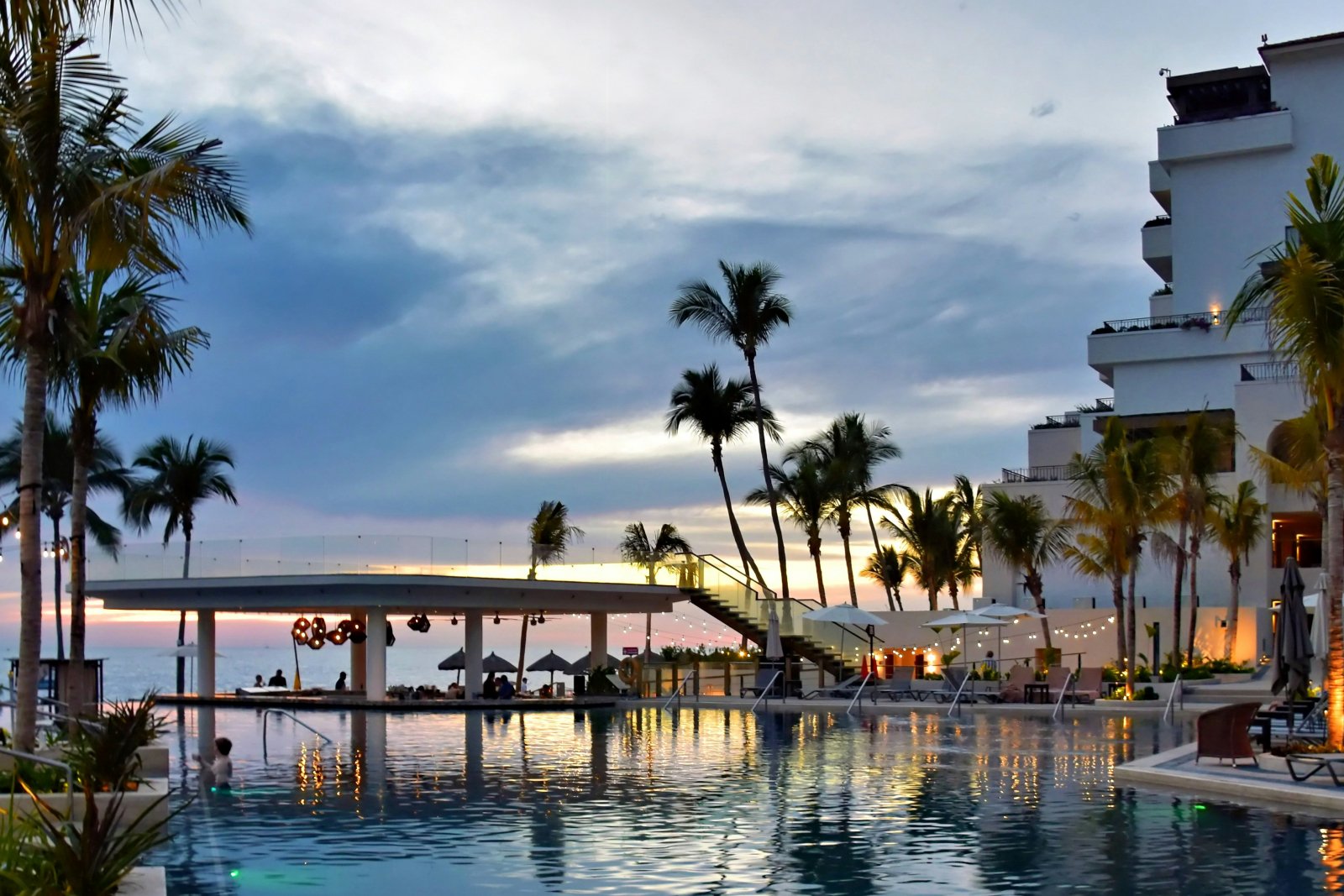
The main pool area, frequently surrounded by palapas, loungers, and open structures, is the space where the tension between protection and aesthetics is most evident. No guest wants to see visible protection structures while sunbathing by the pool on a clear high-season day. This means that, for this space in particular, the "invisibility when retracted" criterion is not an added luxury — it is practically a non-negotiable requirement for any system a hotel is willing to install.
The Technical Solution: Why Open Weave Solves the Three Problems Simultaneously
The AquaGrid system, developed by Hurricane Solution specifically to solve the problem of large-format openings in hotels, addresses the three challenges described above with a single design principle: an open-weave mesh that lets wind pass partially through the surface instead of generating a concentrated pressure zone, as a solid panel of the same scale would. This load reduction is what allows the system to cover continuous surfaces of 15, 20, or more meters without the joints that cause failures in combined-panel solutions — exactly the kind of surface that defines a hotel lobby or open restaurant. You can read why standard solutions don't work in hotels to understand the system's technical origin.
Beyond structural resistance, AquaGrid's design allows a compact storage profile that minimizes visual impact when retracted, and a deployment system designed to complete in minutes, not hours — which directly solves the operational problem of protecting a restaurant without generating a prolonged service closure for every minor tropical-storm warning.
Real-World Scenario: How Protection for Three Spaces Is Coordinated Simultaneously
Consider a 180-room hotel in the coastal zone of Tulum, with an 18-meter open lobby, a main restaurant with a 14-meter facade toward the pool, and a pool area surrounded by three bar palapas. Before installing a system correctly designed for this scale, the hotel's preparation protocol for any tropical-storm or hurricane warning required fully closing the restaurant and lobby for 24 to 48 hours, manually moving furniture and mounting temporary panels that were never designed for that surface — a process that took a six-person team more than four hours, generating service interruptions even for minor events that posed no real threat.
After installing AquaGrid in the three areas, the complete deployment protocol for the three spaces dropped to roughly 90 minutes with a two-person team, allowing the hotel to keep the restaurant operating during lower-intensity warnings and only activate a full closure when the warning actually justifies it. This is a representative operational scenario based on the kind of improvement this type of system allows, not a specific documented case.
Quantification: The Cost of Closing These Spaces Unnecessarily
It is worth quantifying the operational cost of a system that forces the restaurant or lobby to close for any minor warning, even when no physical damage occurs. A main hotel restaurant with average daily revenue of $8,000 to $15,000 USD that closes unnecessarily for 2 to 3 days per tropical-storm warning — which in a typical season can be 4 to 6 minor events in addition to major hurricanes — can lose between $64,000 and $270,000 USD annually in excessive preventive closures alone, without any real damage occurring. This loss is reflected directly in the property's RevPAR and in the effective occupancy of common spaces, even when the rooms remain available. A system that allows the space to stay operational during minor events, reserving full closure only for real threats, directly recovers this revenue that would otherwise be lost to excessive caution over a protection system that is impractical to operate. We develop the full financial calculation in our analysis of hotel hurricane-protection ROI.
The Operational Layer: Who Deploys the System and How Staff Are Trained
A protection system for large-format spaces is only as effective as the operational protocol that accompanies it. For the three spaces described in this article, the correct protocol assigns clear responsibilities: the maintenance team generally leads the technical deployment of the system, while front-desk and restaurant staff coordinate moving furniture and communicating with guests present in the area. Practicing this protocol at least once per season — before the first real warning arrives — is the difference between a 90-minute deployment executed calmly and a four-hour deployment executed under pressure the first time the team attempts it with a real storm approaching.
Operational Decision for Maintenance and Procurement Teams
When evaluating systems for these spaces, maintenance and procurement teams should prioritize three criteria in this order: first, the system's certified capacity for the real surface of the opening, not an extrapolation of a residential system; second, the deployment and retraction time — the system's operational efficiency — which determines whether the hotel can use the system for minor events without sacrificing revenue unnecessarily; and third, the visual impact when retracted, which determines whether the system compromises the guest experience during the rest of the season. A system that fails any one of these three criteria ends up generating a hidden cost — whether from unmitigated risk, lost revenue from excessive closures, or degraded guest experience — that does not appear in the initial quoted price.
Regional Context: How This Challenge Varies Between Playa del Carmen, Cancún, and Tulum
The challenge of protecting large-format open spaces does not present the same way in the region's three main hotel markets. In Cancún, where the density of large-format resorts is higher, lobbies and restaurants tend to be larger in absolute surface but also more standardized in design — which allows, in many cases, protection solutions that replicate with minor adjustments across similar properties of the same hotel chain. In Playa del Carmen, the mix of boutique hotels and mid-size properties means each protection project tends to require a more customized design, because the architecture varies considerably from one property to another, even within the same tourist corridor.
Tulum presents the most complex case from a design standpoint: the area's architectural trend favors structures open toward the jungle or beach with less standardized materials and forms — palm roofs, wooden structures, irregularly shaped openings — which means a generic protection system has even less chance of fitting correctly without a design specific to each space. For maintenance and procurement teams at these properties, this reinforces why a provider with specific experience designing for the particular architecture of each of these three markets offers a more reliable result than a catalog solution applied without adjustment.
The Expanded Financial Layer: The Cost of a System That Isn't Used Because It's Impractical
There is a pattern we see with some frequency in hotels that installed, years ago, protection systems that are impractical to operate: the staff, after experiencing several times how slow or complicated the system is to deploy, begins to postpone its use for lower-intensity warnings, reserving it only for threats they perceive as obviously serious. The problem is that the decision to "wait and see how bad it gets" is exactly the kind of reactive judgment a well-designed protocol seeks to eliminate — because by the time the threat is evident, there is frequently no longer enough time for a deployment that takes four hours with a large team.
This pattern has an indirect but real financial cost: a technically capable but operationally impractical system ends up protecting the property less often than its technical capacity would allow, simply because the staff doesn't deploy it in time during events where the decision to act is not obvious from the start. Evaluating a large-format protection system solely by its certified resistance, without considering how practical it is to deploy in daily practice, underestimates a factor that directly determines how many times the system is actually used right when it is needed most.
Additional Scenario: The Difference Between a Boutique Hotel and a Large-Format Resort
The challenge of protecting open spaces does not look the same in a 40-room property as in a 400-room resort. Consider a boutique hotel in Playa del Carmen with a single 10-meter open-facade restaurant toward a tropical garden. For this property, the protection project is relatively contained: a single system, a single deployment point, and a maintenance team of two or three people who can manage the complete protocol without complex coordination.
A 400-room resort in Cancún, by contrast, can have multiple access lobbies, three or four restaurants with distinct open facades, and two or three pool areas with palapas — each requiring its own system and its own point in the deployment protocol. At this scale, operational coordination becomes as important as the technical capacity of each individual system: the protocol needs to clearly define the deployment order, which teams are responsible for each space, and how it is verified that the spaces with greatest exposure to the dominant wind are protected first, not at random based on which team reaches each location first. This is a representative operational pattern based on the typical difference between these property scales, not a specific documented case.
The Argument That Convinces an Owner Who Isn't Sure Yet
For an owner or general manager still evaluating whether this investment is worth it, the most convincing argument is not technical — it is operational and reputational. Today's booking and review platforms record very visibly when a hotel closes key spaces during high season, whether from real damage or from excessive preventive closure. A guest who books a stay expecting to enjoy the main restaurant with a sea view, and finds that space closed for a tropical-storm warning that never amounted to a real threat, generally does not distinguish between "the hotel made a prudent decision" and "the hotel was not prepared to operate normally." That perception translates directly into reviews, and reviews translate directly into the conversion rate of future bookings.
A protection system correctly designed for a hotel's common spaces not only reduces the risk of physical damage — it reduces the frequency with which the hotel needs to make the binary decision to fully close a key space or take a chance without protection. That operational flexibility, more than any ROI figure calculated on a hypothetical catastrophic event, is frequently the argument that finally convinces an owner who sees hurricane protection as a low-priority expense against other property investments. The same principle applies to commercial properties with similar open spaces.
Conclusion
Protecting lobbies, restaurants, and pool areas in a Riviera Maya hotel is not a residential-protection problem at a larger scale — it is a different engineering problem that demands a solution designed specifically for large-format open surfaces. A correctly designed system, like AquaGrid, simultaneously solves the structural, operational, and aesthetic challenge these spaces present, allowing a hotel to maintain the guest experience that defines its value proposition all year long, without compromising the protection it needs during the days that really matter.
For more information: www.hurricanesolution.com | Hotel solutions | Frequently asked questions
FAQ
What makes protecting a hotel lobby different from a residential window? Scale. An open lobby can be 15 to 25 meters wide with no front wall, while a standard residential window measures 1.5 to 3 meters. This requires a system designed specifically for large surfaces, not an extrapolation of residential solutions.
Can I use the protection system for minor events without closing the whole restaurant? With a fast-deploying system like AquaGrid, yes. The 15-to-45-minute deployment time allows the space to be protected during minor warnings without a prolonged operational closure.
Will the protection system be visible to guests during high season? A correctly designed system, like AquaGrid, has a compact storage profile that minimizes visual impact when retracted, preserving the space's aesthetic experience the rest of the year.
Who should be in charge of deploying the system in a hotel? Generally the maintenance team leads the technical deployment, while front desk and the restaurant team coordinate moving furniture and communicating with guests. Practicing this protocol before the season is key.
Why can't I just combine several residential panels to cover a large lobby? Because each joint between panels becomes a potential failure point under sustained wind pressure — exactly the problem that led Hurricane Solution to develop AquaGrid as a continuous-weave solution for this type of surface.