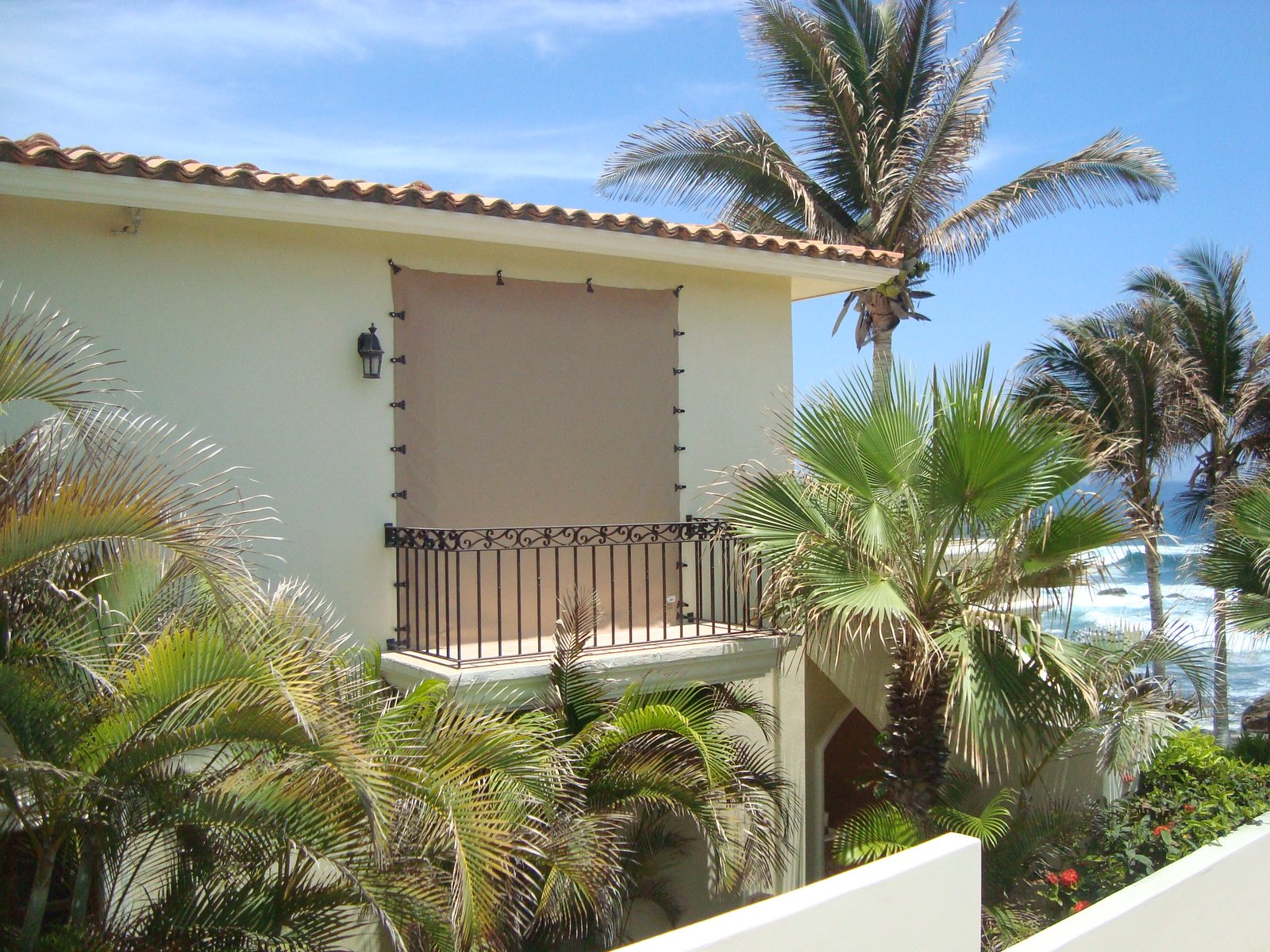
Quick Answer
Hurricane tarps offer better overall performance in real hurricanes because they absorb impact, reduce internal pressure, and prevent progressive structural failures. Metal shutters can resist direct impacts, but they transfer pressure to the structural system and are more vulnerable to anchor failures or deformations under extreme conditions.
The Most Common Mistake: Thinking Stiffer Means Safer
When it comes to choosing between different hurricane protection systems, most people make the same mistake: comparing materials instead of understanding how a hurricane actually behaves on a structure.
It is not just about resisting wind. It is about controlling pressure, impact, and the dynamic behavior of the system during the event.
At first glance, metal shutters seem like the most resistant option. They are solid, heavy, and visually strong. But in hurricane engineering, rigidity is not always an advantage.
When a rigid metal panel receives extreme impact or pressure, it doesn't absorb energy — it transfers the load directly to the anchors, can deform or detach, and creates structural failure points.
Hurricane tarps, by contrast, are designed to behave in a completely different way.
How Hurricane Tarps Really Work
Hurricane tarps don't try to block the hurricane. They manage it.
This type of system disperses impact energy, reduces direct pressure on the structure, prevents load accumulation at critical points, and allows a degree of controlled flexibility.
This is key in Category 4 and 5 hurricanes, where the problem is not just the wind but the internal pressure. When a window fails or a rigid system collapses, the building pressurizes from within. That is the real trigger of catastrophic damage.
To understand how these systems work under real conditions: www.hurricanesolution.com/proteccion-contra-huracanes
Impact vs. Pressure: The Difference That Defines Everything
Many systems pass impact tests. But that doesn't mean they work in the real field.
In a hurricane, wind constantly changes direction, pressure builds up and releases in cycles, materials suffer fatigue, and anchors are subjected to repetitive loads.
Metal shutters work well on single impacts but can fail under cyclic loads and are more prone to structural fatigue.
Hurricane tarps absorb multiple impacts, distribute the load across the entire surface, and reduce stress at anchor points.
This is not a minor difference. It is the difference between a system that survives and one that progressively fails.
The Anchor Problem
One of the most overlooked points in hurricane protection is the fixing system.
In metal shutters, all the load is transferred to screws or rails — if one point fails, the entire system collapses.
In hurricane tarps, the load is distributed, there are no single points of failure, and the system continues to function even under deformation.
This is especially important in large projects like hotels or developments, where a partial failure can escalate quickly.
Certifications and Real Performance
Not all systems sold as hurricane-resistant meet real standards. Certified hurricane systems (especially under Florida regulations) evaluate high-speed projectile impact, positive and negative pressure (PSI), repetitive load cycles, and complete system integrity.
This is where many economical metal solutions fall short. Certified hurricane tarps are specifically designed for these scenarios.
Installation and Adaptability in Real Projects
In large developments or complex properties, installation is a critical factor.
Metal shutters require additional structure, are heavy, can affect architectural design, and have longer installation times.
Hurricane tarps are lighter, adapt to multiple geometries, don't compromise aesthetics, and are faster to implement.
This explains why many developers in the Riviera Maya are migrating toward more flexible systems.
For hotel protection: www.hurricanesolution.com/hoteles
For residential: www.hurricanesolution.com/residencial
Which Is Better for Hotels and Developments?
For high-value projects, the question is not what resists more, but which system better reduces total risk.
Hotels and developments need reliable protection in extreme events, minimal maintenance, large-scale adaptability, and verifiable certification.
In this context, hurricane tarps offer a clear advantage. They don't just protect. They reduce complete structural risk.
Fact Box — Hurricane Tarps vs. Metal Shutters
- Impact absorption: Tarps ✔️ | Metal shutters ❌
- Load distribution: Tarps ✔️ | Metal shutters ❌
- Anchor risk: Tarps Low | Metal shutters High
- Cyclic pressure behavior: Tarps Stable | Metal shutters Vulnerable
- Category 5 application: Tarps Recommended | Metal shutters Limited
Conclusion
Not all hurricane protection systems work the same, even if they appear similar.
Metal shutters can offer a sense of security due to their rigidity, but under real hurricane conditions, that same rigidity can become a structural disadvantage.
Hurricane tarps, on the other hand, are designed to work with the real behavior of wind, pressure, and repetitive impacts.
That is why, in projects where risk is non-negotiable — such as hotels, developments, or high-value properties — the choice of system should not be based on perception, but on real performance.
For more information: www.hurricanesolution.com | Frequently asked questions
FAQ
Are hurricane tarps really impact resistant?Yes. They are designed to absorb and disperse the energy of high-speed projectiles, meeting international standards.
Are metal shutters a bad option?Not necessarily, but their performance depends heavily on installation and the type of hurricane. In extreme events, they can be more vulnerable to structural failures.
Which system is better for hotels?Hurricane tarps are usually the best option due to their adaptability, lower structural risk, and performance under real conditions.
Do hurricane tarps work in Category 5 hurricanes?Yes, as long as they are certified hurricane systems correctly installed.
Where can I see real solutions in Mexico?You can consult specialized systems here: www.hurricanesolution.com/proteccion-contra-huracanes