Quick Answer
Hurricane mesh outperforms metal sheets in real hurricane performance because it not only resists impacts but reduces wind pressure by allowing controlled airflow. Metal sheets, although rigid, tend to fail through structural detachment and load transfer to anchor points, which can compromise the entire structure.
The Most Common Mistake: Thinking Stiffer Means Safer
When it comes to hurricane protection systems in Mexico, one of the most critical — and most misunderstood — decisions is choosing between hurricane mesh and metal sheets.
At first glance, metal sheets seem like the stronger option. They are rigid, heavy, and convey an immediate sense of security. However, in hurricane engineering, visual resistance does not equal structural performance.
The real test occurs under actual conditions: negative pressure, debris impact, sustained gusts, and sudden changes in internal pressure.
How Metal Sheets Actually Fail
Metal sheets function as a rigid barrier. This creates a fundamental problem: they do not dissipate wind energy.
When a gust strikes directly, pressure concentrates on the surface, the load transfers to screws and anchors, and structural fatigue points are generated.
In high-category events, this behavior causes partial or total detachment, permanent deformation, vibration and fatigue in fixings, and internal pressure entry when a point collapses.
Once a sheet fails, the system stops protecting entirely. In hurricanes, a small failure can trigger progressive damage across the entire building envelope.
The Critical Problem: Internal Pressurization
One of the most destructive factors in a hurricane is not just the external wind, but what happens when air enters the interior.
When a rigid protection fails, wind enters under pressure, the building interior pressurizes, and the roof and other structures receive force from within.
This phenomenon is responsible for many structural collapses in coastal hotels and developments. That is why, in advanced hurricane protection systems, blocking wind is not enough — it must be controlled.
How Hurricane Mesh Actually Works
Hurricane mesh is designed under a different principle: energy dissipation.
Rather than acting as a solid barrier, it allows controlled airflow, reduces direct pressure on the structure, and absorbs and distributes the impact load.
This completely changes behavior during hurricanes: lower load transfer to anchors, reduced structural vibration, greater resistance to repeated impacts, and prevention of critical pressure buildup.
Additionally, certified hurricane systems are designed to resist high-speed projectile impacts, simulating real conditions of Category 4 and 5 hurricanes.
Impact Resistance: The Difference You Can't See
A common mistake is assuming harder is better. In reality, sheets can dent or be punctured by repeated impact while flexible mesh absorbs and redistributes energy.
This is especially relevant in areas like the Riviera Maya, where hurricane debris can include concrete fragments, structural lumber, and objects transported at high speed.
Hurricane mesh is designed to maintain integrity even after multiple impacts — something rigid solutions don't consistently achieve.
Durability in Coastal Environments
In Mexico, especially in coastal zones, durability doesn't depend only on hurricanes. It also depends on salinity, constant humidity, UV radiation, and accelerated corrosion.
Metal sheets rust over time, lose structural integrity, and require constant maintenance. High-quality hurricane mesh is UV-treated, corrosion-resistant, and maintains long-term performance.
This makes it a more reliable solution for long-lifecycle projects such as hotels and developments.
Application in Hotels and Developments
For hotels, resorts, and developers, the criterion is not just withstanding a hurricane. It is protecting high-value assets, reducing operational risks, avoiding prolonged closures, and meeting international standards.
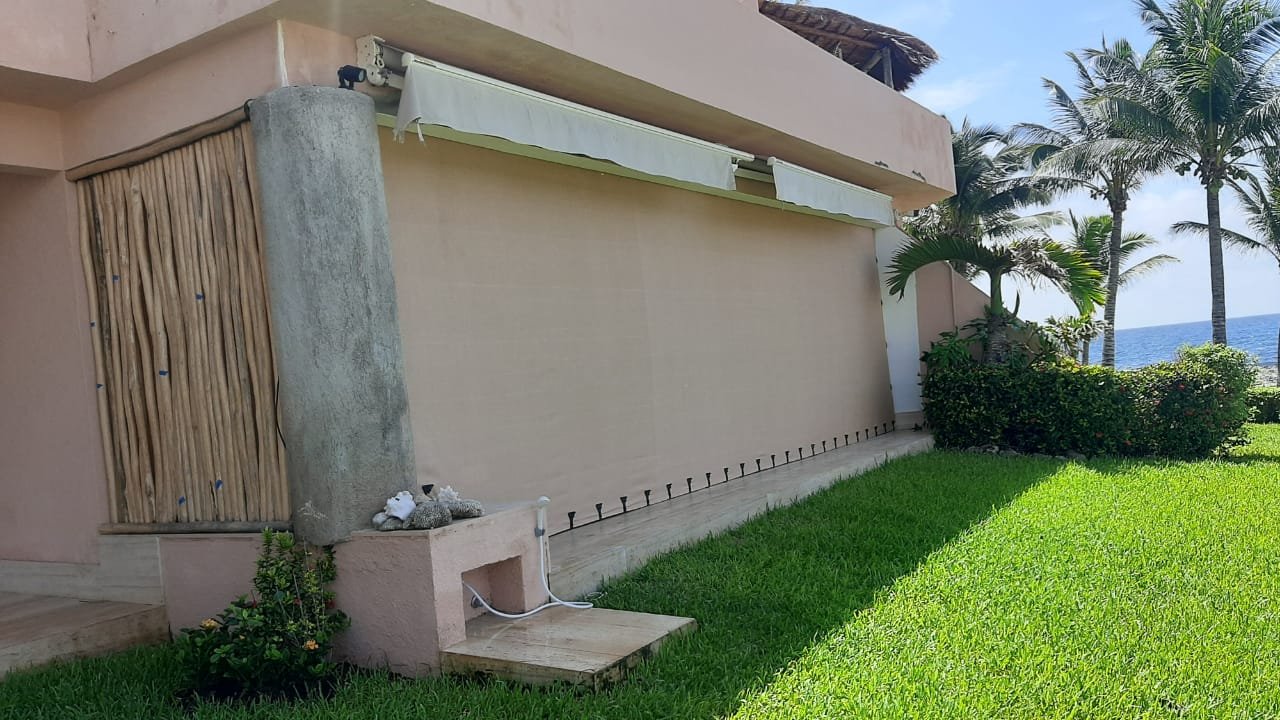
Hurricane mesh allows efficient installation on large surfaces, architectural integration, and continuous protection without compromising aesthetics.
For hotel protection: www.hurricanesolution.com/hoteles
For complete certified systems: www.hurricanesolution.com/proteccion-contra-huracanes
Direct Comparison
Metal sheets: High rigidity, high load transfer, greater structural failure risk, vulnerable to corrosion, protection dependent on fixings.
Hurricane mesh: Controlled flexibility, energy dissipation, lower structural load, high durability, proven performance under real conditions.
Fact Box
- Key factor in hurricanes: Internal pressure is one of the leading causes of structural collapse
- Real impact: Projectiles during a hurricane can exceed 160 km/h
- Common mistake: Choosing systems for visual rigidity instead of technical performance
- Material matters: Resistance to repeated impact is more important than initial hardness
- Durability: Corrosion in coastal zones drastically reduces the lifespan of non-specialized metal systems
Conclusion
Hurricane mesh not only represents a technological evolution over metal sheets — it represents a complete change in how hurricane protection is understood.
While rigid solutions try to resist wind force, advanced systems are designed to control it, dissipate it, and reduce its structural impact.
In real scenarios, that difference is not minor. It is the difference between partial damage and effective protection.
For more information: www.hurricanesolution.com | Frequently asked questions
FAQ
Does hurricane mesh withstand Category 5 hurricanes?Yes, certified hurricane systems are designed to withstand extreme conditions, including high-speed impacts and Category 5 wind pressure.
Are metal sheets safer because they are harder?Not necessarily. Rigidity can increase load transfer and cause structural failures if anchors give way.
Which system requires less maintenance?High-quality hurricane mesh requires less maintenance in coastal environments due to its corrosion resistance.
Are they suitable for hotels and large developments?Yes, they are one of the most widely used solutions in high-level projects for their efficiency, durability, and structural performance.
What is the biggest risk of choosing the wrong system?The main risk is progressive structural failure, especially if internal pressurization occurs after protection is lost at a critical point.